Share the post "Why Do Cyclists Run Red Lights?"
 In this CQFD section (“Ce Qu’il Fallait Démontrer” – What Had to Be Demonstrated), we answer your questions and address your preconceptions about cycling and triathlon. Simple questions, but not necessarily obvious answers for novices or those unfamiliar with our sport.
Like all road users, cyclists are supposed to know and respect the Highway Code, starting with stopping at red lights. Few competitive cyclists systematically respect them. Let’s see what they risk and why they don’t stop.
By Guillaume Judas – Photos: Pixabay.com, Flickr.com, 3bikes.fr
Among the bad habits of cyclists noted by other road users is the tendency to run red lights. As if traffic signs and the Highway Code only applied to motorists. However, from the perspective of two-wheel enthusiasts, this infraction is always less serious than cutting off or not respecting safe distances by drivers of motorized vehicles. This is explained by the feeling of danger and vulnerability experienced by cyclists on the road, who are more exposed to the attitudes of other users due to the absence of a body, and also by the fact that, as we recalled in our previous article on cyclists riding two abreast, while the incivilities and Highway Code infractions of some cyclists can rightly be condemned, we have never yet seen a bicycle kill a motorist inside their vehicle.
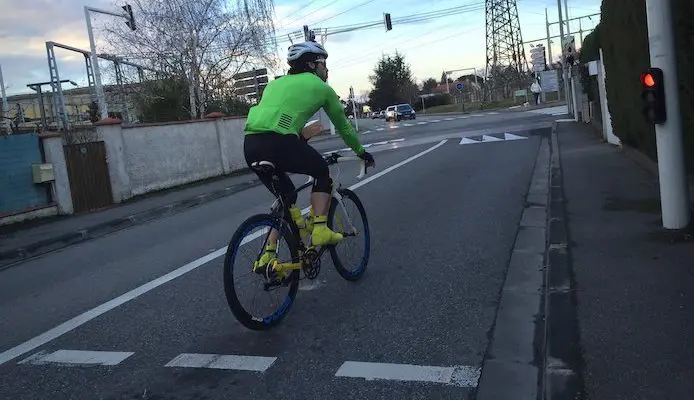
Nevertheless, by running red lights, cyclists expose themselves even more, and can also be victims of an accident they themselves caused. It must be acknowledged, however, that few riders deliberately take risks, and if they adapt the rules in their own way, they do so believing they are not risking much, at least in terms of safety.
Of course, disrespect and carelessness also sometimes exist on this side, unfortunately.
A cyclist cannot lose points
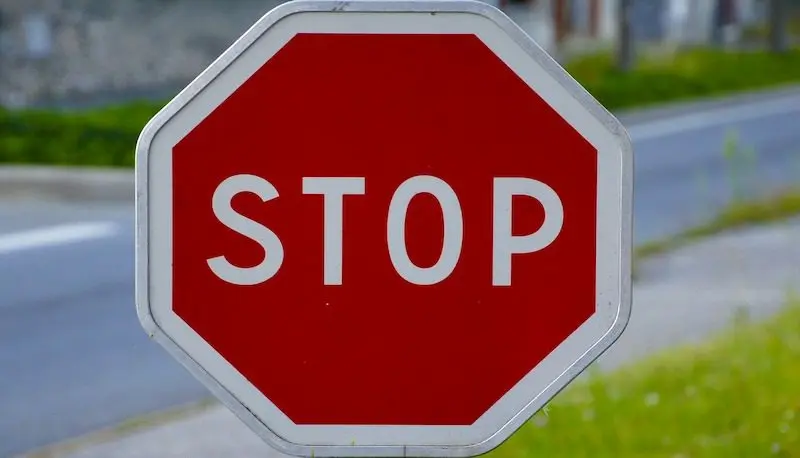
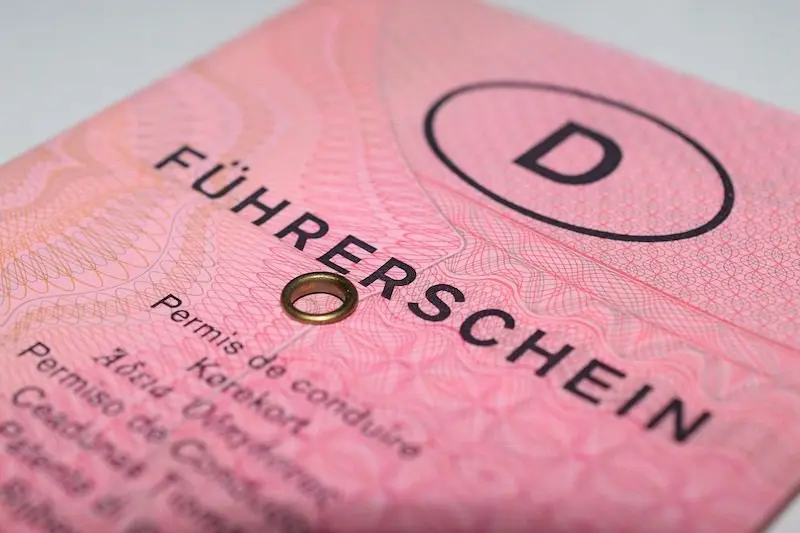
Beyond the obvious physical risks for someone who would enter an intersection without visibility and without taking into account other users, with the associated risks of accident, serious injury, or death, a cyclist risks a fine just like a motorist. Not respecting a red light – and in the event of interception by law enforcement – results in a fourth-class offense with a fine of €135 (€90 reduced if paid within 15 days). However, a cyclist does not risk losing 4 points on their driver’s license, as would be the case for the same offense committed by a motorist. According to the road safety website, the explanation is quite simple: “Points can only be deducted for offenses committed with a vehicle for which a driver’s license is required. Thus, a Highway Code infraction committed on a bicycle or in a microcar, for example, does not result in a point deduction, but may result in a fine.”
This relative impunity does annoy some motorists, who use this argument to, in turn, commit infractions that endanger the lives of cyclists. However, and contrary to popular belief, two recent studies in Denmark and the United Kingdom, conducted with surveillance cameras at intersections, showed that cyclists actually commit far fewer Highway Code infractions than motorists! Indeed, 14% of cyclists in Denmark and 16% in England reportedly run red lights or ride on sidewalks, while 66% of vehicle drivers, according to the Danish study, commit infractions in urban areas (speeding, failure to yield to pedestrians at a crosswalk, using the horn in the absence of immediate danger, using a phone while driving, forgetting to signal, overtaking a cyclist within one meter…). Surprising, isn’t it? Speed is often a factor, especially in all zones limited to 30 km/h.
Reasons why cyclists run red lights
Cyclists’ disregard for red lights is explained by more or less serious, admissible, or understandable justifications for other road users. Whether it’s to “maintain the average speed” of the ride, “avoid getting cold,” or “not wear out pedals and cleats by systematically unclipping,” the problem is mainly linked to the proliferation of traffic lights in heavily urbanized areas, and the time spent by athletes crossing these areas, when all they want is to escape as quickly as possible to breathe and practice their sport.
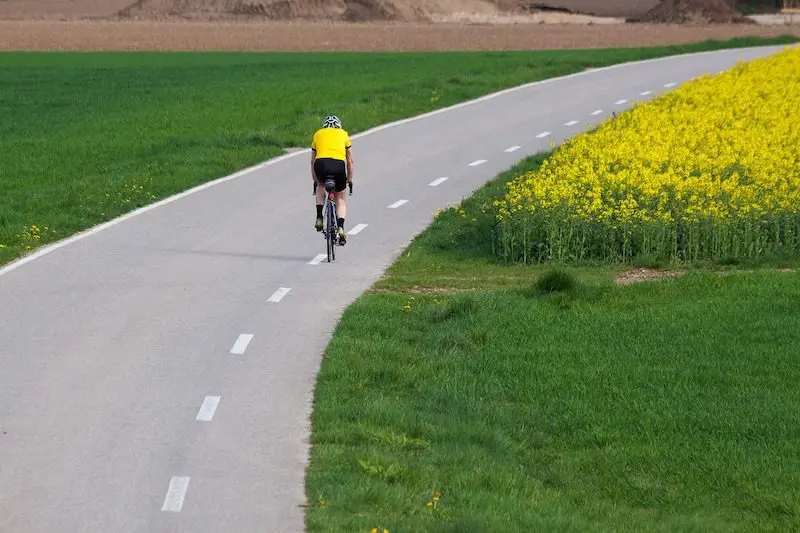
Similarly, for urban cyclists, coexisting with exhaust fumes from other vehicles is a real health problem because they are directly exposed. This is also one of the main reasons why riders move up the line of cars stopped behind the light, then position themselves just in front, away from the exhaust pipes, and ready to restart ahead of the line of cars. Depending on the slope at that location and the impatience of the vehicles in line before restarting, this position is not very comfortable, even if it is always more so than if the cyclist remained in the middle of the line. This is why cyclist advance stop lines sometimes exist, in the front line before the lights.
Unconsciously, and because they feel the inconvenience caused during their restart, many “anticipate” the light, or pass it by gliding, in order to get a little ahead of the flow of vehicles.
An anticipation that becomes an infraction, even if the vast majority of those who practice it take great care to ensure they can do so safely. To our knowledge, however, there is no desire to annoy motorists, but rather to fluidify traffic and get out of it as quickly as possible.
New signs
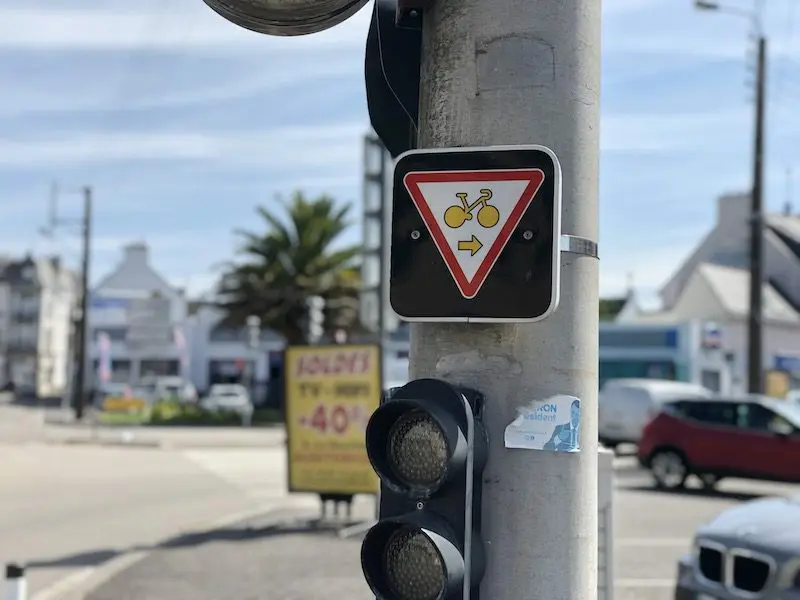
With this observation, and in more and more cities, many traffic lights have signs that allow cyclists to go through a red light, most often to turn right or to go straight in the case of certain intersections. These signs obviously do not give priority but ultimately only legally justify the practice, or the attitude of most competitive cyclists, who are not very respectful of established rules, it’s a fact, but not completely reckless either. They help avoid friction between users and ultimately contribute to the idea of sharing the road.
=> SEE ALSO: All our articles in the CQFD section
Share the post "Why Do Cyclists Run Red Lights?"