Share the post "Why Do Cyclists Ride Two Abreast?"
 In this CQFD section (“Ce Qu’il Fallait Démontrer,” the French equivalent of “Q.E.D.”), we answer your questions, and sometimes your preconceptions, about cycling or triathlon. Simple questions, but answers that are not necessarily so obvious to beginners or to those unfamiliar with our world.
It is summer, the weather is fine, and many cyclists are making the most of the beautiful days to pursue their favorite activity on their usual playground, namely the road. A road they have to share with other road users, which sometimes leads to coexistence problems. But in that case, why do they ride two (or even more) abreast on the road?
By Guillaume Judas – Photos: PhotoMIX Ltd. from Pexels, flickr.com, pxhere.com / DR
Between 2014 and 2018, the number of cyclists killed each year on French roads rose from 142 to 191. In February 2019, early fine weather was even blamed by the Sécurité routière (France’s road safety authority) to explain a 22% rise in cyclist fatalities compared with February in the previous ten years.
An explanation that is rather far-fetched, given that the countries with the fewest cyclist deaths are those with the most cyclists, particularly for urban trips. It is also a way of letting some drivers off the hook, even though they are directly responsible for fatal cycling accidents. Indeed, and this is too often forgotten, while we can rightly criticize the incivility and Highway Code violations of some cyclists, we have never yet seen a bicycle kill a driver sheltered behind a car body. A simple fact that should be enough to calm irascible drivers, encourage them to take more care when approaching cyclists and, at the very least, avoid confrontations.
Among the complaints leveled at road cyclists is that they ride two (or more) abreast on the roadway, supposedly taking up too much space and slowing down drivers. Most of the time, drivers simply fume in silence inside their cars, while others consider it perfectly legitimate to tailgate these same cyclists to make it clear who is master of the road.

To Chat
Cycling, like many sports, brings people together and has undeniable social virtues. Some riders go out alone because they have no real choice, while others enjoy riding together to share a moment of sport and conviviality with friends. Is cycling, on the pretext that it takes place on the road, the only activity where you are forbidden to talk to your companions? Two cyclists riding side by side usually chat, just as two people walking together on a sidewalk, hiking a trail, or two people sitting in a car do.
To Share the Effort
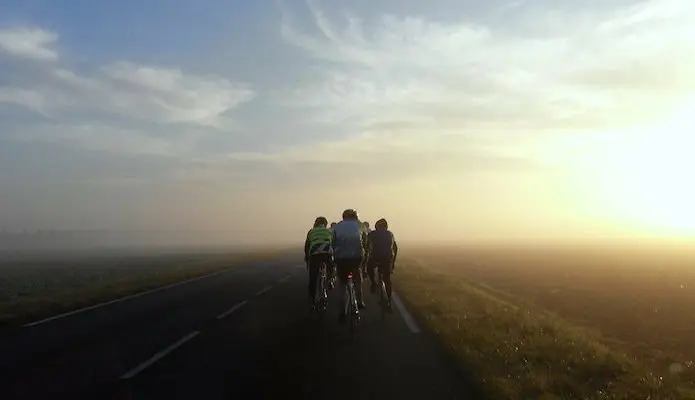
Cycling as a sport is hard, because you constantly have to fight the elements, above all the wind, the primary resistance to forward motion. Cyclists riding together (from two onward) motivate each other and take turns. That is, they share the effort at the front of the group to face the wind and shelter their companions in their slipstream. As a result, seen from behind, a line of cyclists is never perfectly straight, especially when the lead rider moves aside to let the next one through and drops back to the rear of the group.

To Take Up Less Room on the Road
It sounds paradoxical, but two cyclists riding side by side take up less room on the road than two cyclists riding single file, at least if the driver intends to respect the Highway Code. Under this code, “when two vehicles follow one another, the driver of the second must keep a sufficient safety distance, corresponding to the distance covered by the vehicle in a period of at least two seconds ” (article R412-12, fourth-class fine). This article applies to motorists and cyclists alike. Those riding in single file in a group are therefore breaking the rule. And even if they keep a two-second gap between one another, the space is in any case insufficient for a car starting to overtake to fit in.
But this same Highway Code also stipulates, and above all, that “ when overtaking, a driver must not come within one meter laterally of a cyclist in built-up areas, or within one and a half meters outside them” (article R414-4, fourth-class fine of €135, plus 3 points off the driving license). This is the rule most often ignored or misinterpreted by drivers, some of whom are completely unaware of the danger they pose when they brush past one or more cyclists. Cyclists can indeed be pushed off line by a pothole, a gust of wind, or simply a lack of practice. In that case, the consequences of an overtaking maneuver that is too close (and therefore dangerous) can be tragic.
Since July 1, 2015, it has been possible for a driver to cross a solid white line to overtake a cyclist when visibility is sufficient, and thus properly respect that safety distance. This overtaking maneuver is always quicker and less dangerous when cyclists ride as a compact group than when they are all in single file.
To Take Up More Room on the Road
Conversely, in built-up areas, especially as 30 km/h zones become more and more common, the question of overtaking should not even arise, particularly for sporty cyclists who ride at a speed very close to the legal limit.
The Highway Code even specifies that “on roads where the maximum permitted speed does not exceed 50 km/h, a cycle rider may move away from vehicles parked along the right edge of the roadway by the distance needed for their safety ” (article R412-9). A cyclist takes up about fifty centimeters of width, to which you add 80 cm to a meter from the edge of the road and the required meter for overtaking, and it is clear that, in most cases and given the narrowness of streets and road layouts, it is not possible to pass a cyclist in town, even a lone one.
Two cyclists riding side by side in town therefore take up the space they need on the road, and discourage dangerous overtaking.
Because They Have the Right To
Finally, contrary to popular belief here too, the Highway Code stipulates that cyclists have the right to ride two abreast (but no more). According to article R431-7: “Cycle riders on two-wheeled cycles must never ride more than two abreast on the roadway. They must move into single file at nightfall and in all cases where traffic conditions require it, in particular when a vehicle wishing to overtake them signals its approach.” Note, however, the vagueness of that last sentence, vague enough to be open to interpretation depending on whether you are a cyclist or a driver. It nonetheless reminds us that when both sides want to share the road, things generally go quite well, and a light, non-aggressive toot of the horn (that is, not sustained and not too close to the cyclists) is enough for them to move over and make more room for the driver.
=> SEE ALSO: Our other CQFD articles
Share the post "Why Do Cyclists Ride Two Abreast?"