Share the post "Why do cyclists dope?"
 In this CQFD section (“Ce Qu’il Fallait Démontrer” – “What Had to Be Demonstrated”), we answer your questions, and even your preconceptions, about cycling and triathlon. Simple questions, but answers that are not necessarily so obvious for novices or those unfamiliar with our sport.
Among the preconceptions cyclists face is doping. In the media or during discussions around the coffee machine at the office, cycling is an easy target, with a number of conventional arguments that we list here. But the reality may not be what you think.
By Guillaume Judas – Photos: @pixabay.com / pxhere.com
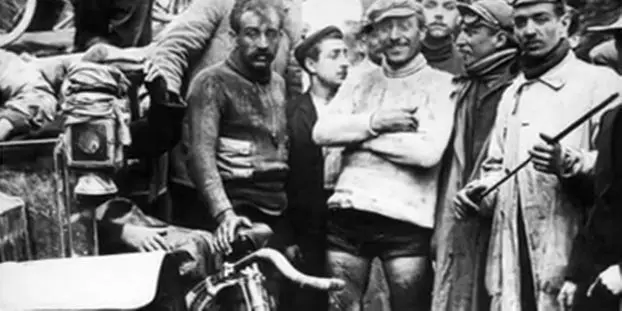
Cheating has been present since the creation of the first major cycling races. In 1904, the first four finishers of the second Tour de France in history were disqualified after it was proven that they had benefited from the help of motorized vehicles or had taken the train. This scandal almost spelled the end of this great race in the making at the time. But the need to artificially improve performance goes back much further, and long before the invention of the bicycle: the first notions of doping date back to antiquity, with the search for drugs capable of optimizing physical and psychological energy or even sexual potential.
The history of doping
Cycling during the 20th century was no exception, in relation to scientific advances. In the 1920s, some riders used alcohol, morphine, and cocaine, before the discovery and frequent use of amphetamines caused a lot of damage after World War II. Then came anabolics in the mid-1950s, followed by other synthetic hormones designed to both improve performance and circumvent anti-doping controls. The idea was to use substances that were not yet detectable. It’s the story of the eternal race between cops and robbers. Cycling quickly established itself as a popular sport, with simple and sincere riders as champions, who did not hesitate to reveal some of the secrets of their profession. Like the Pélissier brothers in the 1920s, Fausto Coppi in the 1950s, or Jacques Anquetil in the 1960s. When doping was not yet formally prohibited.
“Because it’s cultural”
It was in the mid-1960s that cycling authorities decided to take matters into their own hands by introducing the first controls after the promulgation of the first anti-doping law in France. Cycling was thus the first sport to act in this direction and to decide to sanction its offending athletes. A courageous and necessary decision to protect the health and lives of riders, but dramatic for the image of the sport. For many, cycling became a sport of dopers, while many other federations chose to turn a blind eye to such practices. It took a tightening of this anti-doping law in 1989, and especially in 1999, to begin to see a harmonization of research and sanction methods between sports disciplines, and then the creation of the World Anti-Doping Agency at the end of 1999 to begin to see a harmonization of treatment across countries. Because, of course, doping cannot be solely a cycling matter. Multiple reasons push athletes to dope. Ignoring them is merely a justification for this persistent prejudice that only cyclists are tempted to improve their performance.
“Because it’s too hard”
Cycling is considered one of the most difficult sports, although it is at least equaled in this sense by running or boxing, for example, in terms of demands, suffering, and competition. The length and difficulty of competitions are not valid arguments: Ben Johnson doped for the 100m event in athletics at the 1988 Olympic Games, and there are many examples of athletes caught in this discipline. People dope to go faster, not necessarily to go for a long time.
“Because there’s too much competition”
Cycling has become highly internationalized today, with increasingly fierce competition at a high level. We can note, however, that cyclists were already doping when only French, Belgian, and Italian riders were competing in the major races. And on the other hand, what about the immense competition faced by aspiring champions in a highly publicized discipline like football? The need to raise one’s level further can encourage an athlete to push the limits, but this is true in any sport, or even artistic discipline.
“Because it’s a sport where strength takes precedence over technique”
Cycling is certainly a sport where physical condition is paramount, but one should not forget the tactical and technical aspects that make the difference between athletes of equal value. And this argument does not absolve other disciplines where technique seems essential to success. Those who doubt it should try to dribble an opponent at the end of a 90-minute football match after having covered a dozen kilometers broken down into about fifty big accelerations to convince themselves. Or they should try to stop a 200 km/h serve at the back of the court during the fifth set of a tennis match. In both cases, a little boost in the form of a chemical adjuvant can just as easily facilitate things as in the last turns of the climb up Alpe d’Huez.
“Because there’s too much money at stake, too much pressure”
Cyclists earn a better living, but they are still far from the highest-paid athletes in the world, like the best footballers, basketball players, or tennis players. Money and the lure of gain are, of course, arguments that can explain the temptation to cheat, but they are not the exclusive domain of cycling, far from it. Moreover, doping also exists at the level of small competitions, among amateurs or in recreational events where there is little or nothing to gain. It is thus becoming increasingly difficult to draw a portrait of the primary doper, in relation to their discipline or level of play. As shown by this annual report published by the MPCC (Movement for Credible Cycling) which lists cheating cases for high-level athletes in all sports. Cycling only ranks 13th.
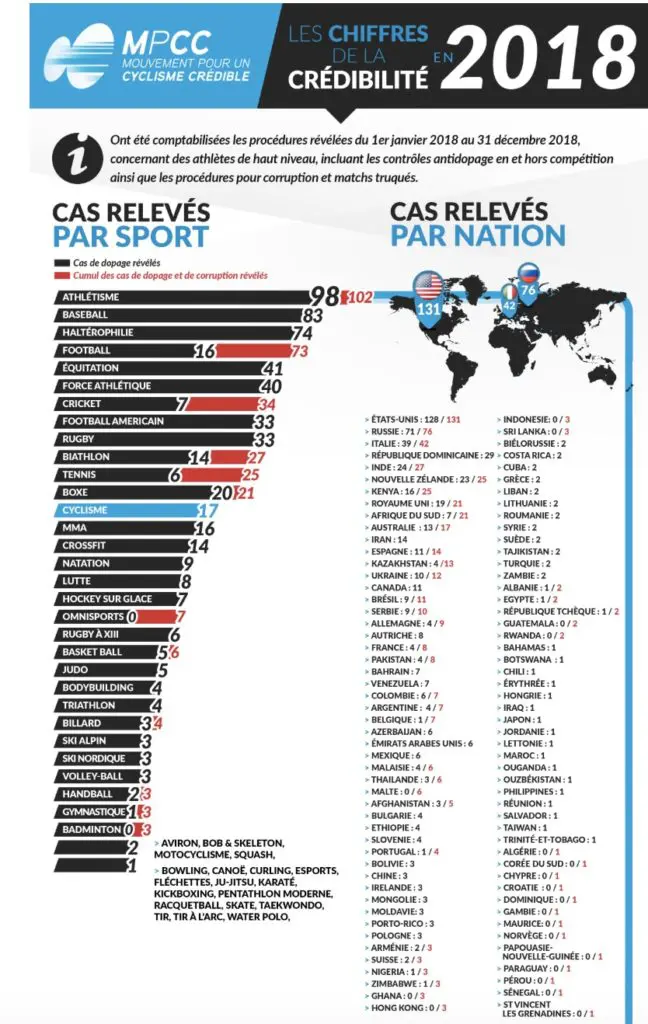
Or this same report for cycling differentiates cases by the level of the teams concerned, the type of practice, and gender.
“Because there is indirect evidence”
As the credibility of anti-doping controls can always be questioned due to the discrepancy between research methods and the reality of the products used, or due to corruption and complicity between athletes and officials, some rely on indirect methods to try to demonstrate doping. First, by comparing performances across eras. With watts, or with times. An interesting method but limited by all other unknown parameters (evolution of equipment, roads, competition, level of teammates) and without knowing exactly the limits of the human body. And then there are those who simply rely on their intuition. Who say to themselves, for example, “you can’t be that thin and still ride a bike.” This is confusing causes and consequences. A high-level endurance athlete is thin because they need to optimize their weight to be as performant as possible, seeking the best power-to-weight ratio, but they are also thin compared to the average person because they train a lot. Even if one can be concerned about the thinness of some athletes, whose eating behaviors are close to anorexia and therefore dangerous for health, one cannot conclude with certainty that this hides doping.
Doping still exists today and will continue to exist for a long time. Hoping to completely eradicate the phenomenon is unfortunately a lost cause. Whatever the sport, or whatever the activity. It’s in human nature. But cycling is today one of the sports that has done the most to fight doping and thanks to which many measures have been put in place for prevention, research, and repression. It is one of the most monitored sports, and consequently one of the cleanest, despite what the big oaf at the coffee machine and his preconceived notions might say.
=> SEE ALSO: other articles in the CQFD section
Share the post "Why do cyclists dope?"