Share the post "Long-Term Test of Continental GP 5000 Tires"
At Continental, the new GP 5000 tire faces the daunting task of replacing a model that has established itself as a true benchmark through its various iterations over two decades: the famous GP 4000 (S II for its latest version). We tested it over nearly 4,000 km and can confirm that the German brand has once again raised the bar in terms of performance and traction, while improving comfort and maintaining durability.
By Guillaume Judas – Photos: 3bikes.fr
The Continental GP 4000 SII tire already boasted numerous qualities, verified by several independent tests in the areas of low rolling resistance, good grip on both dry and wet surfaces, excellent durability, and even the best aerodynamics on the market (thanks to the shape and tread pattern), even though this last feature wasn’t necessarily intended from the start. As for its shortcomings—even though some compromises are always necessary when looking for a versatile tire—it could be criticized for a slight lack of comfort, some fragility in the sidewalls, and a tendency to expand slightly over time, resulting in a wider profile than advertised.
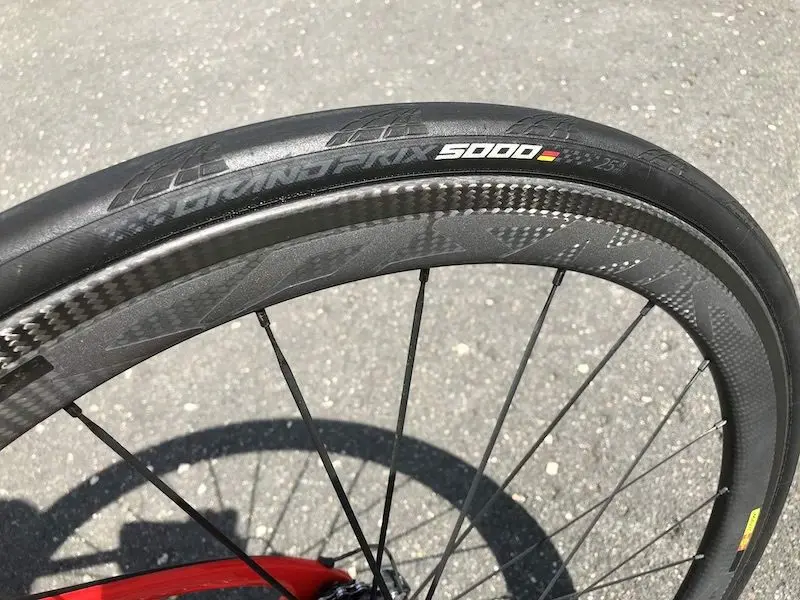
With the goal of doing even better, Continental introduced two versions of the new GP 5000 in late 2018: a standard tire and a tubeless version, which is also remarkable but whose long-term test we’ll publish a bit later.
An Even Better Compound
Without revolutionizing its approach to high-end/all-around tires—and unlike most other brands, which can only produce either ultra-high-performance or ultra-durable tires, but rarely both— Continental has optimized its Black Chili compound for the GP 5000’s tread. These slight modifications also make the tire a bit blacker, whereas the GP4000 S II had a more very dark brown/gray hue.
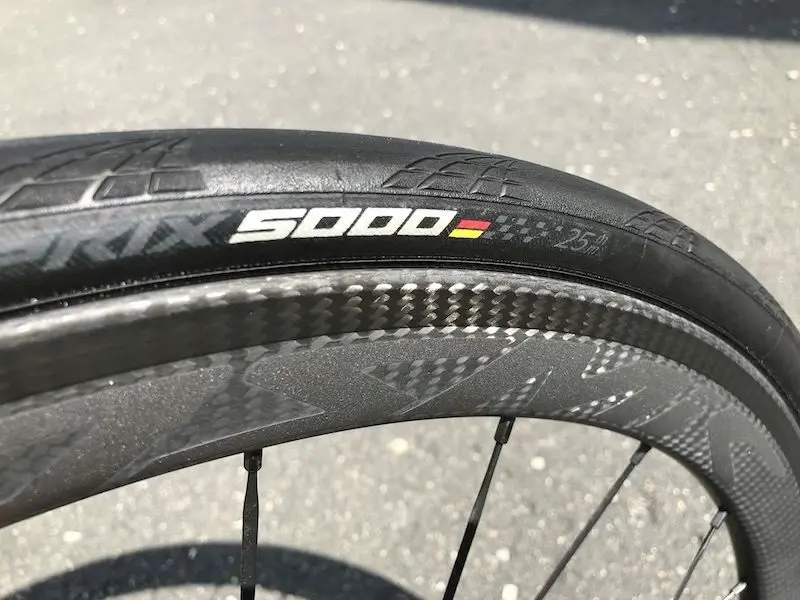
The tread consists of three layers and, according to Continental, offers lower rolling resistance than the 4000 (-12%) and better protection against punctures (+20%). This is indeed a difficult balance to strike and remains the preserve of the very largest manufacturers, given the resources required to develop these high-performance rubber compounds.
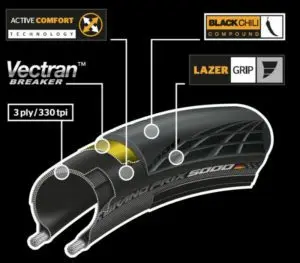
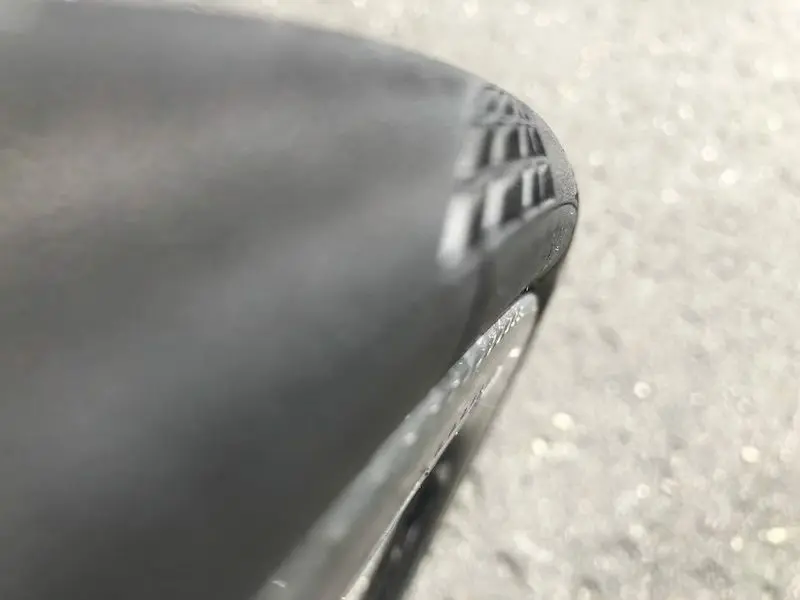
Beneath the first layer in contact with the road is a Vectran Breaker layer made with synthetic fibers to improve durability without adding excessive weight. Finally, there is a layer of Active Comfort polymers to dampen vibrations and enhance comfort. Finally, regarding traction, Lazer Grip technology is featured on the sides of the tread, forming a pattern of small structures designed to provide better grip on wet surfaces.
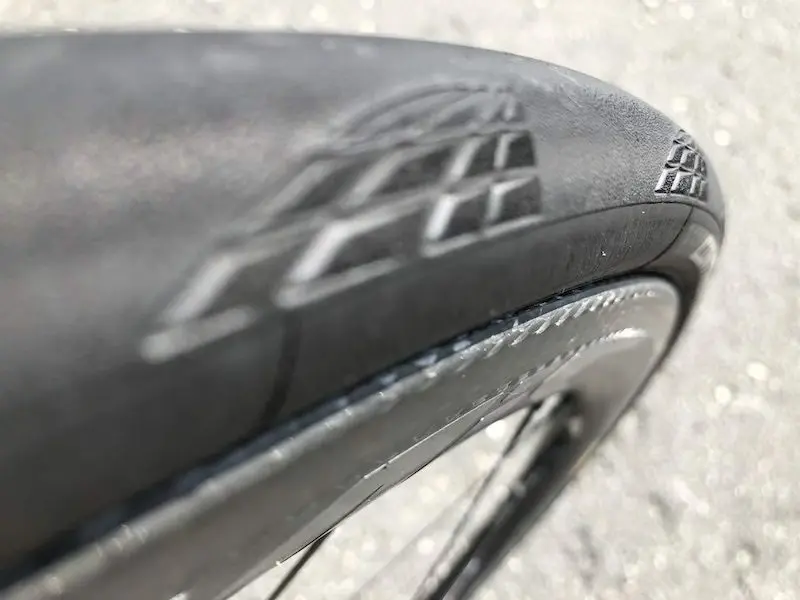
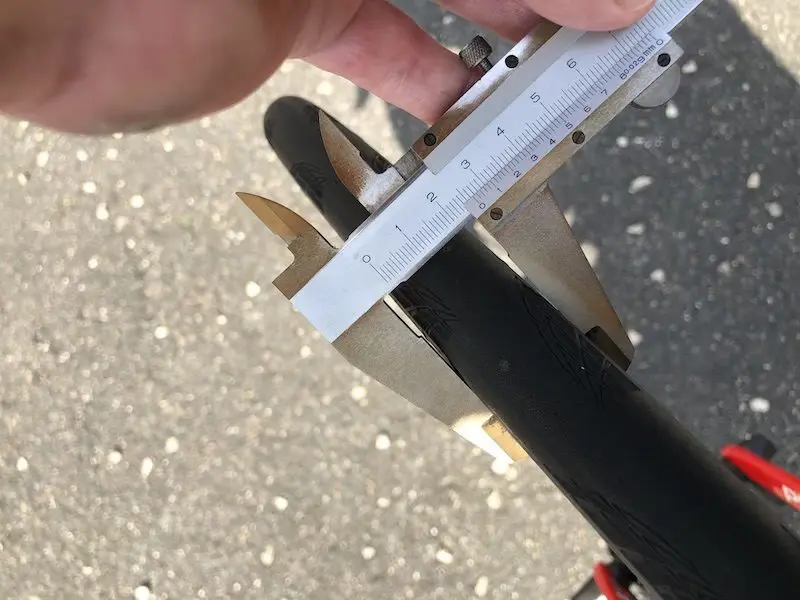
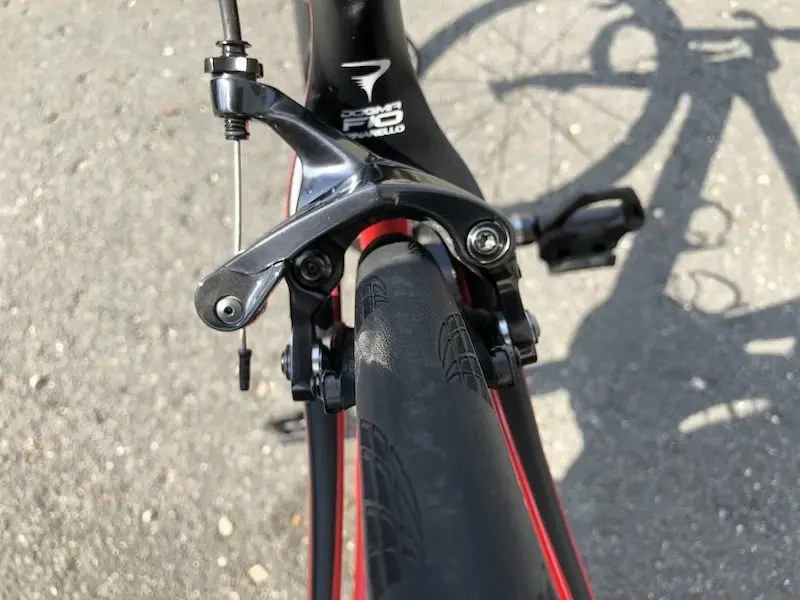
Beneath these three layers lies a carcass composed of three plies, each rated at 110 TPI, for a total of 330 TPI (330 threads per inch). This indicates a very high level of flexibility—and thus responsiveness—for the tire. In terms of weight, our test pair weighed in at 221 and 222 g for the two 700×25 tires, instead of the advertised 215 g. Mounted on Mavic Cosmic Pro Carbon SL wheels (non-UST), with an internal width of 17C and an external width of 25 mm, the tires actually measure 27 mm in width. The increase in volume is indeed limited compared to the GP 4000 S II, or even the Michelin Power Compétition tires that were previously mounted on these wheels, which were quite close to an actual measured 28. Let’s just say that when you look at the wheels fitted with the GP 5000, the rims seem to blend seamlessly with the tire sidewalls, creating no bulge. This is better for aerodynamics, but also for the riding feel, with crisp and direct responses during changes in direction.
Exceptional rolling performance
The leading website Bicycle Rolling Resistance tested and compared the rolling resistance of the Continental GP 5000 with that of its competitors and even the best tubulars or tubeless tires. Verdict: The tires tested here rank sixth among all tires ever tested by the site, surpassed in the tube-type category only by the specialized Continental GP TT model (which is lightweight and fragile). The GP 5000 Tubeless tires rank third. A 1.7-watt difference in rolling resistance separates the tubed tires from the tubeless ones, while 2.2 watts separate the GP 5000 from the already highly rated GP 4000 S II. The German brand clearly knows how to make fast tires—that much is obvious.
And that’s exactly the feeling you get from the very first few revolutions of the wheels with the GP 5000s—tires that seem to glide over the road, whether riding at a steady pace or through a series of changes in pace. But where they really stand out from the 4000 S II is in terms of comfort—though that’s a term we don’t particularly like to use when talking about performance bike tires. In fact, talking about “comfort” implies a passive riding style, and we know full well that it’s relatively easy to reduce vibrations with conventional tires: either by increasing the tire width (for example, by choosing a 28 mm tire) or simply by lowering the tire pressure. But in both cases, you sacrifice performance. Wider tires offer lower rolling resistance once the bike is up to speed and riding at a steady pace, but they’re also heavier and less responsive, in addition to being less aerodynamic (creating a bulge above the rim). In short, for the same tire width, the GP 5000 has less impact than its predecessor, and this is also evident in terms of traction: on a road with a rough surface, the tire seems to bounce less.
The GP 5000 really encourages you to lean into turns and “attack” them, with a compound that truly feels like it’s biting into the asphalt.
This doesn’t compromise grip—quite the opposite—offering exceptional confidence on dry surfaces. The GP 5000 really encourages you to lean into turns and “attack” them, with a compound that truly feels like it’s biting into the asphalt. In wet conditions, you obviously need to be a bit more cautious, but the tire doesn’t catch you off guard by losing grip without warning. Skids are gradual, allowing you to anticipate and adjust your speed, braking, or lean angle.
Durability That Always Delivers
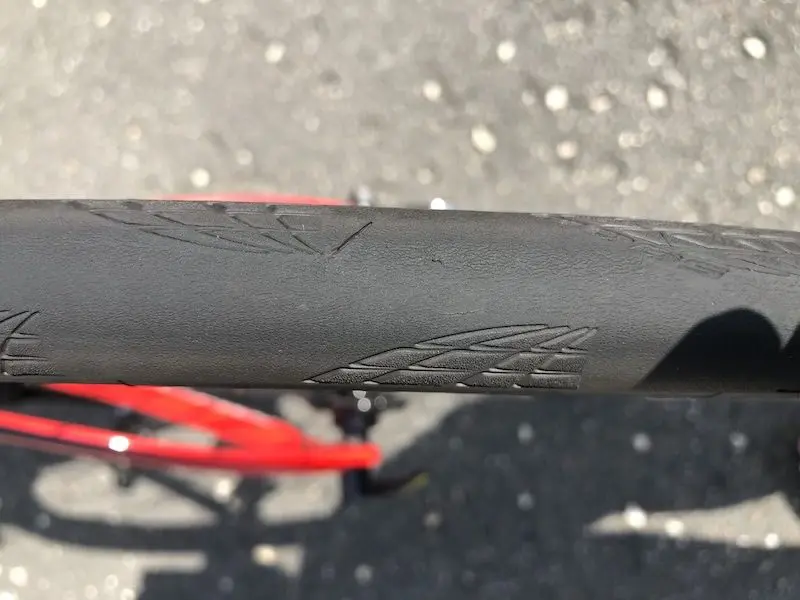
Over nearly 4,000 km—admittedly mostly on dry roads—we didn’t experience a single flat tire. That’s a very good result, though not exceptional for this price range or during the spring. However, we didn’t go easy on them, regularly riding on bike paths or roads under construction. The Vectran Breaker protection seems to live up to the brand’s promises, despite a few cuts in the tread—which are inevitable after two months of intensive use. The rear tire is also starting to show wear, and it’s probably time to swap it with the front tire, in the hope of getting another 4,000 km out of the GP 5000s. It’s therefore difficult to make an exact comparison of this new model’s durability against its predecessor, since road conditions, weight, and season always vary slightly, but it appears to be on par. But even if the GP 5000 were slightly less durable than the 4000 S II, it still ranks well above the competition among high-end all-around tires, which generally have a lifespan of around 4,000 to 5,000 km.
The New Benchmark
This Continental GP 5000 tire thus becomes the new benchmark given its performance and numerous other qualities—except, of course, for ultra-specific uses. Before we give you our verdict on the tubeless GP 5000 in a few weeks (once we’ve had a chance to ride it as much as we have with the tubed version!), we highly recommend this tubed tire for all amateur couriers, recreational cyclists, and triathletes looking for a high-performance, versatile model.
| CONTINENTAL GP 5000 |
| Rating: ***** Pros: Efficiency, grip, durability, improved comfort Cons: Weight slightly higher than advertised 330 TPI Contact: continental-pneus.fr/velo and guyonneau.fr |
=> SEE ALSO: All our gear reviews
Share the post "Long-Term Test of Continental GP 5000 Tires"