Share the post "SRAM Force eTap AXS 12-Speed Groupset Review: Wireless Shifting With a Wider Range"
Presented a few weeks ago and already offered fitted on some manufacturers’ bikes, the brand-new SRAM Force eTap AXS 12-speed groupset had not yet been tested in depth. That is now done with 3bikes.fr, since we rode more than 500 km on a Lapierre Xelius SL 700 equipped with this long-awaited new drivetrain. On the agenda: wireless electronic derailleurs, an innovative gear range, a dedicated smartphone app, and disc brakes on our test model.
By Guillaume Judas – Photos: @3bikes.fr
The SRAM Force eTap AXS 12-speed was unveiled a few weeks after what had already been billed as a revolution with the high-end SRAM Red eTap AXS 12-speed groupset, and it is a more affordable take on the new technology SRAM is offering. Until now, the Force groupset has always been positioned as a rival to the best-selling Shimano Ultegra, though it has been far less widely fitted, even though it is lighter. SRAM already had its flagship Red groupset with electronic (and wireless) shifting, but the arrival of AXS technology was also an opportunity to offer a second-tier groupset with virtually the same features. The new Force eTap AXS therefore sits directly against the Shimano Ultegra Di2, and just below Red AXS, using less expensive materials and therefore a bit heavier.
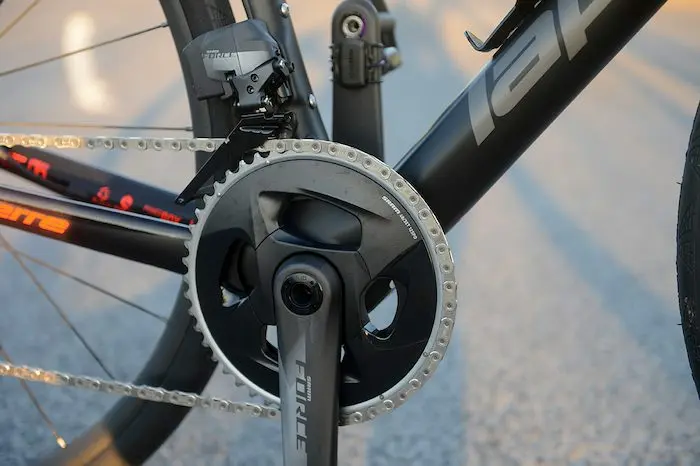
Force eTap AXS comes in several versions: double or single chainring, with or without a Quarq power meter, with disc or rim brakes, or in an aero version.
Here is an idea of the official prices and weights, although you can already find them cheaper without looking very hard.
Double, disc brakes: €2,548 / 2,812 g (our test version)
Double, rim brakes: €2,408 / 2,453 g
Single, disc brakes: €2,148 / 2,572 g
Single Aero, rim brakes: €2,058 / 1,983 g
In its base rim-brake version, moving to 12 speeds and electronic derailleurs adds a little over 200 g and roughly €1,300 to the Force groupset. In the disc-brake version, it adds 300 g and roughly €1,200 more.

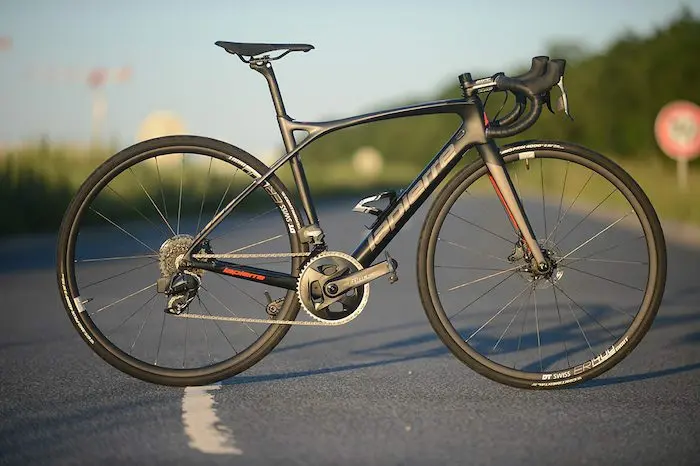
In the end, with the Lapierre Xelius SL, you get a weight of 7.980 kg in size S for a complete bike (ready to ride) sold at €4,699. A bike that does not fully express its potential because of its relatively high weight. Still, in terms of performance, there are many positives to highlight, which alone can justify the investment.
The concept
Around the AXS concept, there is a 12-speed cassette (largely responsible for the groupset’s weight gain, starting at 236 g for the 10-26) offered in three tooth combinations: 10-26, 10-28, and 10-33 (our test version). Using a small 10-tooth sprocket requires a specific cassette body called XDR on the wheel, but allows the use of smaller chainrings. As a result, the gear range offered (the spread between the largest and smallest gear) and called X-Range by SRAM is wider, while shifts are more progressive from one tooth to the next, thanks to the twelfth sprocket on the cassette, at least with the 10-26 and 10-28. In both cases, the first 8 gears follow tooth by tooth, compared with 7 at best on an 11-speed, and even 5 most of the time.
On the other hand, with a 10-33 cassette like the one on our bike, only the first 6 sprockets follow each other, which is somewhat penalizing for sporty riding on merely rolling terrain, except perhaps when using a single chainring. To explain: at usual training speeds, the most-used sprockets are 15, 17, 19, and 21 teeth with the big ring, and here you always end up somewhere in between, with the jump from 15 to 17 quite a punch. Ironic with 12 speeds at the back, even though we opted for a cadence sensor to forget our usual reference points with a classic big chainring.
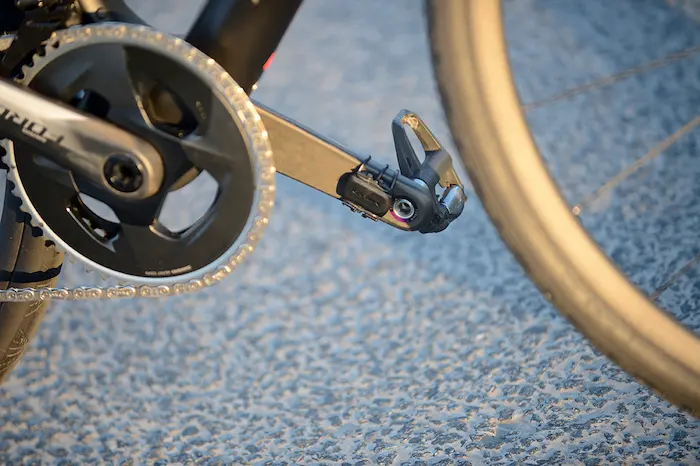
The gear range offered is wider, while shifts are more progressive from one tooth to the next, thanks to the twelfth sprocket on the cassette.
On the chainring side, only two double combinations are offered, with 48-35 (our test model) and 46-33. The 50-37 version is reserved for the Red AXS groupset, and probably even for professional riders, since a 50/10 is equivalent to a… 55/11. In our case, a 48/10 is therefore almost as big as a 53/11. Suffice it to say that it is more than enough for the average rider.
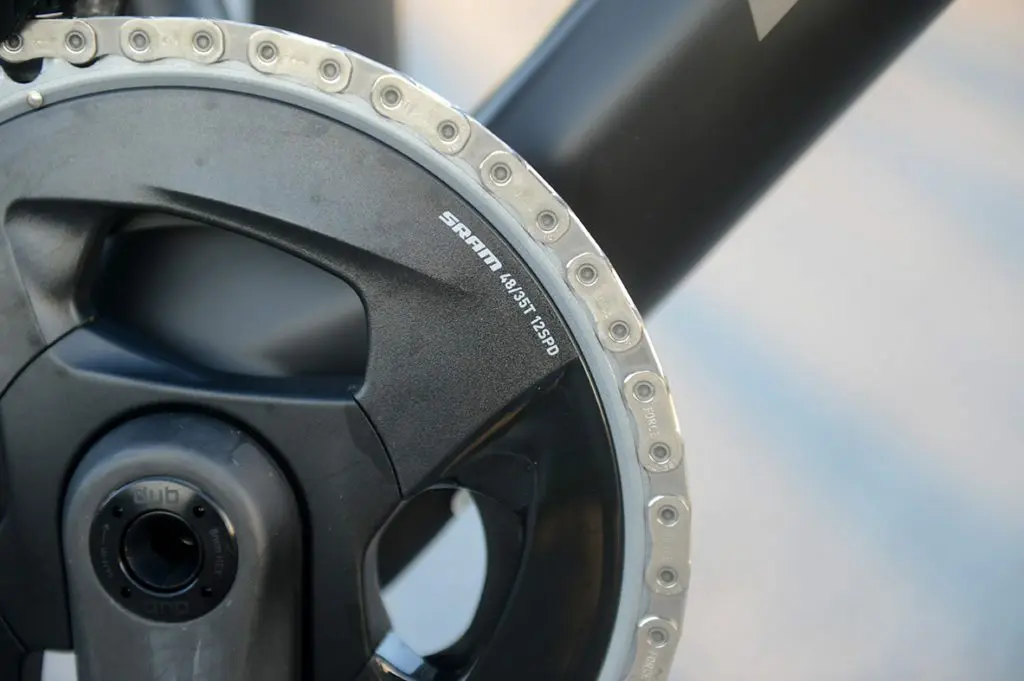
In the other direction, you almost get a full “wheel turn” with a 35/33, equivalent to a 34/32 used in the mountains by some cyclotourists. From our point of view, this 10-33 cassette can therefore perfectly suit those who want to simplify things by riding single-ring, since the SRAM Force eTap AXS is available with a single chainring in 36, 38, 40, 42, 44, 46 teeth, and 48 teeth for the Aero version. While the first six chainring options suit cyclo-cross or gravel use, let us recall that with a 48, the 48/33 is equivalent to a 39/27. Plenty of room for our triathlete friends!
=> SEE ALSO: 12 or 13 speeds: the lowdown on the new drivetrains
Simplified operation
In terms of efficiency, there is a bit of chain rub at extreme crossings with a double chainring, especially 48/33 and 35/10 and 11, all the more so because the front derailleur has no automatic mechanism to compensate its alignment for the chain’s position on the cassette, as is the case with Shimano.
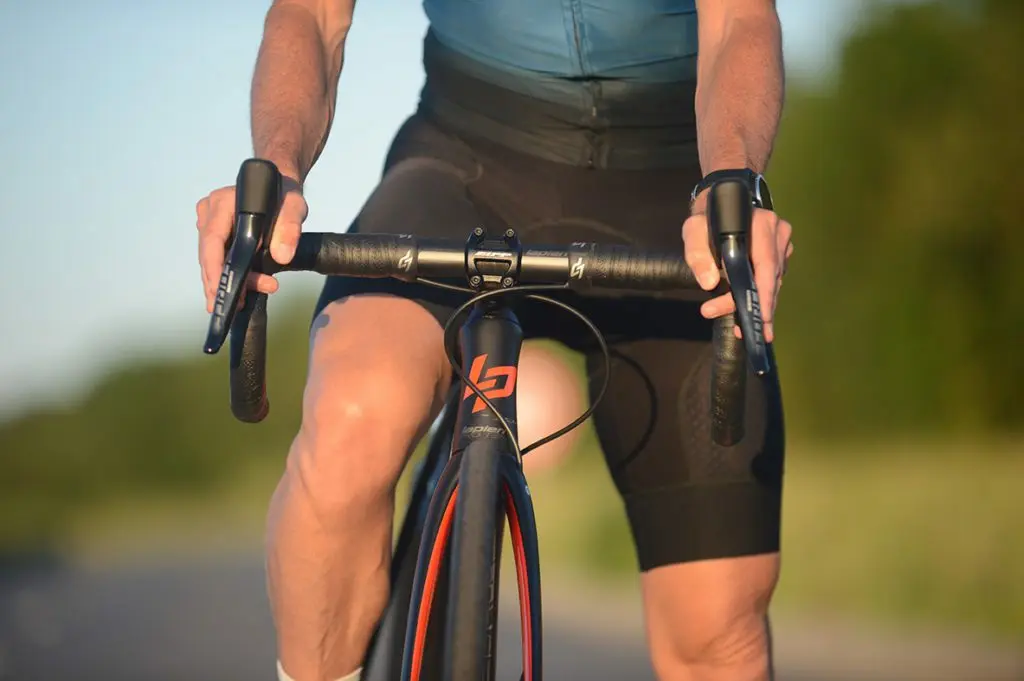
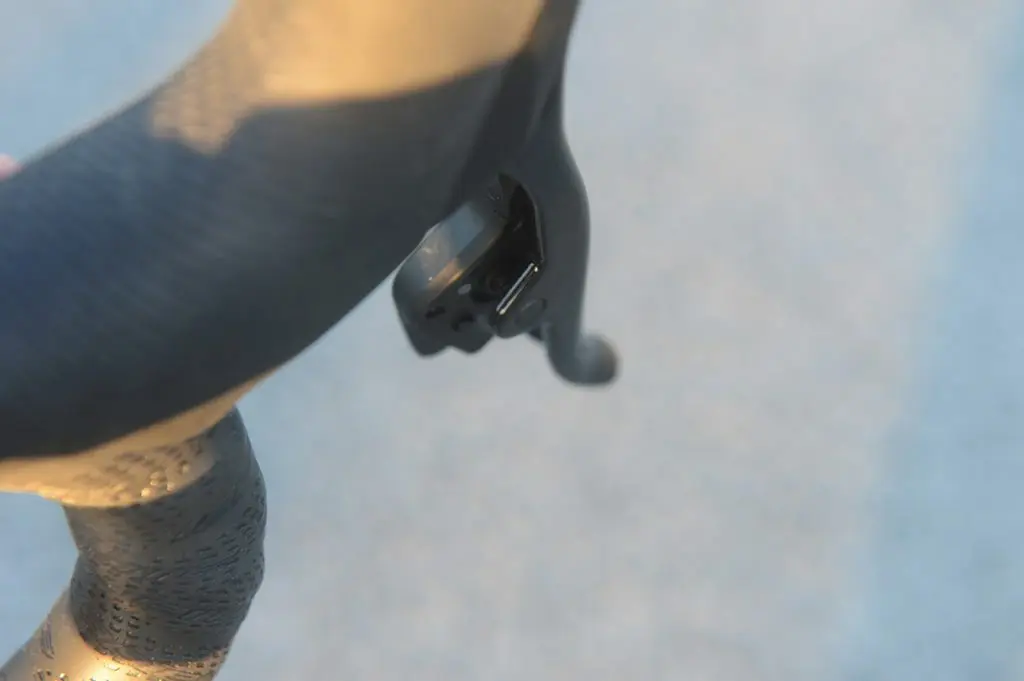
Shifting is relatively simple with the SRAM eTap system. By default, the right-hand paddle behind the brake lever moves the chain down the cassette sprockets, while the paddle on the left lever moves it up. A simultaneous press on both paddles, with a crisp, direct click, changes chainring. Note the texture of the lever, which feels pleasant and makes it easy to grip. Behind the paddles, a small button gives access to the rear derailleur adjustment mode, to fine-tune indexing even while riding, which we were able to test in real conditions.
The AXS system also comes with a smartphone app, which is much simpler to use than Shimano’s e-tube version. First, the app downloads in seconds. Then you simply “wake up” one of the components so the app recognizes the system in use, along with its serial numbers. It then shows, for example, the battery charge of the derailleurs or the battery in the levers.

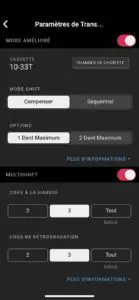
The big new feature is that it is now possible to customize how the levers work, not only by swapping the commands given by the left and right levers, but also by setting how shifting behaves when you keep your finger pressed on a paddle: sweeping through the whole cassette, or a shift limited to two or three teeth, for example.
Finally, the system has a “compensation” mechanism, or sequential shifting, comparable to Shimano’s semi-synchro and Synchro-Shift. This means that when you change chainring, the system shifts one or two sprockets at the back to avoid too big a gap in gear ratios (your choice), or, when sweeping through the cassette, the system changes chainring on its own at a given point to get a gear just higher or lower with the other ring.
The only difference from Shimano is that here you cannot choose where the automatic shifts happen. On the other hand, the wireless link with the smartphone seems as simple as the link between the derailleurs and levers. You just tick an option for the system to accept it, which lets you, if needed, adjust settings during a brief stop on a ride.
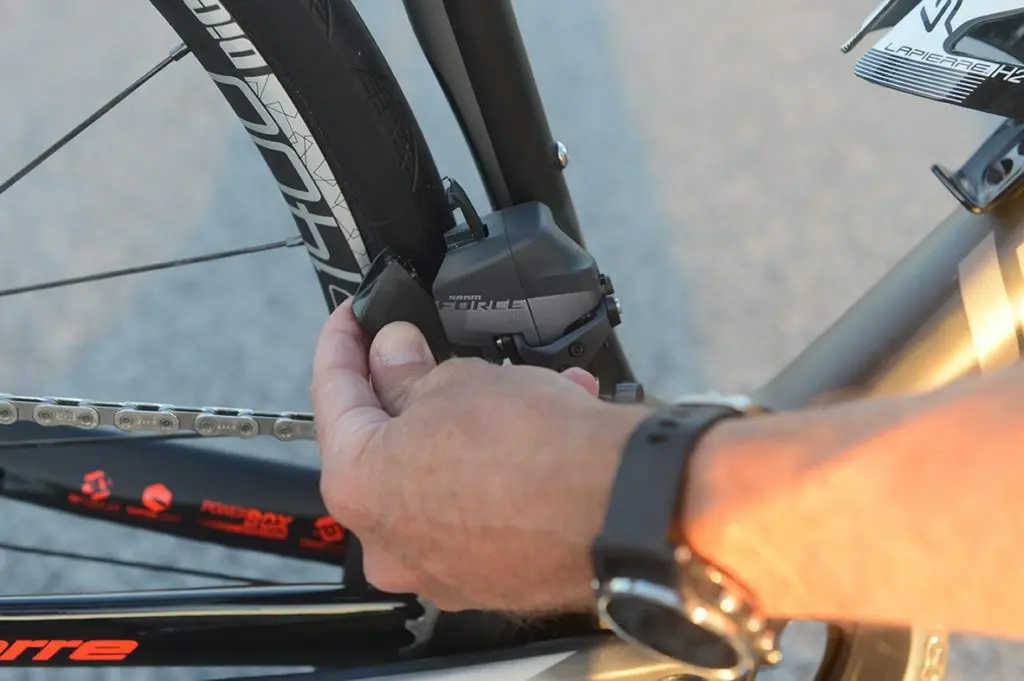
Finally, for anyone worried about batteries in the derailleurs, you should know that they are easy to disconnect for charging (the bike, or groupset, comes with the charging system), and above all they are interchangeable between the front and rear derailleurs. So you can always get home without any trouble, by moving the battery from the front to the rear, for example. As an example, after 500 km of testing, the two batteries had not even dropped below 50%.
On the road
The chain, of course, has a specific profile and thickness to handle the 12 sprockets of the cassette, while gaining smoothness, precision, and durability, and being able to cope with the tight radius created by the 10-tooth sprocket. It stands out with its flat top profile and does a great deal for the groupset’s visual identity.
While it is hard for us to measure the possible loss of watts caused by chain wrap (in theory, with conventional drivetrains, the smaller the sprocket, the lower the efficiency), we immediately felt a lack of smoothness in the links with a new chain, which prompted us to lubricate it generously from the second ride onward. Pedaling smoothness then improves, but the chain loses some of its good looks.
There is nothing to fault in the indexing precision, or even in how quickly gears change.
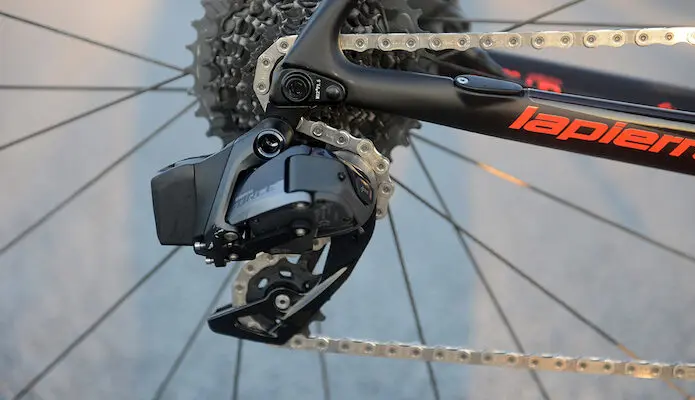
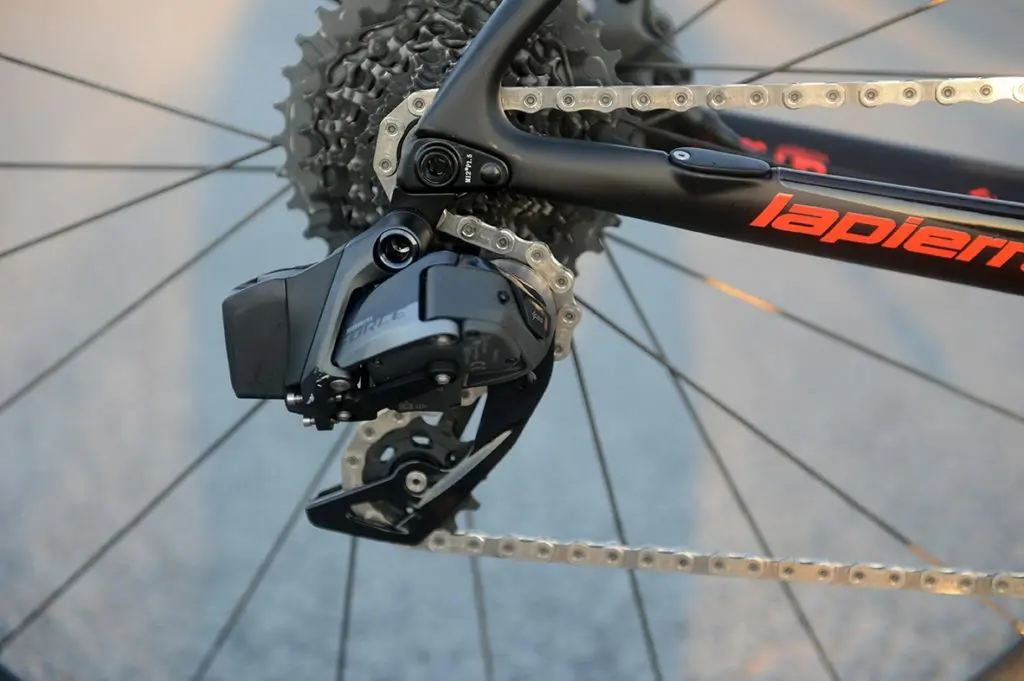
Nevertheless, despite readjusting the rear derailleur after the second ride, there is nothing to fault in the indexing precision, or even in how quickly gears change. It is certainly very slightly slower than Di2 or EPS, but this is due to the wireless system. After a few kilometers, we were no longer surprised by the very slight latency at each sprocket change. It is almost imperceptible. That said, even though everything works perfectly, even in “sequential” mode, a resonance noise from the drivetrain remains on the large cassette sprockets. Nothing serious, but we are not yet at the silent drivetrain promised by the Orbit technology of the rear derailleur (a hydraulic clutch system), which is supposed to secure shifts and above all keep the chain tension optimal by removing friction noise.

This derailleur does have the advantage of being unique regardless of the cassette chosen or the number of chainrings. The front derailleur, meanwhile, is designed to allow more clearance for wider rear tires, as is the case here with 28 mm Continental GP 4000 SII tires, which actually measure 31 mm. This derailleur uses Yaw technology, which is supposed to need no readjustment depending on the chain’s position (which is in any case impossible to adjust while riding), but in practice, as we wrote above, it rubs at extreme crossings, although those are not recommended anyway. One of the big benefits noted by mechanics and individual riders who opt for an eTap groupset is ease of installation, thanks to the absence of cables or wires.
Staying with the drivetrain, the crankset feels rigid, as do the chainrings, which are thicker than SRAM 11-speed ones. The crankset bearings spin very freely on the Lapierre, although 500 km is a bit short to draw firm conclusions. To keep compatibility simple, the crankset exists only in DUB spindle format, a new standard close to 30 mm that can fit all kinds of frames with the appropriate bottom bracket shell.
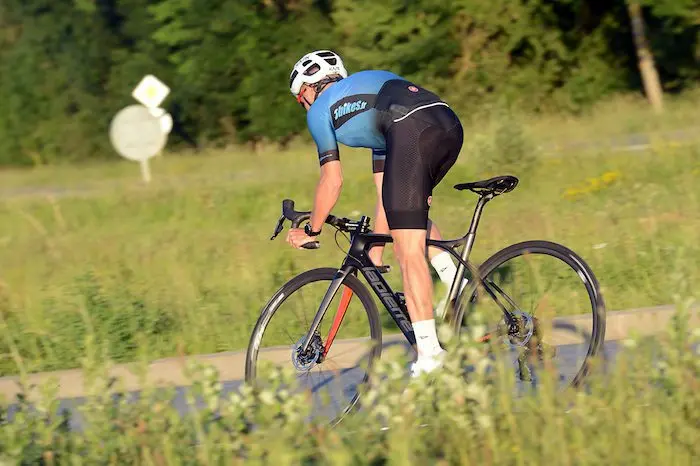
Since this is our first “hands-on” contact with a groupset, let us linger a little on the brake/shift levers, which are slightly slimmer in this hydraulic version than the old SRAM, but without quite matching the slimness of the Shimano Dura-Ace and Ultegra Di2.
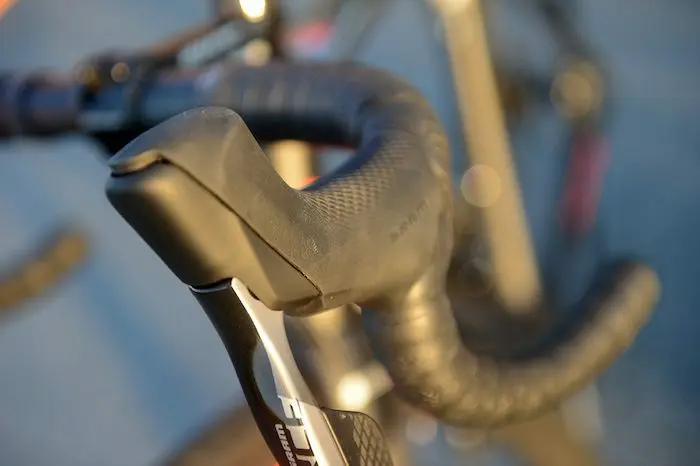
The rubber on the hoods provides very good grip, even when riding without gloves and even in the rain. We do, however, regret the blunt edge at the lever pivot, which is not very comfortable on the index finger over long rides.
These levers have the advantage of being adjustable both in reach (how far the brake lever sits from the bar) and at the contact point between the braking action and how the pads work in the calipers.
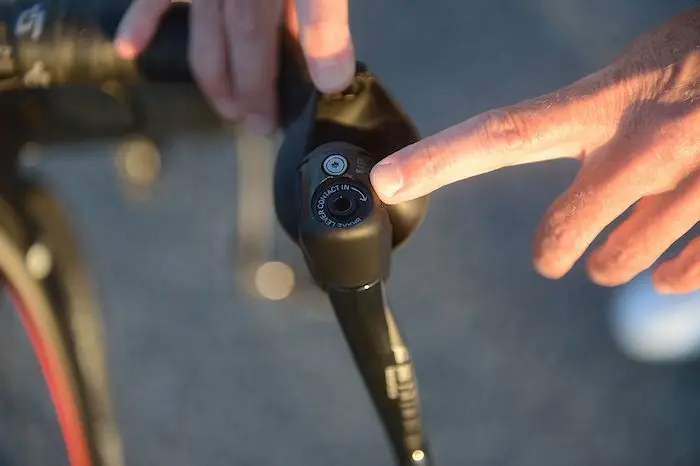
A trick that lets you personalize handling, in a way, even though the very principle of disc brakes does not allow the pads to be pulled away from the discs as would really be needed. The very small gap between the pads still causes micro-friction that stops the wheels from spinning very freely. It may be only psychological, but it is something that still bothers us on this type of bike.
We must still praise the progress of SRAM disc brakes, which are very effective here with 140 mm rotors that suit our weight, and above all are finally quiet. They only made a slight noise in the rain and at the end of braking, on a few occasions. And we only had to attempt some big accelerations in very big gears (thus putting a lot of stress on the frame and wheels) to hear them lightly brush the calipers. The brakes have also lost the slightly spongy lever feel of previous models, which we found made them hard to modulate.
=> SEE ALSO: Disc brakes for road bikes: the 2019 state of play
A well-designed groupset
The SRAM Force eTap AXS 12-speed groupset is a pleasant surprise, even if one can be irritated by marketing talk with somewhat overblown promises, especially regarding smoothness or drivetrain noise. It has many advantages, starting with its wireless electronic derailleurs, its easy-to-use app, its 12 speeds (provided you pick the right cassette), and its innovative approach to gear ranges. And the brakes too, which have improved over previous versions. But SRAM’s second-tier groupset loses some of its outstanding weight-to-price ratio by moving to disc brakes and electronic derailleurs. Even so, we think it should be a big success on bikes in the 2020 range, especially against its rival Shimano Ultegra Di2, whose move to 12 speeds has not yet been announced.
| SRAM FORCE ETAP AXS 12-SPEED |
| Rating: ***** Pros: 12 speeds, wireless derailleurs, easy-to-use app Cons : weight, drivetrain noise Crankset: available in 46-33 or 48-35, or single chainring (36, 38, 40, 42, 44, 46, and 48 teeth). Quarq power meter option. 741 g in 46-33. Price: €2,058 to €2,548 depending on options Contact: www.sram.com |
=> SEE ALSO: All our Gear articles
Share the post "SRAM Force eTap AXS 12-Speed Groupset Review: Wireless Shifting With a Wider Range"