Share the post "BMC Timemachine Road Review"
Long gone are the early 2000s, when the Swiss firm made a splash with its carbon tube frames assembled via “Skeleton” lugs. Design techniques have obviously changed, and like many brands, disc brakes have made their appearance. Released a year ago, the Timemachine Road is an evolution of the Timemachine, but designed for road use. Like its close cousin, it is focused on speed.
Text and photos: @3bikes.fr
Design and aerodynamics are two elements dear to BMC. Proof of this is the Timemachine Road, a direct evolution of the Swiss brand’s time trial bike but designed for the road.
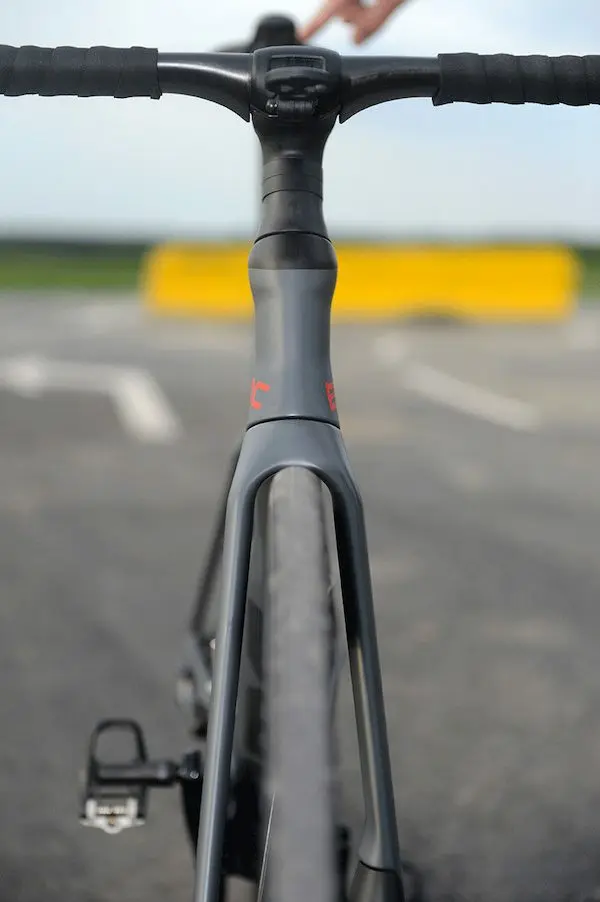
With the ICS (Integrated Cockpit System), BMC focuses everything on the integration of components from the cockpit. In short, absolutely nothing protrudes. The handlebar is available in three widths (40, 42 and 44) and the stem in four lengths (from 100 to 130 mm). The spacers and the cover under the stem are designed to route the hoses and electric wires.
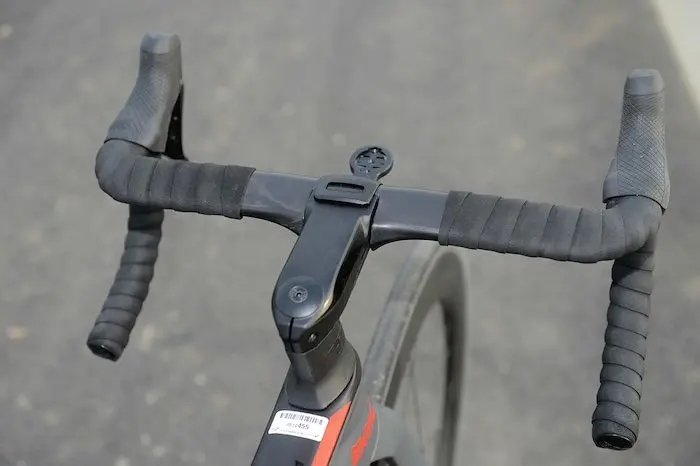
BMC has pushed integration to the maximum, to favor aerodynamics obviously, by also integrating the bike computer mount. Still on the adjustment side, the seatpost (190 g) offers three positions for saddle placement, at 0, 15 and 30 mm.
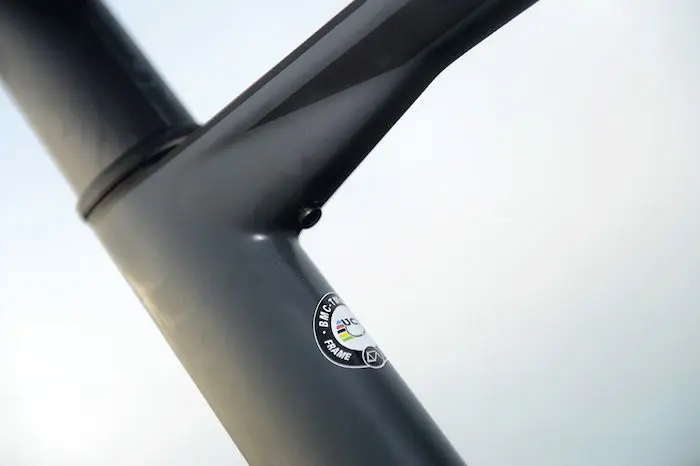
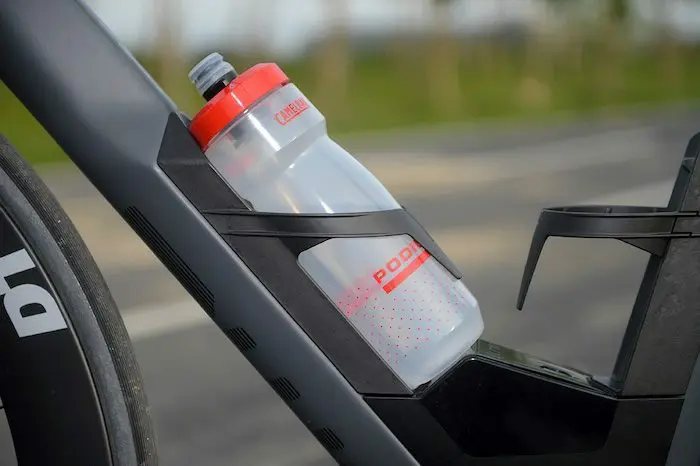
But what attracts the eye most is the integration of the bottle cages and bottles. We can see that the tubes have been designed to accommodate hydration elements as well as a “box” under the bottles, to house the repair kit. This technique is widely used in triathlon today, either via integrated systems or additional elements. Here, a small bag is provided for the box with two tire levers, an inner tube, a CO2 cartridge and its nozzle, as well as a multi-tool. If everything is well secured, nothing moves, nothing rattles.
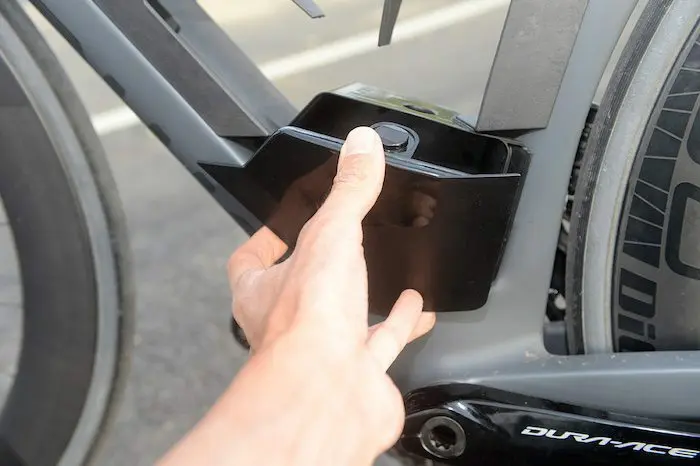
Also, under the bottle on the down tube, you’ll find the control for the Shimano Di2 system. Finally, to conclude with integration and aerodynamics, there is also a deflector at the disc level on the fork leg. This is to further reduce aerodynamic drag and limit the detrimental effects caused by the brake caliper.
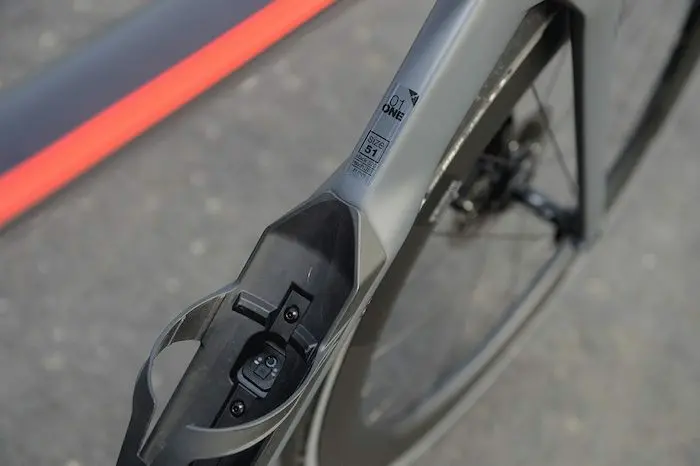
Like all fighter jets, the Timemachine features technologies not visible to the naked eye
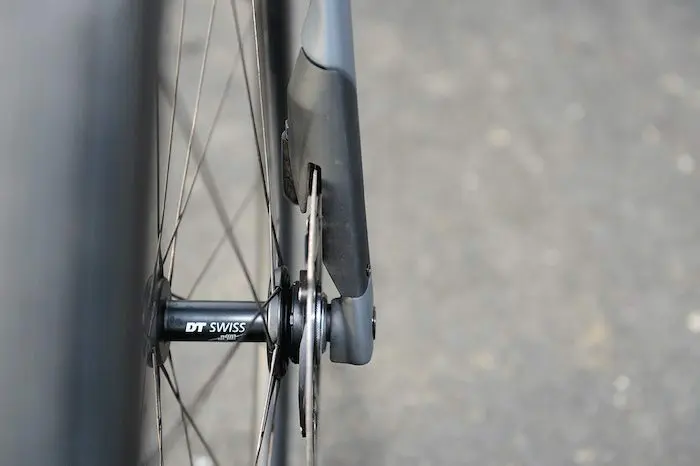
Like all fighter jets, the Timemachine features technologies not visible to the naked eye. The TCC (Tuned Compliance Concept) in particular, optimizes vertical compliance at strategic points. BMC has therefore worked on the fibers of the fork legs and seatstays without compromising the overall rigidity.
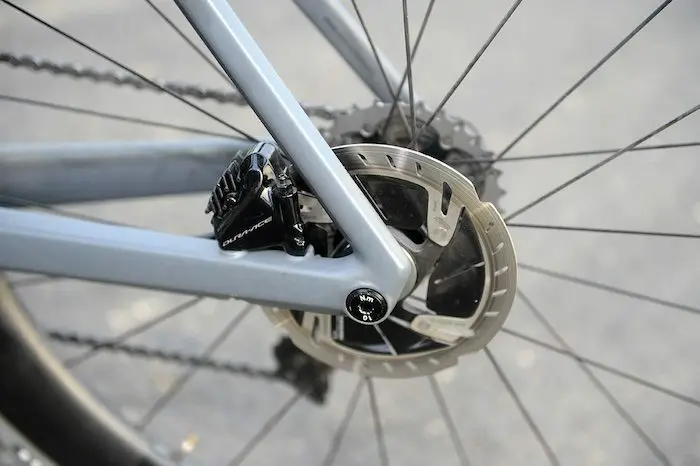
The frame is available in six well-spaced sizes (980 g in size 54 and 410 g for the fork). It can accommodate tires up to 28 mm, which explains why the chainstays are not longer than 410 mm. This particularity allows the Timemachine to remain consistent in its objective of aerodynamics and performance.
On the road
No need to look for comfort where there isn’t any, the Timemachine Road is truly designed for speed, the rest is irrelevant and it doesn’t bother with details. Unfortunately, the bike’s weak point, in our opinion, lies in the lack of rigidity of the integrated cockpit. This is immediately noticeable, sensitive from the first pedal strokes, and it persists throughout the rest of the ride. For purists and the most meticulous, this element will need to be changed, even if the handlebar offers some comfort with hands in the drops.
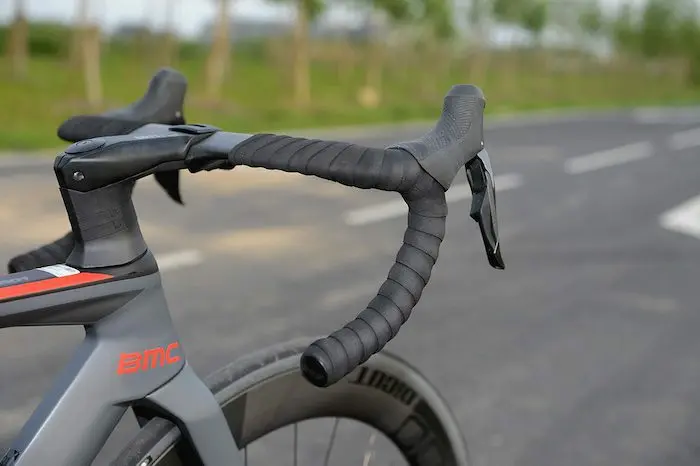
Fortunately, this detail is quickly forgotten. Partly because it balances out with the good overall rigidity. In fact, it provides a small element of comfort at the front, which is ultimately not a luxury.
We are therefore dealing with a rigid, stable, straight bike.
For the rest, we are therefore dealing with a rigid, stable, straight bike. The use of disc brakes, and thus thru-axles, further reinforces this impression. However, the work done on the rear triangle and the fork allows for a certain unity to be felt, and that’s a good thing because the risk with this type of setup always lies in the imbalance induced by the presence of a braking system on the wheel axles. But the Timemachine Road is a bike designed primarily for discs, so it behaves as its nature dictates.
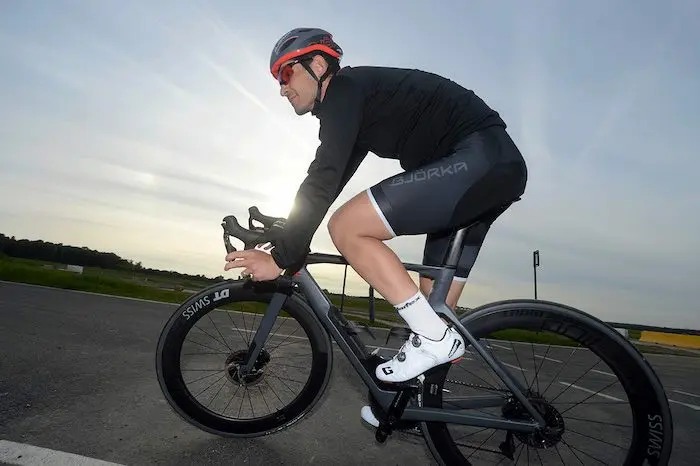
With its aero tubes and 60 mm rims, the BMC did not “carry us away” excessively with the wind. Small rider or not, the Timemachine is quite easy to handle in this regard and steers easily, both entering and exiting turns. Once the disc braking is mastered, all you have to do is attack decisively, the front wheel places itself, the rest follows, and the tire grip does the rest. With a narrower tire width, you would lose very little grip, but you would gain tremendously in efficiency.
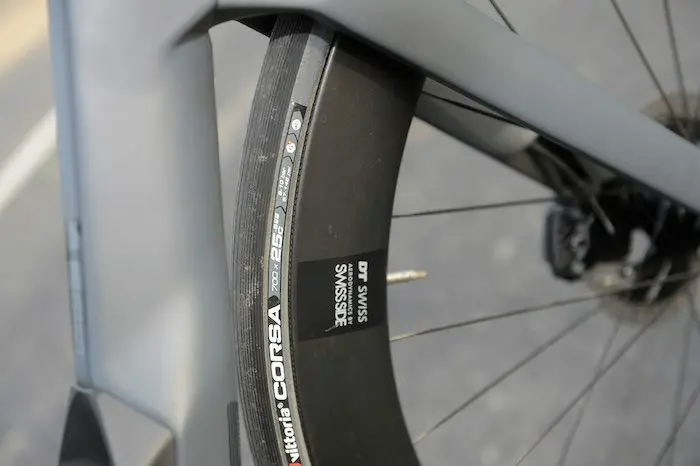
For the rest, despite its rigidity, the bike is not “on rails,” even if it can be a bit sluggish at the start. The rider’s physical condition and build play a big role then. But it stays on track. It’s difficult, however, to appreciate its aerodynamics while riding, but it’s clear that the blade effect, with nothing protruding, is noticeable, at least mentally.
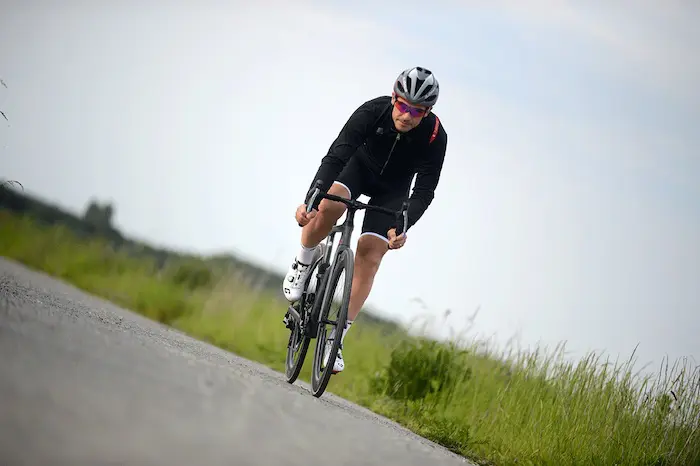
While riding, we mainly look at the road, and opponents, of course. But hearing is also another sense developed on the bike, and we seemed to hear a slight noise from the storage box. This is the risk with this type of system. Even if very practical, everything must be perfectly secured so as not to be disturbed. And, in fact, this time, it was our fault!
Attack, accelerate, sprint. The Timemachine truly has that in its blood.
Attack, accelerate, sprint. The Timemachine truly has that in its blood. It is designed for rouleurs and short-distance triathletes. The latter, however, might be hampered by the fact that no mounting system exists to attach extensions to the handlebar. It will therefore have to be changed.
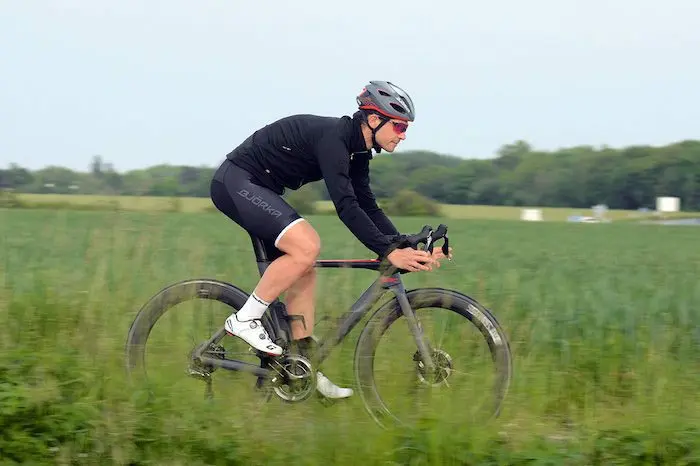
But be careful, we had the opportunity to try this very high-end version of the BMC. At 7.5 kg, it can become significantly heavier, like all disc-brake machines, with lower-end equipment. The difference can therefore be notable and the disappointment proportional to the price difference. But one thing is clear, the Timemachine Road is not for everyone, and not suitable for leisurely rides.
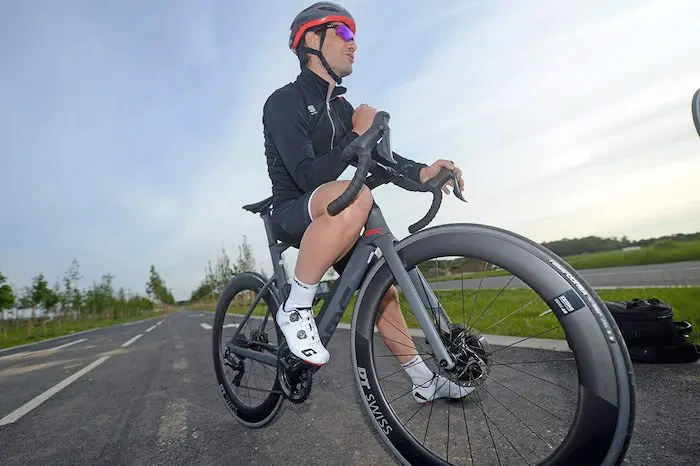
Its price remains extremely high. Our test bike reaches the 12,000 € mark and only three models are available, all with electronic shifting naturally. For your information, you cannot use the BMC with the storage box in a UCI event, but it is naturally possible in triathlon. At 4,199 € for the module alone, it also seems complicated to build an affordable Timemachine because you cannot use a traditional drivetrain. Many will say that technology and innovation have a price. We will add that passion also has one.
| BMC TIMEMACHINE ROAD |
| Rating: ***** Pros: technology, aerodynamics, fully integrated system, aggressive bike behavior. Cons: very high price, not compatible with mechanical drivetrain, handlebar lacks rigidity. Frame and fork: Timemachine Road. Geometry: 47 51 54 56 58 61 TT: 520 535 550 560 575 590 St: 480 518 548 568 588 611 HT: 88 113 135 150 170 196 Reach: 373 381 390 395 405 413 Stack: 496 520 540 555 574 598 RC: 410 410 410 410 410 410 SA: 73.5° 73.5° 73.5° 73.5° 73.5° 73.5° BMC Timemachine Road 01 one (our test model): 11,999 € Contact: www.bmc-switzerland.com |
=> SEE ALSO: All our Gear articles
Share the post "BMC Timemachine Road Review"