Share the post "FSA Powerbox Power Meter Review"
Reliable and well-built, the FSA Powerbox power meter performed flawlessly during the 1,500 km test we put it through at the end of winter. Beyond its performance, it primarily helped us at the start of the season to perfect our training and approach the first events in good form.
By Sylvain Pigeau – Photos: S.P 3bikes
No more calibrating before a ride, at the risk of getting crazy data. No more tedious maintenance for a simple battery failure. Today, power meters are very easy to use, reliable, and accurate, while also being more financially accessible.
But it’s always difficult to venture into highly scientific territory. What to do? What more can be said about a sensor whose accuracy is estimated at plus or minus 3%? For the average person and the vast majority of cyclists, this margin is not even noticeable in training, in the short or long term. Unless you’re using a sensor that gives outlandish data from one month to the next or from one season to another (due to temperature differences), it’s very difficult to tell the difference between two models. And for a simple reason: comparing two power meters (each with its degree of uncertainty regarding data accuracy) can only be done by using a third sensor, which is also imprecise, as a reference.
The Powerbox did not give us any such unpleasant surprises. It must be said that the device from the Taiwanese brand FSA is not actually unknown, as it is the German Power 2 Max sensor (used, for example, by Movistar riders, with Alejandro Valverde at the forefront).
In February and March, in the Parisian cold, the humidity of Brittany, or the dry air of the South of France, no anomaly was detected, and the measurements proved stable and precise, and consistent with our past references. We’re not going to quibble over 2 watts, that would be ridiculous. But you can see below how we proceeded. Even with a battery at the end of its life, which was quickly replaced. The lifespan of the latter (CR 2450) is given as 400 hours of use (approximately 12,000 km). In our case, the sensor had already been used.
The battery life (CR 2450) is rated for 400 hours of use (approximately 12,000 km).
The Powerbox in practice
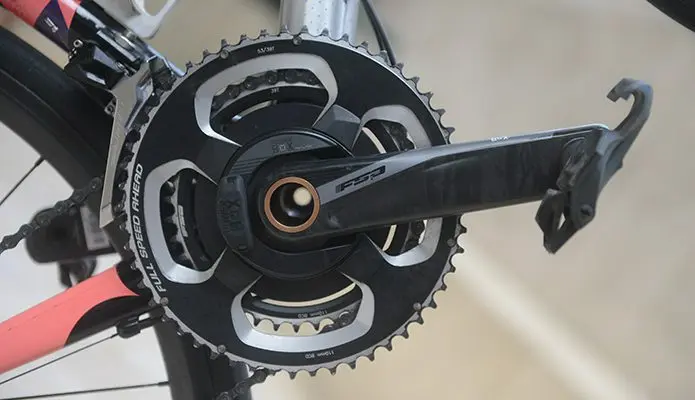
Light (733 g with 53×39 chainrings), featuring stiff carbon cranks with a UD finish, our test model primarily demonstrated precision and reliability.
Once installed, the connection was immediate with our ANT+ devices, both on the Garmin 520 Plus and on the Wahoo smart trainer. The Powerbox is also Bluetooth Ready and therefore compatible with smartphones, among other devices.
Naturally, it provides traditional power measurements (instantaneous, maximum, or average), as well as right leg – left leg balance.
The cranks are made of UD carbon, the axle is aluminum to the BB386EVO standard, and the chainrings, compatible with Shimano and Sram 11-speed, are CNC machined. Finally, in terms of availability, the new version offers a range of five crank lengths and three chainring combinations (four-bolt). So everyone can find what they need.
That’s for the technical side, and all that remains is to specify the price: €1,249, a bit high for this type of equipment, which tends to become more affordable below the €1,000 mark. But to save some money, it’s possible to switch to the version with aluminum cranks, at €699 (announced at 921 g compared to 733 g, weight verified by us, for the carbon model).
Avoiding overtraining
But what did the Powerbox bring us? With the goal of preparing for the long-distance triathlon season, the aim was primarily to “rebuild the basics,” rather than to practice advanced exercises.
> READ ALSO: Power in cycling
On the menu, therefore, fundamental endurance, long rides with Negative Split (at a progressive pace), some long series at I4, and two exercises called “Gimenez.”
> READ ALSO: Focus on the so-called Gimenez session
Once reassured after the first rides, regarding the consistency of the displayed values for average power (around 180 watts average on our rides in general), the work could begin with rides containing repeated climbs, long and steady, as in the Monts d’Arrée in Brittany, or on the roads of Tanneron, on the Côte d’Azur.
At the beginning of the cycle, in early February, the longest ascents (regular gradients of 2 to 5% for about 3 km), in the Monts d’Arrée, were completed at around 230 watts average (for 59 kg). For a time gain of about 10% (observed on Strava segments), a month later, we noticed an increase of about 5 watts on the averages. This was consistent with a regained “fitness,” without having specifically “pushed hard.” Here, the Powerbox fully played its role, without drift or erratic measurements, despite the bad weather and somewhat mistreated equipment.
Because the challenge was there, especially during a period when climatic conditions hinder fragile bodies from performing high intensities. We left that to those performed in the pool (three one-hour sessions per week) and on foot (about two running sessions per week, only one of which contained short VMA-type exercises).
By combining sessions, with swimming and running, the use of the power meter made perfect sense.
By combining sessions, with swimming and running, the use of the power meter made perfect sense.
During heavy weeks, both in terms of swimming and running sessions, we observed a slight drop in average power on certain cycling outings that were nevertheless “simple” and without too much elevation (always between 500 and 1,000 m approximately), at around 165 watts. A sign that we needed to ease off, whereas conversely, on light weeks (around 10 hours of sport per week), it was possible to complete the same outings at over 190 watts.
> READ ALSO: How to gain Watts
In the case of these cross-trainings, and in the absence of competitions to gauge ourselves, the use of the sensor helped us a lot. It is also useful during exceptional weather phenomena. We won’t forget that late February ride in Brittany, where, starting with a west wind, we found ourselves with over 210 watts average on the way out. For less than 150 on the way back…
Alpe d’Huez as a benchmark measurement
And since the idea was to test ourselves, it was possible to do so on the climb of Alpe d’Huez, via the BKool application. 1 hour, at I3, for about 230 watts, we were pretty much “on track,” even virtually. Especially given the period (late February) and the kilometers accumulated since December 1st (3,500). Here too, the Powerbox didn’t budge, and by setting the Garmin to the “30-second power” indication, the exercise was quite comfortable.
Reliable, precise, and very simple to operate, the Powerbox largely won us over. Guaranteed for 2 years, it requires no calibration and remains very easy to synchronize. In terms of price, it remains competitive compared to the competition. But it is true that today, for this type of equipment, we would ask for an additional effort from brands, such as almost systematically dropping below the 1,000 euro mark.
| FSA POWERBOX (POWER 2 MAX SENSOR) |
| ***** Pros: Easily replaceable battery, lightweight, stiff, precise, immediately detected by ANT+ and Bluetooth devices. Cons: Still high price Carbon cranks: 165, 170, 172.5, 177.5, 180 mm 4-bolt chainrings: 50×34, 52×36, 53×39 Compatibility: Shimano and Sram 10/11 speed Right leg/left leg analysis. ANT+ connectivity (and Bluetooth available with update). Available in aluminum version at 699 euros. Bottom bracket: BB386EVO, BB30 Weight: 733 g Price: 1,249 euros Contact: FSA |
Share the post "FSA Powerbox Power Meter Review"