Share the post "KALENJI Kiprun Ultra Light Review"
Largely inspired by the Kiprun Race 2018, the Kiprun Ultra Light 2019 is a speed shoe that offers excellent sensations in terms of stride and dynamism. With a 6 mm drop and a featherlight weight, all the ingredients are there to boost your stride. All at an unbeatable price, a constant at Kalenji.
By Pierre-Maxime BRANCHE. Photos: 3bikes.fr
Year after year, Kalenji refines its running shoe offering. The eternal naysayers who label the brand as too untechnical and too mainstream have less and less to complain about, as the efforts and progress have been significant for some time. Since 2018, and because each runner has different needs depending on their practice and geographical location, the group has refined its ranges to meet the needs of every runner, dividing running into five sports: jogging, road running, trail running, athletics, and orienteering.
In fact, at Kalenji, jogging is first and foremost well-being running, accessible to everyone. The jogger has no performance objective, but rather life objectives: feeling good in their body, clearing their mind, staying in shape, running for a cause or just for fun. On the other hand, road running defines runners who participate in races with an objective of individual and/or collective performance and self-transcendence. With the desire to perform while respecting their body, they follow specific training plans and are looking for technical and personalized advice in terms of equipment, nutrition, etc. It is for this category that our test model was designed.
Inspired by the Kiprun Race 2018
The Kalenji Kiprun Ultra Light certainly belongs to this second category, as it is largely inspired by the Kiprun Race 2018. Developed for regular to intensive use for runners looking for a very light and dynamic product, the latter enjoyed great success last year and found many feet to its upper. With 203 g in men’s size 43, 180 g in women’s size 39, a 10 mm drop (difference in sole height between the heel and the toes, editor’s note), an airy mesh upper and Up’bar technology, i.e. a Pebax piece placed from the midfoot to the forefoot that stiffens the sole to offer better propulsion, its users loved its great dynamism and lightness.
This year, the Kiprun Ultra Light takes this base and goes even further. The airy 3D mesh has been reworked with even more micro-perforations to wick away perspiration as much as possible. It is also much more flexible and lighter to adapt to the shape of your foot, from the instep to the metatarsals, and to give it greater freedom to position itself. The 10 mm drop is gone, as we find here a 6 mm drop that favors a midfoot and forefoot stride attack. We find the famous Up’bar system for energy return, the light EVA cushioning foam on the midsole, but also the same outsole as the Race, textured in the center to wick away water and smoother on the sides for grip, and finally Seamless technology (seamless) on the forefoot to limit friction.
No K-Ring cushioning
What we don’t find in this new model are the two technologies launched by Kalenji in 2016 and present on the rest of the road running range. On the one hand, the K-Only concept, which is materialized by the integration of another Pebax piece at the midfoot and a dual-density foam under the first metatarsal, a concept that adapts the shoe to all strides, whether pronator, neutral or supinator; on the other hand, K-Ring cushioning, an EVA midsole foam, circular in shape for better deformation and open in its center, placed under the heel to absorb shocks.
As always with Kalenji, and more generally with the Decathlon group, the price is unbeatable with €70 to pay to get them.
On the scale, this Ultra Light weighs 200 g in men’s size 43, a small weight loss compared to its predecessor and places it in the category of very light shoes. Kalenji targets this model for runners weighing up to 85 kg and for distances ranging from 5k to marathon. As always with Kalenji, and more generally with the Decathlon group, the price is unbeatable with €70 to pay to get them. Far, very far from the standards in this segment of speed shoes.
An almost deconstructed mesh
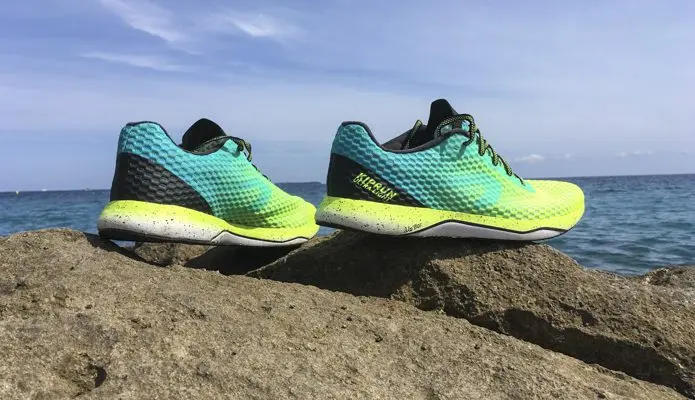
The look is a very personal matter, but visually, we find this model very successful with these different shades of fluorescent yellow, green and blue mixed together. It’s dynamic, very summery and makes you want to put them on to devour the asphalt at high speed. The honeycomb-like 3D upper is very airy. In fact, when you slide a hand inside, you can quite clearly distinguish your fingers through it.
These Kiprun Ultra Light live up to their name. Unfortunately, we were unable to verify the weight of the tested size 43, but it is certainly featherlight. Once the upper’s support cardboard is removed, we discover a very flexible, deconstructed, and unsupported mesh that is quite unsettling. It is almost possible to mold it as desired with your fingers. The tongue is ultra-thin. This shoe is not very flexible in its length and in the impulse zone, as well as in the transverse axis due to the Up’Bar system.
Inside, the foot is very well received by an Essensole insole. The last shape is narrow, from the heel to the forefoot and especially under the arch. For wide feet, a mandatory try-on is necessary to choose the right size, especially since this Ultra Light runs small in the toe area. Once the laces are tightened, the mesh upper adheres comfortably to the foot, perfectly molding its shape. Without specific reinforcement, the Achilles tendon is positioned in a cozy hollow, the malleolus has great freedom of movement, the flat and short tongue delicately positions itself on the top of the instep, and the flat laces allow for precise tightening. For its part, the mesh adapts to the position of your toes, offering no resistance or hard spots. Note the absence of a rear tongue to facilitate transitions in triathlon.
Long live the pace
There’s no secret: when you put on a pair of running shoes weighing around 200g, with a 6mm drop and forefoot rigidity, you have to ensure you’re pushing the pace and that your calves are well warmed up. The sensations with these Kiprun Ultra Light are excellent as soon as you increase the pace. The foot is well held in place, the tightening doesn’t move, neither does the tongue, the grip is good with an outsole that pulls well on the ground in dry or wet conditions. However, we avoid paths, even clean and flat ones, where this Ultra Light was caught off guard on changes of direction.
The foot is well held in place, the tightening doesn’t move, neither does the tongue, the grip is good with an outsole that pulls well on the ground in dry or wet conditions.
The drop encourages at least a midfoot strike, and the Up’Bar system energizes the support and propulsion. This is very characteristic during VMA or threshold training sessions. Fortunately, because this shoe is made for that, it’s its preferred terrain. This is necessarily less the case on relaxed outings or on more or less steep slopes where we deliberately took it out of its comfort zone.
In this case, it’s better to equip yourself from the Kiprun Fast or even Long range, depending on your experience and stride, as Kalenji prices give you the complete freedom to choose your footwear according to your sessions and routes. A great advantage compared to all other brands.
A galvanizing drop
On moderate-paced outings, the Ultra Light’s effectiveness decreases, but it must be admitted that one still feels this beautiful fluidity in the stride and a permanent desire to reach the forefoot as quickly as possible. This stride is the consequence of the small 6 mm drop, which extremely stresses the calves. If you are used to drops of 10 or even 12 mm and you switch directly to 6 mm, be careful to observe a transition period and adapt your training. The flexible mesh, the freedom given to the ankle, and this drop are three constraints that make the calf work hard in terms of stability and stride dynamism. Especially since if weakness threatens you, the cushioning will not be there to save you. Certainly, this Ultra Light has a midsole with EVA foam reinforced at the heel, but as indicated above, it does not have the K-Ring heel protection concept. No problem if you only have a few kilometers to cover, but if it has to last, the lack of cushioning is felt with an attack that quickly becomes very harsh.
A rapidly degraded sole
In terms of comfort, and with socks, nothing to report. During sessions between 8 and 15 km, the foot stays in place, the countless micro-perforations play their full role, and no overheating was felt. Barefoot and after a few kilometers, things went less well with blisters on the outside of the foot, especially under the 5th metatarsal, several irritations on the top of the toes (4th metatarsal on both feet) due to friction, and this despite a seamless construction. These hot spots appeared during a 14 km session at medium intensity and in spring temperatures, neither hot nor cold. Should we blame the inner surface of the mesh which, to the touch, lacks softness and comfort? Perhaps also the slight lack of space in the toe box?
Another damage to mention: the outsole slightly detached from the midsole, which itself tore a little after only 80 km of testing. A real surprise when you know that Kalenji makes it a point of honor to work on the durability promise of its soles, which it places between 800 and 1,000 km depending on the runner’s morphology.
A true speed shoe
Nevertheless, the Kiprun Ultra Light is a true speed shoe, intended for training and short races on road or track. Its dynamism, weight, and stride are its three major assets to help you beat your records. The brand recommends it for runners up to 85 kg and for distances from 5 km to marathon. From our point of view, it should only be considered for long distances if you have a forefoot or even midfoot strike and your build is not too heavy.
Favor it for 10k races, they will be ideal for helping you gain precious seconds, or for half-marathons, a distance on which they can also galvanize you. For triathlon, you can aim for very short distances such as XS, S, the Olympic distance (M), and up to the Ironman 70.3 format. Beyond that, with muscular and joint fatigue, it’s riskier. One last significant advantage: the value for money, a constant with Kalenji.
| KALENJI KIPRUN ULTRA LIGHT |
| ***** Pros : stride, dynamism, weight, price Who is it for? Neutral strides, light builds up to 85 kg. New ultra-flexible airy Mesh |
| Contact: www.decathlon.fr and https://www.kalenji.fr |
=> SEE ALSO: All our Gear articles
Share the post "KALENJI Kiprun Ultra Light Review"