Share the post "fi’zi:k Transiro R1 Infinito Knit Shoes Review"
By Pierre-Maxime BRANCHE. Photos: 3bikes.fr
For two years, it has been the shoe of records. In its sponsorship strategy, fi’zi:k counts numerous teams and athletes, in cycling as well as in triathlon. On the road side, Movistar and its world champion Alejandro Valverde, Teams Sky, Jumbo-Visma, Wiggins, ag2r-La Mondiale and Cofidis; on the triathlon side, the names are certainly a little less resounding, but the Italian brand still relies on Alessandro De Gasperi, Craig Alexander, Ivan Risti, Daniel Fontana, Michelle Vesterby, Charlotte Morel and… Cameron Wurf.
=> SEE ALSO: Charlotte Morel interview
The fastest shoe in Hawaii
Recent winner of the Cannes International Triathlon on April 21st, this 35-year-old Australian athlete, a high-level rower until 2006, a professional cyclist from 2007 to 2015 and now a pro triathlete for four years, has set records in the biggest races with his Infinito R1s on his feet. In 2018, he set a new benchmark for the bike course of Ironman France Nice (173 km, 2100 m D+) in 4h32’20, erasing the record of five-time winner, Belgian Frederik Van Lierde (4h33’29 in 2013). At the Ironman World Championship in Hawaii last October, Cameron Wurf, who set the best time (4h12’54) in 2017 over 180 km after breaking the old record (4h18’23) held by Norman Stadler since 2006, further improved this benchmark by signing a fabulous 4h09’26… The Australian resisted for 15 km on foot before finally taking 9th place.
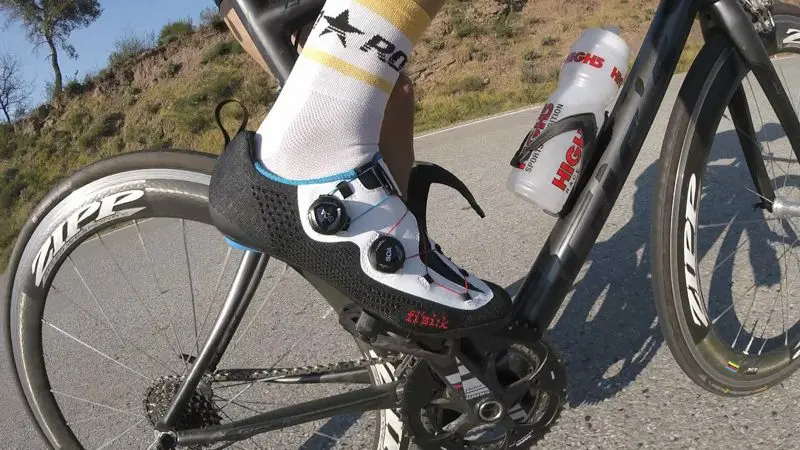
New triathlon range
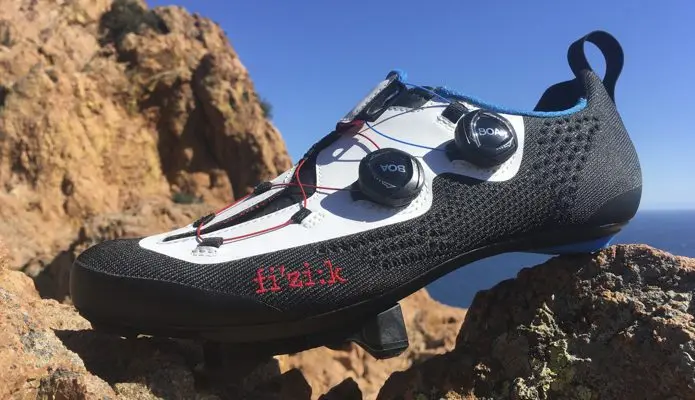
At fi’zi:k, the Transiro R1 Infinito Knit is the high-end model in the triathlon segment. The Italian shoemaker launched a range dedicated to the triple effort this year, “Transiro”, based on its road range. Two other models are available: the R3 Infinito (white/black color, €249) and the R4 Powerstrap (black/white or black/red, €119). Our R1 is priced at €380, the same price as the high-end road model, in a beautiful predominantly black and white color with touches of blue and red. Very classy and well-finished, as is often the case with Italian brands.
For triathletes, fi’zi:k has combined the know-how of its road models, in terms of stiffness and adjustment, with a design that facilitates quick foot entry and exit for transitions, but also great comfort for those who prefer to pedal without socks. All this, while adding a lot of breathability for drying the foot after swimming.
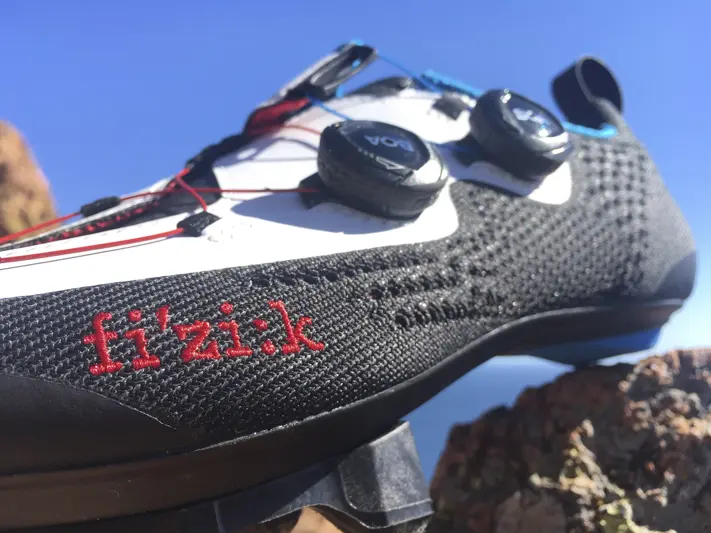
Knit is beautiful
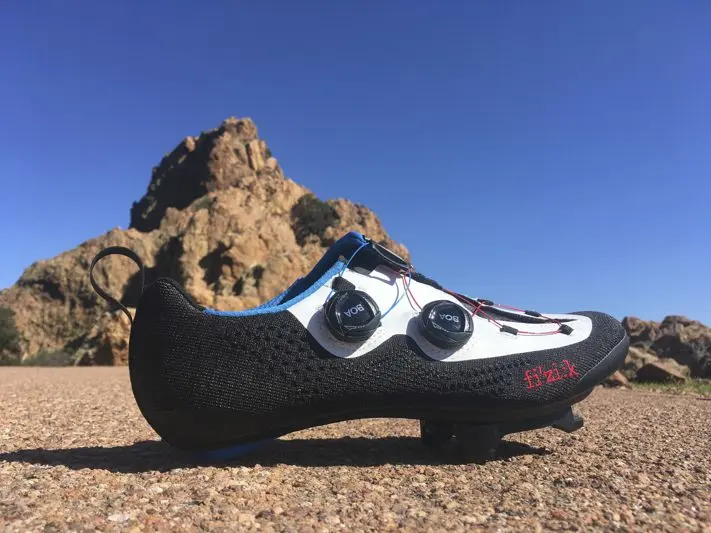
We find the Knit technology, a particularly aesthetic and pleasant-to-look-at knitted upper, which differs from microfiber models. This technology allows for even greater adaptation to the desired shoe design, it eliminates seams and better targets the functionalities of each key area, for example if more ventilation or support is desired, thanks to more precise work and orientation of the mesh. On top, a water-repellent treatment has been sprayed to protect the foot in case of rain and keep the shoe dry. Some polyurethane parts have also been added for support and to increase power transmission.
More balance and power in support, therefore better power transmission
30 cm of cable
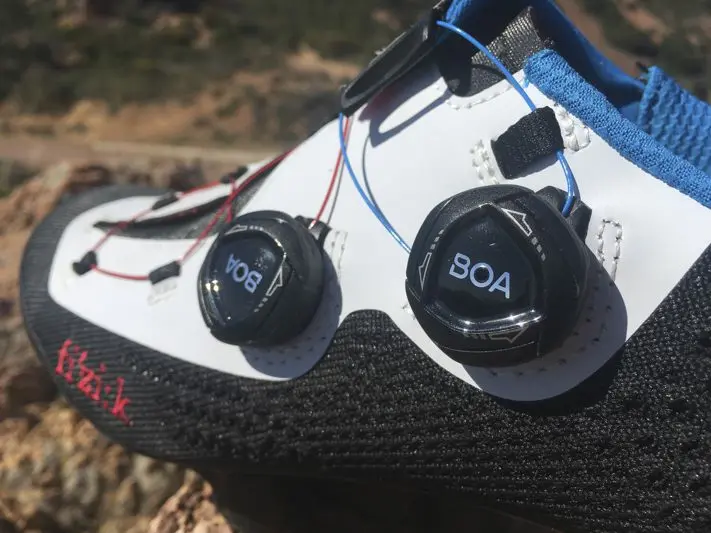
This R1 features a large opening for slipping the foot in and a wide rear loop located above the heel. The closure consists of a double IP1-B system, Boa’s top-of-the-range, adjustable while riding. These two dials offer micrometric tightening where each click is equal to 1 mm. Simply pull on the dial to fully release the tightening. The 30 cm steel wire covers almost the entire instep, a technology called Infinito at fi’zi:k, to offer more balance and power in support, thus better power transmission.
Completely made of unidirectional carbon fibers, the sole offers a high level of stiffness and lightness combined with maximum ventilation thanks to six vents (3 at the front and 3 at the center) to channel airflow under the foot.
The upper offers integrated and adaptable arch support that works in conjunction with the lower Boa dial. Inside and at the back, there are silicone dots at the top of the heel to optimize support and Lycra inserts for foot comfort, especially without socks. On the scale, fi’zi:k announces 252 g in size 42.
An essential pull tab
What do we ask of triathlon shoes compared to classic road shoes? First and foremost, that they are easy to put on; then that they are breathable to dry quickly after swimming due to wet feet but also during effort; that they are comfortable inside in case you pedal without socks; finally, that they are efficient in terms of power transmission. Ultimately, there are not that many differences because efficiency, comfort, and ventilation are already qualities sought after by road cyclists.
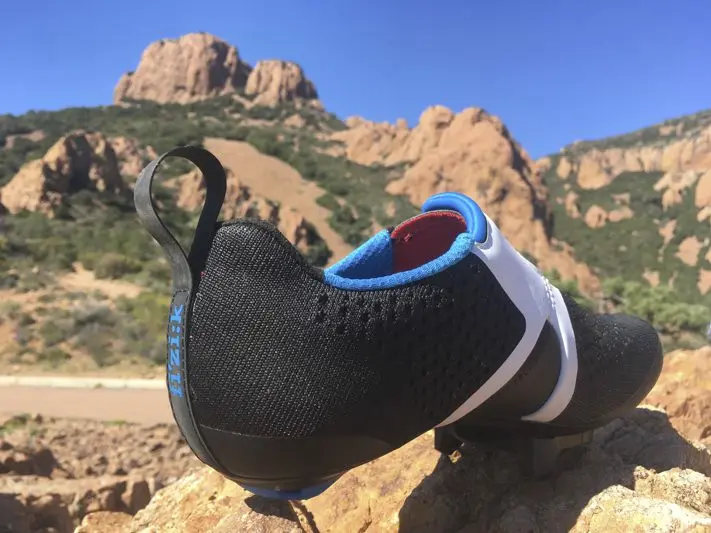
This pull tab is strong enough to pull hard if the foot gets a little stuck on entry or exit
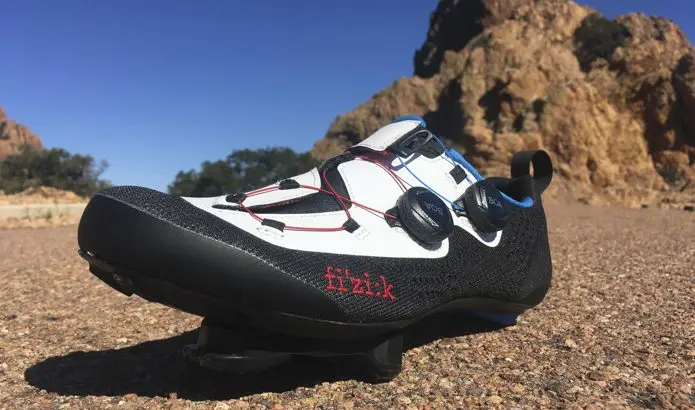
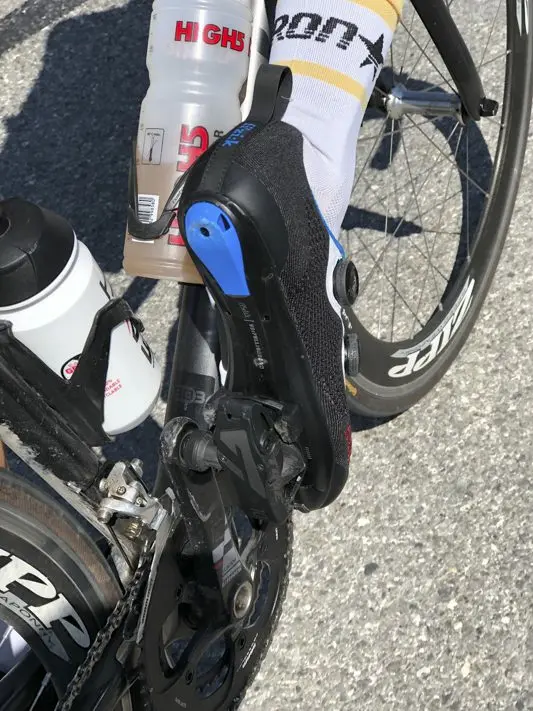
What we primarily ask for is practicality and quick donning to best manage transitions, whether over long distances and even more so over short distances where every second counts. Here, our Transiro R1 has the essential rear loop. This has a double benefit: first, to keep your shoes straight when clipped in so you can run alongside your bike in the transition area (and thus avoid either running with your cleats or seeing your beautiful shoes scrape the asphalt and spin around); second, to allow you to hold it to slide your foot in. Due to its high position on the heel, its straight orientation, its size and width, this pull tab perfectly fulfills its dual role as it is easy to grab and strong enough to pull hard if the foot gets a little stuck.
=> SEE ALSO: Triathlon, the right transition
Limited opening
A situation that can potentially happen because the opening of this R1 is not large. The vamp is not open like those found on other models, and the outer part of the upper, which includes the two Boa dials, is positioned under the inner part. Even with maximum loosening of the system, this opening remains limited; you won’t get your foot in directly in the blink of an eye. You therefore need to firmly grasp the rear pull tab to position your foot at the entrance before sliding it in, and also be careful not to catch the Boa wire between two toes if you are wearing no socks. Taking them off, however, is simpler, although it also requires using the pull tab.
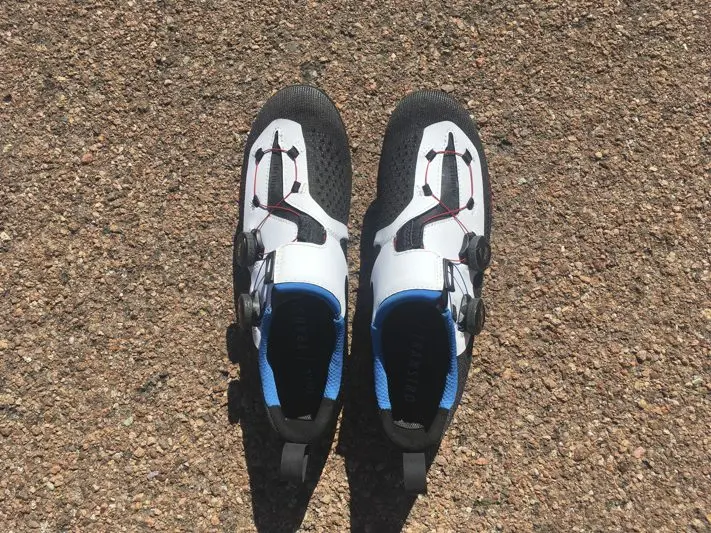
Once the foot is slipped into the shoe, the Boa closure is simple and quick. As soon as you engage them, the two IP1-B dials offer progressive tightening, to the millimeter. With the upper dial, and as described above, the outer part of the upper slides under the inner part where polyurethane inserts prevent any creases that could bother the foot.
The lower dial, on the other hand, acts on the entire front part of the instep for a more uniform and comfortable tightening. fi’zi:k calls this technology the Infinito Closure System and Volume Control. This means that due to the routing of the Boa wire through the four guides and over a large front area, the tightening offers a better fit, without pressure points, and also acts on the volume of this area by adapting the shoe to your foot shape. If you overtighten, you can loosen without fully disengaging the system.
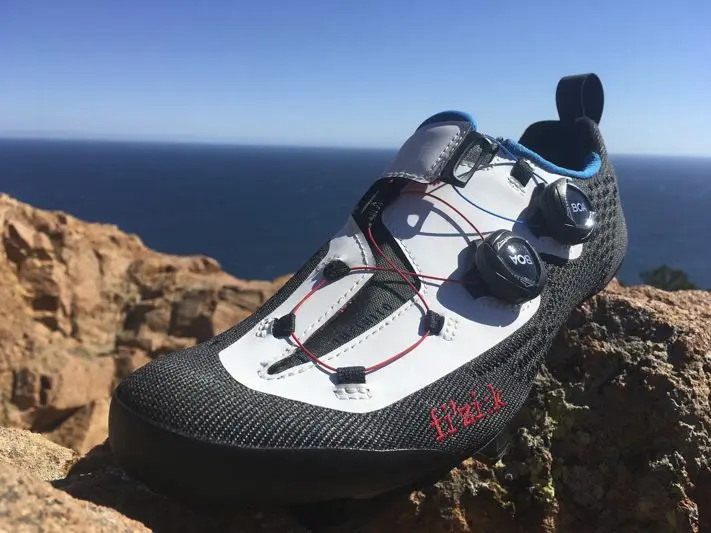
A firm fit
To realize this and benefit from it in terms of performance, it is necessary to tighten the system well. A light tightening will not allow the front of the shoe to mold to your foot. On the other hand, when you tighten the Boa in anticipation of a difficulty or a change of pace, a few extra clicks on the lower dial allow the shoe to be pressed down and improve sensations and power transfer by a perfectly supported foot. This Boa closure is really very pleasant and efficient. Sensations, comfort, and efficiency often come down to the millimeter. Here, its tension, balance, and the ergonomics it offers are very appreciable over long distances where needs evolve according to effort, terrain, and your physical condition. Be careful, however, when tightening, that the upper cable does not slip under the upper and tighten directly on your foot, as has happened to us several times.
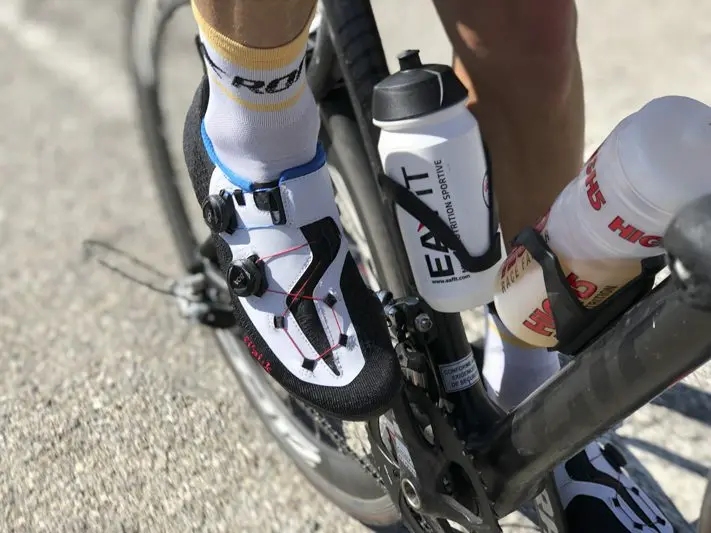
Inside, the fit provides firm support. In fact, if you don’t overtighten the Boa, you can easily pedal without feeling like you’re losing too much efficiency. In the rear area, the heel is well-cradled and supported without excessive stiffness, aided by the small silicone dots. The ankle bone is free, and you feel a certain softness and flexibility that contrasts with strong stiffness at the front. While the toes have plenty of room to move at the foot’s entry, the tightening allows the front of the shoe to become much more ergonomic without pressure points. The shoe becomes one with the foot. Only the big toe has a little freedom, even when tightened firmly. With socks, we felt no discomfort. Without socks, the end of the upper that slides along the foot with the tightening proved to be a little irritating and scratchy.
A significant curvature of the carbon sole that conforms to the arch of the foot
Quick drying
At the arch of the foot, there is integrated support directly in the upper. This Dynamic Arch Support works with the foremost Boa dial: when you turn it to tighten, the cable pulls the guide located above the arch so that the support arch conforms to it and provides more support. Honestly, we tightened it as much as possible, but we didn’t really feel any effect, not to mention the sensation of compression due to over-tightening. Nevertheless, this Transiro has a significant curvature of the carbon sole that already conforms quite well to the arch of the foot.
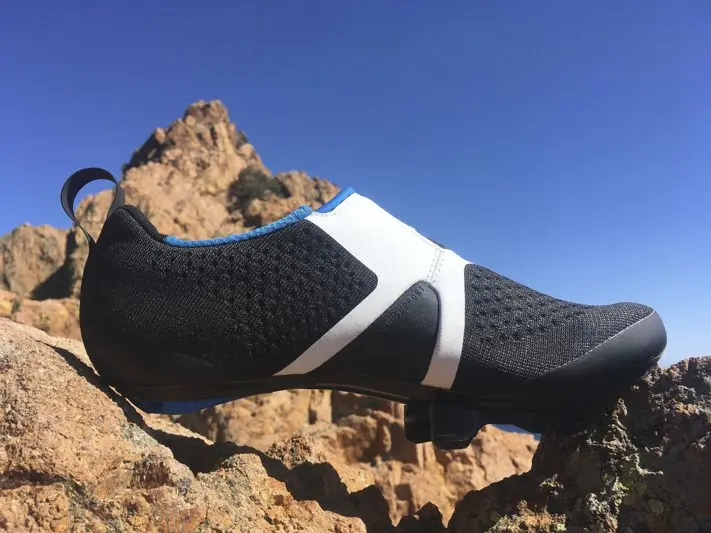
At the intensities performed, this carbon sole shows no flex. Our friend Cameron Wurf may be able to deform it, but this was absolutely not the case for us, even during uphill sprints and almost standing starts. With the excellent Boa closure, the shoes and pedals become one, giving the impression of pushing and pulling the pedal directly without an intermediate zone and without loss of power in energy transmission. Even though we didn’t test it in very hot conditions, the upper seems well-ventilated and especially breathable. We deliberately poured half a water bottle on each foot: drying proved to be quick. On very early morning rides, this ventilated upper also managed to keep the foot warm.
For Long Distance
Very ergonomic and stiff, the qualities of this Transiro Infinito R1 Knit seduced us, especially the homogeneous and adjusted tightening. For triathlon, it is more aimed at long-distance enthusiasts, its limited opening potentially being a disadvantage in short-distance T1 when ultra-fast transitions are required. Once worn, it is very comfortable and efficient at retransmitting energy without loss. Its weight of 252 g in size 42 is a plus.
Note that it seems to run a little large. With this model tested in 42.5, we thought we might lack a small margin for foot swelling during effort, but this was not the case: on the one hand, there was plenty of room for the toes at the front of the foot; on the other hand, the Infinito Closure System allows for very good ergonomics once tightened. At €380, the investment is significant, but the result is worth breaking the bank for.
| FI’ZI:K TRANSIRO R1 INFINITO KNIT |
| ***** Pros : ergonomics, closure, weight, ventilation Full UD ventilated R1 full carbon sole |
| Contact: www.fizik.com |
=> SEE ALSO: All our Gear articles
Share the post "fi’zi:k Transiro R1 Infinito Knit Shoes Review"