Share the post "Review of the MET Codatronca Aero Helmet"

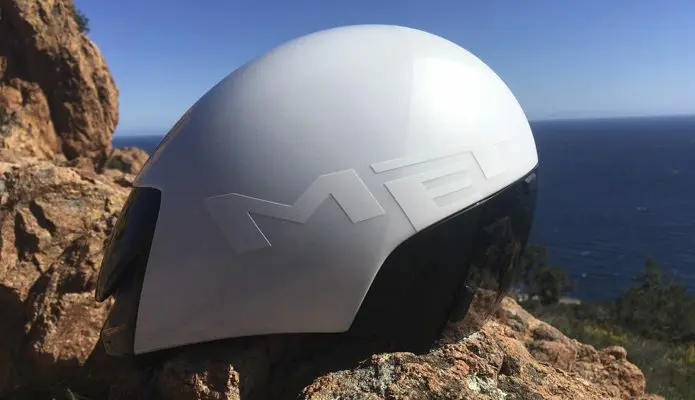
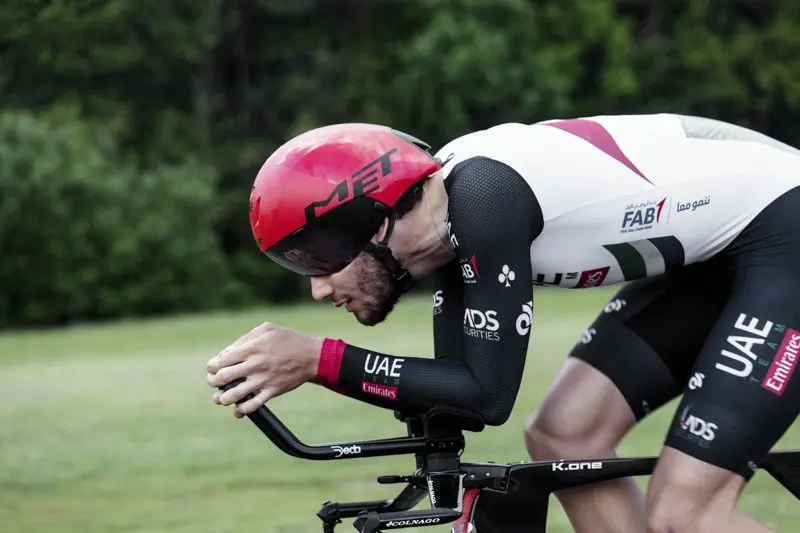
With its new Codatronca, MET offers an aerodynamic helmet featuring a wide design for better airflow penetration regardless of the wind angle, and a short rear section that allows your head to move freely. A product designed for time trials and triathlons, used by Frederik Van Lierde, five-time winner of the Nice Ironman and 2013 Ironman World Champion. We tested it on the roads of the Côte d’Azur race for six weeks.
By Pierre-Maxime Branche. Photos: 3bikes.fr and MET Helmets

When you’re looking to go fast, every detail counts. Whether it’s a road race, a time trial, or a short- or long-distance triathlon, the equation is always the same: the drag coefficient depends on every aspect of the cyclist and their bike, from the aerodynamic position to the rim height, including the frame tube design and… the helmet, since it’s one of the first frontal surfaces to act as a brake on your forward momentum.
Compared to a standard model, an aerodynamic helmet can save you 6 or 7 watts at a speed of 45 km/h
However, if you don’t pay attention to this, the watts you lose every second just to keep moving quickly add up to minutes as the kilometers go by. Compared to a conventional model, an aerodynamic helmet can save you 6 or 7 watts at a speed of 45 km/h—the standard speed for wind tunnel tests—which is roughly equivalent to the difference between a pair of high-profile and low-profile rims. In terms of time, these 6–7 watts translate to about 50 seconds saved over a 100-km distance at an average power output of 200 watts. So, over the legendary 180-km Ironman distance, you can estimate this gain at a minimum of 1 minute and 30 seconds just from using an aero helmet. Honestly, it’s worth it, isn’t it? Above all, this adds to all the other areas you can optimize, such as your riding position, wheels, frame, the smooth operation of your drivetrain, and your bearings—not to mention the cyclist themselves (their weight and physical condition) and their training.
A short tail
To meet the needs of cyclists and triathletes seeking both aerodynamics and comfort, MET launched its new Codatronca last December. The Italian brand wanted to offer a model with a short tail, allowing the head to move freely without the constraints of a long tail, and featuring a wide design that ensures the best possible airflow penetration regardless of the wind’s angle of attack. MET’s catalog now features two aero models: this new short-tail Codatronca (330 g in size M, €300) and the already well-known long-tail Drone (350 g in size M, €300).

Wide-Body Design
Developed in a wind tunnel near Milan, the Codatronca features a widened “wide-body” front design. The goal: to guide airflow over the shoulders—which present a large surface area that creates drag—and thereby significantly reduce your aerodynamic drag. At the rear, as mentioned earlier, the short tail is designed to make your life easier: it also helps reduce drag by hugging the top of your back, but also allowing you to move your head without sacrificing aerodynamics—unlike a long tail, which becomes an air resistance source when your head is no longer aligned with its axis and thus loses its aerodynamic benefits.
Providing aerodynamic efficiency regardless of your head position
While it’s possible to maintain a compact, streamlined position with your head aligned during a prologue or a short time trial—or even up to 40 or 50 km for some—it’s much harder to do so over longer distances. During an XL or XXL triathlon, there are inevitably moments when the body and head lift up slightly—either out of necessity to relax, or due to the terrain, such as hills to climb or even a mountain pass. That’s the goal of the Codatronca’s design: to provide aerodynamic efficiency regardless of your position, the position of your head, and the various possible angles at which the wind hits you.

Ultra-wide visor
Another key area of development is visibility. This helmet features ultra-wide visors (tinted, mirrored, or clear) secured by four magnetic clips, which enhance the aerodynamic performance of the helmet-and-visor assembly. This wide field of view is the result of a visor design that is wider on the sides and higher above the eyes to optimize peripheral vision. Since it’s important to stay cool, three vents are positioned on the front, where airflow creates maximum pressure but turbulence is minimal; at the back, a wide opening allows hot air to escape, keeping you in optimal thermal comfort.

Magnetic closure
MET ensures a 360° fit thanks to the Safe-T Orbital system. This strap system offers four vertical adjustment positions, two occipital positions, and remains compatible with ponytails. Like the visors, the Fidlock closure buckle is magnetic to facilitate transitions.

The Codatronca features an in-mold polycarbonate construction with EPS injection, adjustable Air Lite straps, and hand-washable internal foam padding. It comes in three sizes—S (52/56 cm), M (56/58 cm), and L (58/61 cm)—and three colors: white, black, or black/red. It comes with a “smoked” magnetic visor; two others are available: mirrored (39 €) and clear (29 €).

Multiple adjustment settings
Even though it’s not mandatory, wearing a helmet is now second nature for any self-respecting cyclist. But a poorly fitted helmet is useless. Before heading out for a ride—and especially if it’s your first ride with your new helmet—take the time to adjust it properly. This MET model features four small notches on the inside of the strap that let you raise the helmet a few millimeters, for example, if the visor is touching your nose. Similarly, there are two positions available to tighten or loosen the back strap slightly before even adjusting the micrometric tension dial. While riding, this dial is actually quite easy to access thanks to the absence of a long tail.

Once the straps are properly adjusted, you can close the magnetic buckle. This is really very convenient because all it takes is one hand and simply bringing the two ends together or touching them for it to lock. An undeniable time-saver for triathlon transitions.

A bubble of concentration
When worn, the Codatronca sits on the skull without any pressure points, but the thickness of the comfort padding is a bit on the thin side. An extra millimeter or two would have been welcome. Weighing 330 g in size M, it doesn’t feel heavy at all. Without the visor, it almost feels like wearing a classic helmet—albeit one with very few vents. The ear pads highlight its aerodynamic design for time trials or triathlons. It’s only when you clip on one of the visors that the Codatronca transports you to another dimension—that of your own bubble of concentration on your effort.

Again, you only need one hand to snap the visor into place using its four magnetic slots—two at the ends of the forehead and two on the sides. Note that if you want to remove the visor for a few minutes during a race—while climbing a mountain pass, for example—you can unclip it with one hand and place it upside down (nose up) on the front of the helmet. It will remain securely attached magnetically, with no risk of falling off.

Visor Quality
The promise of a wide field of view is delivered. You have a 180° view, with nothing obstructing your vision—not even in the corners—thanks to the visor’s generous height at the edges. When stationary with your head tilted back, the rim of the nose becomes visible and can be bothersome, but while pedaling—with your head tilted forward and your eyes fixed far ahead on the road—there’s no discomfort at all. Similarly, when your head is tilted back, air tends to rush in around your nose and can irritate your eyes. As soon as your head returns to a more forward position, the airflow is redirected over the top of the helmet, and your eyes remain well protected.


The mirrored and tinted visors provide excellent protection against glare, especially when facing the sun. The clear visor reflects colors exactly as they are, while the other two offer a slightly darker contrast without obscuring details on the road. Once again, take the time to properly adjust the Codatronca to fit the height of your forehead. With exertion and sweat, it tends to slide forward slightly, and the visor—even though it has a nose guard—may end up resting on your nose. After 150 km, it’s not painful enough to make you cry out, but you might feel a slight discomfort.

Ventilation in question
Are the three front vents enough to cool the inside of the helmet and expel hot air through the back? It’s hard to say for sure on this point. Tested from February to April on the French Riviera, the weather conditions didn’t offer enough heat to truly gauge the effectiveness of the Codatronca’s ventilation. At temperatures of 22–23° and during a long 170-km ride, we weren’t bothered by a feeling of heat or fogging, even during moderate-intensity effort on an 18-km climb. The foam strip across the width of the forehead quickly became damp as it absorbed sweat, but this area didn’t get excessively hot. However, during this long ride, droplets formed and began to run down. Given the Codatronca’s design and its panoramic visor, it’s difficult to wipe them away to prevent them from ending up as salty drops in your eyes.
How would it fare in the middle of summer? It seems the placement of the vents is just right: in an aerodynamic position, with your head forward, they face directly into the airflow, which you can feel entering and brushing against the top of your head. Your ears don’t overheat either. On the other hand, due to the limited number of vents, the foam padding gets wet by the end of a ride. So one might wonder if the Codacontra provides good thermal balance in the blazing heat. We’ll have the answer in a few months in the comments section of this same article.

A big mushroom
Visually, in front of the mirror—let’s be honest—the Codatronca really gives the impression of having a disproportionately large ball on your head, a consequence of Met’s decision to offer a “Wide Body” design. It looks like a big mushroom, especially on a small, slender, elongated head like mine. In the aerodynamic position, it’s less noticeable and more harmonious because its design—both from the front and in profile—blends seamlessly with the pursuit of speed. What’s particularly noticeable is that, because of the forward position of the arms, head, and shoulders—and thanks to its wide design—the airflow has no choice but to deflect fairly high above the back and, on the sides, over the back of the shoulders.

When you turn your head—whether facing headwinds, crosswinds, or even strong gusts—the Codatronca remains unaffected, with its short tail proving to be a definite advantage in these conditions. It’s impossible for us to quantify the energy saved or the watts gained on our rides, but this model perfectly fulfills its purpose: it’s an aero helmet suited for short-distance speed efforts, but especially for long-distance rides. Its fit, wide field of view, and relatively light weight make it a reliable companion on any type of route. It remains to be seen whether its ventilation is adequate for the intense summer heat—a significant consideration for triathletes who specialize in long distances.

| MET Codatronca |
| ***** Pros: visor quality, field of view, aerodynamics, tail design, weight. Cons: price, ventilation, thickness of the inner padding, visor that can rest on the nose during exercise.In-Mold polycarbonate shell and EPS inner structure Safe-T Orbital retention system Hand-washable inner padding Air Lite straps Fidlock magnetic quick-release closure system Adjustable Air Lite strap dividers Comes with a “Smoked” magnetic visor Helmet bag Sizes: S (52/56 cm), M (56/58 cm), and L (58/61 cm) Weight: 330 g (M) Other visors: Mirror (39 €), Clear (29 €) Price: 300 € |
| Contact: www.met-helmets.com |
=> SEE ALSO: All our Gear articles

Share the post "Review of the MET Codatronca Aero Helmet"