Share the post "Disc braking for road bikes: an update for 2019"
Text: Guillaume Judas – Photos: Orbea/ Pirelli / Mavic / Wouter Roosenboom / Irmo Keizer – Shimano / Christophe Guiard / 3bikes.fr

Sunday, April 14, 2019: in the final of Paris-Roubaix, five of the six breakaway riders are on disc brakes. Such dominance is a first at this level of competition, especially at Roubaix where quick repairs in case of a puncture are essential for performance. In fact, Peter Sagan, last year’s winner, was still on rim brakes in 2018, while he has definitively adopted discs for all races, including Roubaix, for several months now.

Their use is no longer even debated in MTB, or even in Gravel or cyclocross, as they have changed the reliability and capabilities of these bikes designed to ride everywhere and in all conditions. It is surprising to see that the only rider at the front of the great cobbled Classic to ride rim brakes is former cyclocross world champion Wout van Aert. But it is true that he chose to mount an additional brake lever on the top of the handlebars, a modification impossible with hydraulic brakes.
The use of disc brakes is no longer even debated in MTB, or even in Gravel or cyclocross, as they have changed the reliability and capabilities of these bikes designed to ride everywhere and in all conditions.
Raced in dry conditions, Paris-Roubaix is not normally the preferred terrain for disc braking. The race takes place on almost flat terrain, and this is not where the superiority of disc braking over traditional rim braking is supposed to be expressed. Marcel Kittel was the first to lead the way in 2017, winning five stages of the Tour de France with a disc-brake equipped bike – which was a revolution at the time. Except that the German sprinter only won flat stages, switching back to a rim-brake bike as soon as the peloton hit the mountains, a terrain where disc braking should normally show its superiority, according to the arguments of manufacturers and equipment suppliers.

Even if a number of teams and riders are still resisting, we know that there is a disc “lobby”. The pressure is very high from certain manufacturers, who would welcome a complete renewal of the bike and wheel fleet. And to accelerate the movement, nothing beats showing champions riding with discs whatever the conditions, even if for them the technical interest is not the most obvious.

The positioning of the disc “costs” 2 to 4 watts at 45 km/h, depending on the wind angle. A slight loss that can be canceled out with the use of a thru-axle without a lever. But in this case, an Allen key is essential for removing the wheel, or a power drill for professional mechanics. Added to this are the problems of standards with different disc sizes and even their location on the hub. A repair in a few seconds is therefore more difficult to achieve, even if we know the adaptability of pro team mechanics.

On the other hand, rim braking has never been so good, with rigid, light and reliable calipers, specific compounds for aluminum or carbon that are ever more effective, and braking surfaces on carbon wheels that are finally reassuring in both dry and wet conditions. Equipment manufacturers continue to offer groupsets with both types of braking anyway. However, on the bike brand side, the choice is starting to narrow, with some models only offered for disc braking. The fact remains that this choice is sometimes judicious for reasons other than braking, as we will see later.

Major developments
Some of the prohibitive flaws of the first systems offered have recently been ironed out by the three major players in the equipment market. With its DB system, Campagnolo limits the weight gain of groupsets equipped in this way, and installs small springs behind the pads that promote brake return and limit rubbing noises during accelerations or after heavy braking. Sram, with its HRD system, was the first brand to offer contact point adjustment, to limit the dead travel of the lever before activating the braking. Finally, with the latest Dura-Ace and Ultegra Disc, Shimano offers excellent integration of the oil reservoir inside the lever, so that it is almost identical to the traditional system.

Major developments that do not change all the specificities of disc braking and which must be taken into account: the overall weight increase, a slight loss of aerodynamic efficiency of the brake itself, recurring braking noises, even while riding, and extremely precise adjustment.
Specific equipment
You don’t switch from traditional braking to disc braking with a snap of your fingers. Bikes and wheels are specific, which requires a total system change, and the impossibility of reusing old wheels. Frame and fork are reinforced to accommodate the calipers, located near the wheel axle, and to withstand braking forces. The wheels are specific, as they receive the discs near the hubs. Here again, the stresses exerted during braking require stronger spoke lacing, with more spokes and/or a different arrangement of them during assembly. As the rims must always withstand tire pressure (no spectacular weight reduction to be expected there) and powerful braking goes hand in hand with larger tire sections, disc wheels are about 200g heavier than traditional wheels. Thru-axles replace quick releases, for greater rigidity and to limit disc wobble within the very small space between the brake pads.
A disc-brake bike weighs 500 to 800g more than its rim-brake equivalent of the same range.
A good frame for this type of braking must also be reinforced at the bottom bracket shell for homogeneous rigidity of the entire bike. This adds a little more weight, as does the system itself. With Campagnolo, the additional weight of the calipers, levers, and rotors is approximately 120 to 240g; with Sram and Shimano, it’s approximately 300 to 350g. Ultimately, a disc-brake bike weighs 500 to 800g more than its rim-brake equivalent of the same level.

This extra weight is almost unnoticeable in the very high-end, as competition bikes are in any case limited by the UCI’s 6.8 kg limit. A pro disc bike around 7 kg is therefore common today. However, in the entry and mid-range, the addition starts to be significant, and the extra weight adds to the sluggish behavior of bikes with accessories that also lack responsiveness. For sporting use, a disc bike over 8 kg becomes a handicap, and sometimes even disappointing, especially given the unfavorable price-performance ratio of discs. Furthermore, if the UCI finally decides to lower the bike weight limit (established almost 20 years ago), disc bike manufacturers will have a hard time competing with rim-brake bikes in certain conditions, for mountain use for example.
More safety?
Disc braking is powerful, progressive, and impervious to mud or moisture. This normally reduces braking distances, both in dry and wet conditions, while ensuring consistent deceleration, which can conversely pose a problem with a traditional system when the rim heats up, the pads wear out, and the cable loosens. Pads and rotors are changed less frequently than rim pads, and carbon rims are not exposed during every braking event.

However, braking power can also exceed tire grip capabilities in certain conditions. To remedy this, manufacturers offer bikes with wider tires. The bikes gain in road holding, but lose in responsiveness.
Braking quality can be seriously impaired on long descents by maintaining pressure on the rotors, which causes them to heat up. Rotor warping is therefore common after intensive use and a succession of heavy braking.

Discs therefore do not solve the problem of those who are afraid of gaining speed on mountain descents, where it is better to adopt aggressive braking, slowing down very sharply at the entrance to curves and releasing the brakes on straight sections. For braking that does not lock the wheels at the slightest action on the levers, discs adapted to the user’s weight are necessary. On road bikes, bikes are equipped with 140 or 160 mm discs, which differ significantly in terms of feel.
Discs do not solve the problem of those who are afraid of gaining speed on mountain descents.
Finally, there is the question of the prominence of the rotors, which can be sharp in the event of a collective fall, especially after a long descent when the brakes have been heavily used and are overheated. But the real problem in a peloton is to be found in the coexistence of discs and rim brakes, since adherents of one or the other system do not adopt the same attitudes.
The hydraulic system
Maintaining the hydraulic system of disc brakes requires time and expertise. The advantage of this system lies in the fluid installed in the hoses, from the lever to the calipers, instead of a cable. This fluid, actuated by a master cylinder in the lever during braking, multiplies the force exerted by the fingers during braking. Hence an impression of smoothness and consistency in braking. The fluid pressure must be constant in the system; air or moisture must not alter the assembly. The system can be weakened during bike transport, with leaks that can occur, rendering the braking inoperative, or if a lever is inadvertently actuated empty, which has the effect of derailing everything.

The maintenance budget should not be overlooked, especially since few riders are truly able to do it themselves.
However, this system has also enabled other advances in terms of bike performance. Indeed, a hose with hydraulic fluid inside is much more flexible than a traditional brake cable with its housing. The routing of the hose between the lever and the brake can therefore be much more complex than with a cable, without affecting the operation of the whole, which allows it to be completely or almost completely concealed through the handlebars, stem, head tube, and frame or fork.

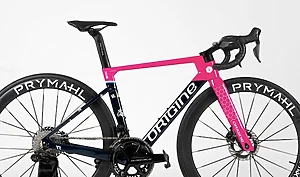
In this sense, disc braking makes it possible to streamline the cockpit of the most modern bikes, and to make them more fluid and aerodynamic. We mentioned above that the disc on the front wheel costs 2 to 4 watts at 45 km/h, but its mounting on certain bikes, while still complex, allows for watt gains elsewhere by eliminating the aero drag of the cables at the front of the bike.
Not to mention that 12mm thru-axles are much stiffer than a traditional quick-release system, which optimizes the connection between the frame and the wheels.

Discs, yes but…
Some of the most recent bikes, designed around disc braking, are therefore extremely high-performing, both in terms of rigidity and aerodynamics. These bikes feature perfectly successful integration, and will undoubtedly benefit from the advancements of a system that still needs to evolve in the near future to address its few shortcomings. However, this requires investing in very high-end bikes, the only ones currently capable of rivaling their rim-brake counterparts in terms of performance.

To date, and if we’re talking solely about braking, discs are superior to rim brakes, but not to the point of being essential for everyone and in all conditions. Because traditional calipers with good rims and good pads do the job very well, while being cheaper, lighter, easier to maintain, and not annoying anyone with rubbing noises during accelerations out of the saddle. It’s rather for all the perspectives that the system as a whole can offer that it becomes interesting. The real revolution will be when a mid-range disc bike proves to be as light and dynamic as its rim-brake counterpart.
-> SEE ALSO: All our Gear articles
Share the post "Disc braking for road bikes: an update for 2019"