Share the post "12 or 13 speeds: an update on new drivetrains"
Things are moving in the world of drivetrains, with Campagnolo and Sram adding a twelfth cog to the cassette, and Rotor going as far as 13! But if for the Italian brand the extra cog is an opportunity to fill a gap in the current gear range, Sram and Rotor see it more as a way to rethink the concept with their drivetrain. Let’s see what the advantages and disadvantages of switching to 12 or 13 speeds might be.
By Guillaume Judas – Photos: Campagnolo / Sram / Rotor / Shimano / 3bikes / DR
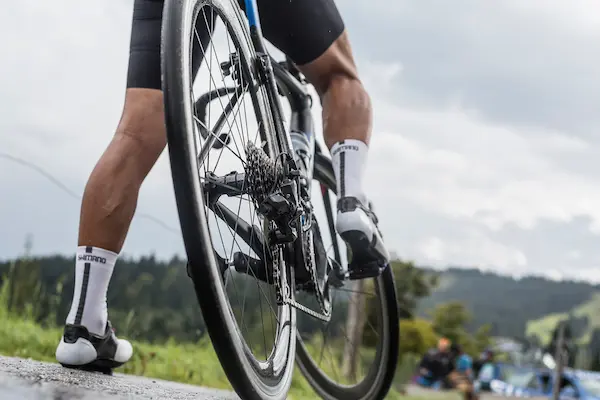
For 25 years, Campagnolo has been the pioneer in the field of the extra cog. With 8, 9, 10, 11, and now 12-speed cassettes, the Italian brand has always been the first to innovate, at least in the road bike sector. To kick things off, so to speak, because Shimano and Sram, since the mid-2000s (before that, the American brand was only present in MTB), have been forced to follow. And each time, Campa started by dispelling concerns related to the usefulness of an extra cog, particularly in terms of reliability and durability. Gear changes have always been faster thanks to the reduced spacing between cogs, whether with mechanical (cable) or electronic derailleurs. Today, this twelfth cog, introduced a year ago and now optimized with EPS electronic drivetrains, allows the Italian brand to offer only two different cassettes (11-29 and 11-32), with the three most classic chainring combinations (53-39, 52-36, and 50-34), while filling a significant gap in the usual gear range, between the 15-tooth and 17-tooth cogs.
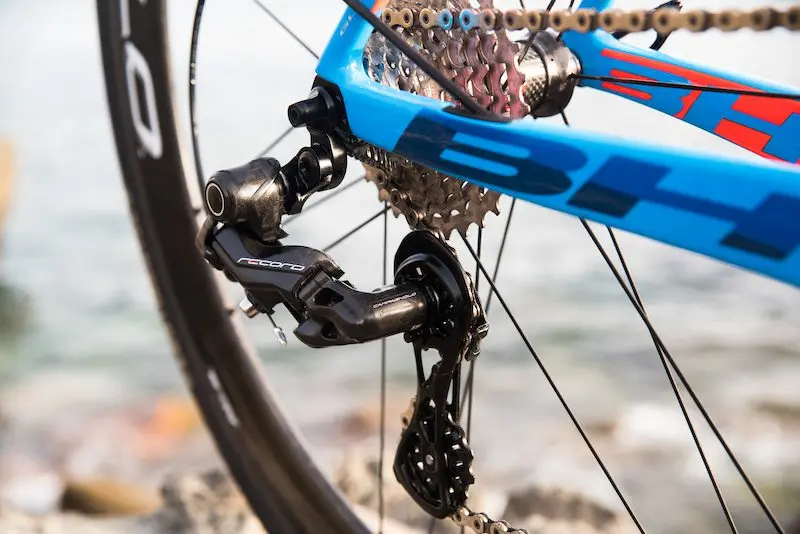
Thanks to 12 speeds, Campagnolo offers cassettes where the first seven cogs follow tooth by tooth. It is indeed on the smallest cogs that each gear change is most sensitive in terms of gearing, and therefore in terms of changes in pedaling cadence.
| A break in pedaling cadenceWith 11 speeds and a cassette with a high gear range, the 16-tooth cog is often the first to be omitted from manufacturers’ ranges. However, this means going from a ratio of 3.53 with 53/15 to a ratio of 3.11 with 53/17, a difference of 11%. Higher up on the cassette, a jump between 39/23 and 39/25 only produces a difference of 7%. This shows that the larger the cog, the smaller the gear ratio difference between cogs, and the same applies to smaller chainrings. The famous 11-28 cassette mounted on most production bikes, Shimano offers the following cog sequence: 11-12-13-14-15-17-19-21-23-25-28 The absence of a 16-tooth cog creates a “hole” in the most used zone on flat terrain. For example, with a 53-tooth large chainring, riding at 38 km/h, a cadence of 85 rpm is needed with the 15-tooth cog, and 96 rpm with the 17-tooth, whereas 91 rpm would suffice with the 16-tooth. These are significant differences that are difficult to manage during effort. While the gear ratio difference is less significant between the largest cogs, the most extreme cassettes (e.g., 11-32 or 11-34) necessarily have even earlier gaps in the cog series, where the differences are most significant. With an 11-12-13-14-16 sequence, the 11-32 cassette is even more harsh. As for the 11-34 and its 11-13-15 sequence, it is completely unsuitable for sporting use. A twelfth cog can therefore primarily serve to fill one of these gaps. |
Ultimately, the Campagnolo 12-speed drivetrain offers 15 different gear combinations, using both chainrings and avoiding overlapping gears, whereas an 11-speed drivetrain offers only 14 in the best case.
Sram reinvents the gear range
Sram goes even further by offering its new Red eTap AXS 12-speed drivetrain, with smaller cogs and chainrings. The advantage is twofold: increasing the gear range (difference between the smallest and largest gear), while maintaining a minimum difference between the teeth of the cassette. The concept is based on three chainring combinations (50-37, 48-35, 46-33) each with only a 13-tooth difference, and three cassettes (10-26, 10-28, 10-33), the first two of which have the first eight cogs following each other.
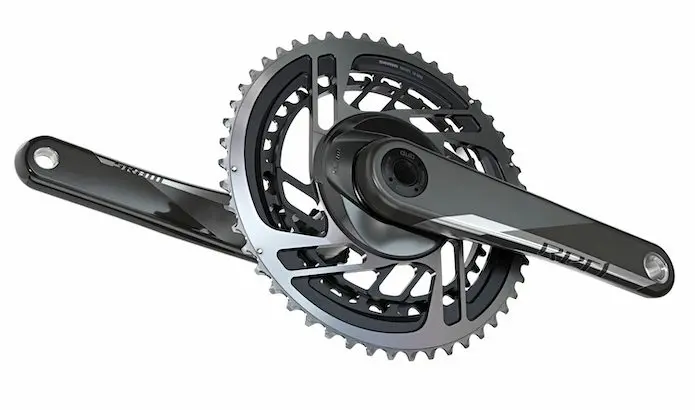
If we take, for example, 48-35 and 10-28 – an ideal combination for a sportive rider – we end up with more different gears available (15 vs 14) than the classic 52-36 and 11-28 11-speed, and larger and smaller extreme gears, and even a slightly larger gear range than that offered by Campagnolo.
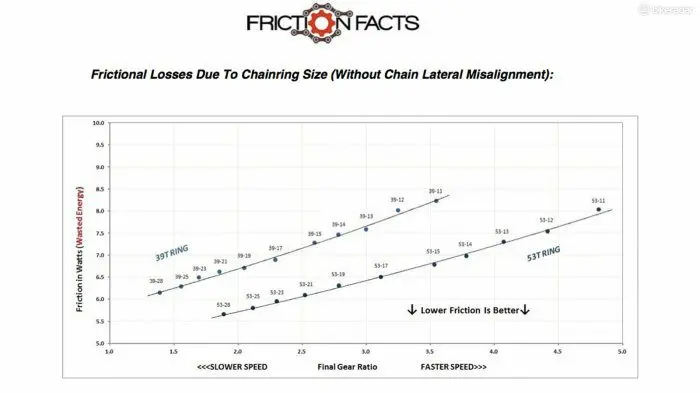
Legitimate questions remain regarding the mechanical efficiency of the smallest cogs. Indeed, the Friction Facts website published a study in 2015 that showed the superiority of large chainring – large cog combinations compared to small chainring – small cog combinations, in terms of friction and at equal gearing. Of course, this plays out at less than 3 watts between the two extremes, and this benefit can be negated with excessive cross-chaining.
-> SEE ALSO : Why you should avoid cross-chaining
But given the already significant difference between an 11-tooth and a 12-tooth, it is highly likely that the 10-tooth does not offer the best efficiency. So let’s wait and see what happens with the new Sram chain for the Red eTap AXS group. Note also that a cassette with a 10-tooth cog requires a special freehub body, which is not the case for the Campagnolo drivetrain.
| A simple way to compare gear ratiosRather than looking for a gear ratio correspondence table that takes into account wheel and tire size, simply establish a ratio between the number of teeth on the chainring and that on the cog. This allows you to compare gear ratios with each other, with the same bike or the same wheel. Thus, Sram’s 50/10 (ratio of 5) is comparable to a 55/11 of a drivetrain starting with 11, and therefore larger than a 53/11 (ratio of 4.81). At the other end of the cassette, Sram’s 37/26 (ratio of 1.42) is smaller than a 39/27 (ratio of 1.44). And in all cases, an identical number of teeth on the chainring and cassette always gives a ratio of 1 (34/34, 36/36 or 42/42 for example), thus an equivalent gear. |
The case of the single chainring
This increase in the number of cassette cogs and the number of truly available different gears allows for pushing the evolution even further, by potentially removing a chainring from the crankset, similar to what is now done in MTB, cyclocross, or gravel. Gear changes are thus easier to manage, with also an optimized chainline (the single chainring being recentered relative to the entire cassette). This saves weight, improves aerodynamics, and simplifies maintenance.
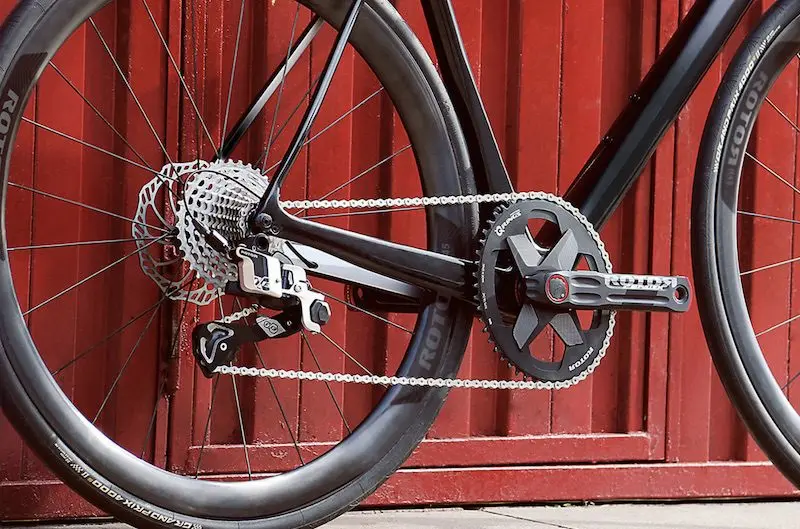
This is a concept championed by Sram with the 12 speeds of the Red eTap AXS group (optional as a single chainring, for example, for time trial bikes), or by Rotor, which is launching a 13-speed group, but with a single chainring. The group is announced as the lightest on the market, at less than 1800g. It offers four cassette choices (10-36, 10-39, 10-42, and 10-52) and a chainring choice from 38 to 54 teeth. With a 50-tooth chainring and a 10-36 cassette, you end up with extremes equivalent to 55/11 and 39/28, and thus 13 different gears (instead of 14 in 11-speed double, and 15 in 12-speed double).
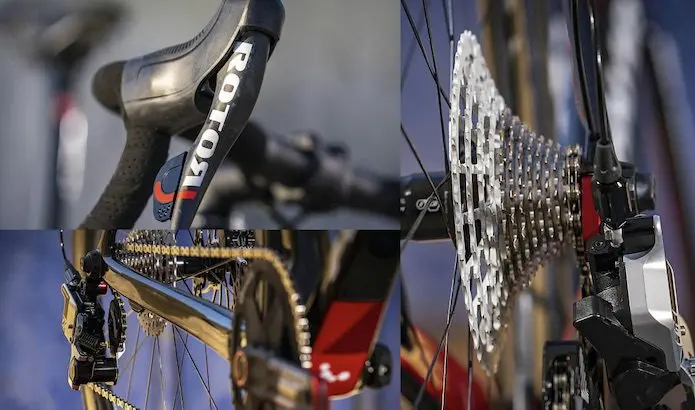
Here, however, you lose out in terms of progression, with only the first six cogs of the cassette following tooth by tooth. It also remains to be seen how the group manages the risk of chain drops, with the absence of a front derailleur as a safety measure on roads with poor surfaces.
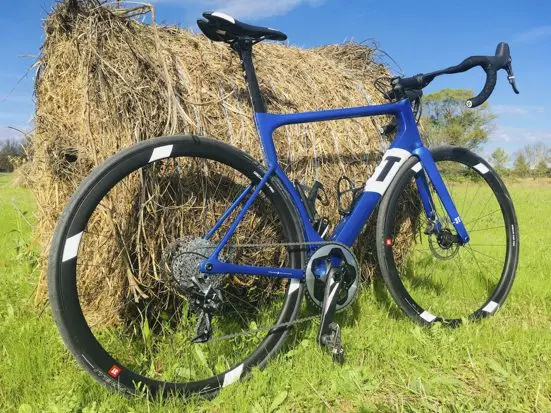
We know that in 2018, the pro team Aqua Blue gambled at the start of the season with the famous 3T Strada bike, and its Sram Force 1x single chainring drivetrain. A concept defended by Gerard Vroomen, the bike’s inventor, for its simplicity and aerodynamics. In practice, however, the riders quickly reached the limits of the system in competition, with too significant gaps between the teeth, as some of them revealed in the press. But there were only 11 speeds then. We are now at 12, or even 13.
-> SEE ALSO : 3T Strada Pro Disc Review
What you need to know before switching to 12 or 13 speeds
In all cases, the additional cog(s) on the cassette imply a complete drivetrain change, including cassette, chain, derailleurs, shifters, and crankset. Logical so far. Campagnolo allows a 12-speed cassette to be adapted to an 11-speed freehub body, as it uses the same spacing. It is therefore possible to keep the same wheels, if they have a Campagnolo ED freehub body. For Sram Red eTap AXS, the 10-tooth smallest cog requires the installation of a specific XDR freehub body, available as an option from many wheel brands. Here again, it is therefore possible to use current wheels, but only with this modification. Rotor offers a two-step change of universe. Indeed, the brand is launching a 12-speed cassette starting with 11 teeth, to be used on current Shimano/Sram 11-speed freehub bodies, but with the 1×13 drivetrain, which then becomes a 1×12. To truly benefit from the 13-speed cassette, you then need to switch to a specific hub or wheels, but always with the same chain. While waiting for Shimano’s reaction, you haven’t heard the last of 12 or 13 speeds, which we will soon be testing on 3bikes.fr.
-> SEE ALSO : All our GEAR articles
See all our articlesAdviceShare the post "12 or 13 speeds: an update on new drivetrains"