Share the post "Shimano S-Phyre new shoes review"
By Guillaume Judas – Photos: 3bikes.fr
For more than 25 years, since the launch of SPD pedals, Shimano has not only offered some of the most popular and widely distributed drivetrain groups in the world, but its shoes have also become a benchmark in the Japanese brand’s range. At the top of the Shimano catalog now sits the S-Phyre, whose 2019 version, code-named RC901, benefits from subtle evolutions compared to the RC9 released two years ago. S-Phyre is a comprehensive concept at Shimano, which takes into account various key performance elements: power transfer, aerodynamics, and freedom of movement, and which is found on other high-end accessories such as clothing or eyewear. Beyond a simple marketing concept, the approach is consistent with the principle of drivetrain groups, whose components are designed to work together and provide the best possible performance. S-Phyre in the equipment domain is therefore on the same level as Dura-Ace for braking or transmission.
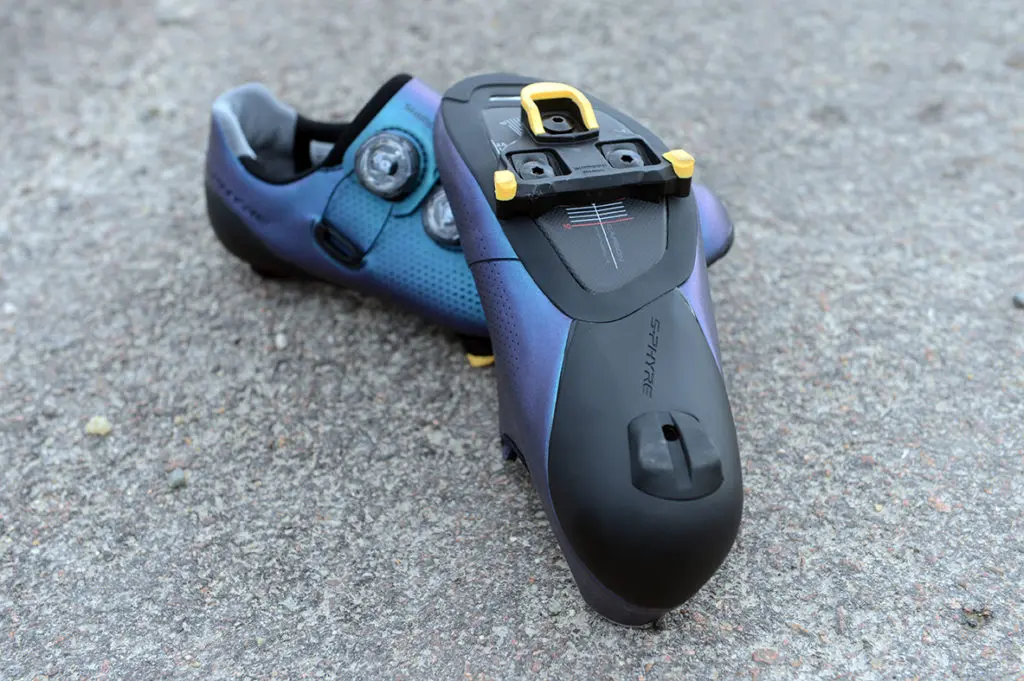
Note, however, that for the same price as the previous version, the RC901s no longer come with the dedicated pair of socks previously supplied with the shoes. These socks were supposed to provide ventilation and foot support in line with that of the shoes. It is likely that the system was not fully understood by customers. A shame, because we loved those socks!
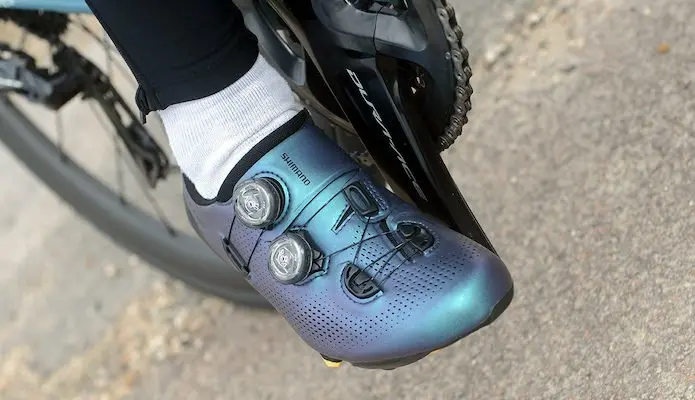
As you may have gathered, as existing users of Shimano S-Phyre shoes, we can therefore compare the new model with the old one quite precisely. For the occasion, we were able to benefit from a limited edition Aurora pair, whose upper, with its blue, green, and purple reflections, changes shade when light reflects on the shoes. Only 700 pairs are available in Europe, 60 in France, and only in three stores:
- Cycles Darnois (92, Bourg-la-Reine)
- Jolly Cycles (31, la Salvetat-Saint-Gilles)
- Roland Vélo (85, Chantonnay)
More traditional Shimano colors are, of course, available in unlimited quantities: white, black, blue, and fluorescent yellow, in sizes 36 to 48, with half sizes from 37 to 47. A wide model is also available.
What hasn’t changed
With the S-Phyre, Shimano has introduced several elements designed to optimize performance and comfort. First, the carbon outsole, with a stiffness index of 12/12 on the Shimano scale. It is difficult to objectively compare it with other high-end shoes, as the sensation of stiffness or efficiency also depends on other factors such as overall foot support during pedaling. But let’s say that if the soles of Specialized S-Works 7 or Bont in general seem to us to be the stiffest on the market, those of Shimano come directly behind. The RC901s therefore use the same soles as the first S-Phyre.
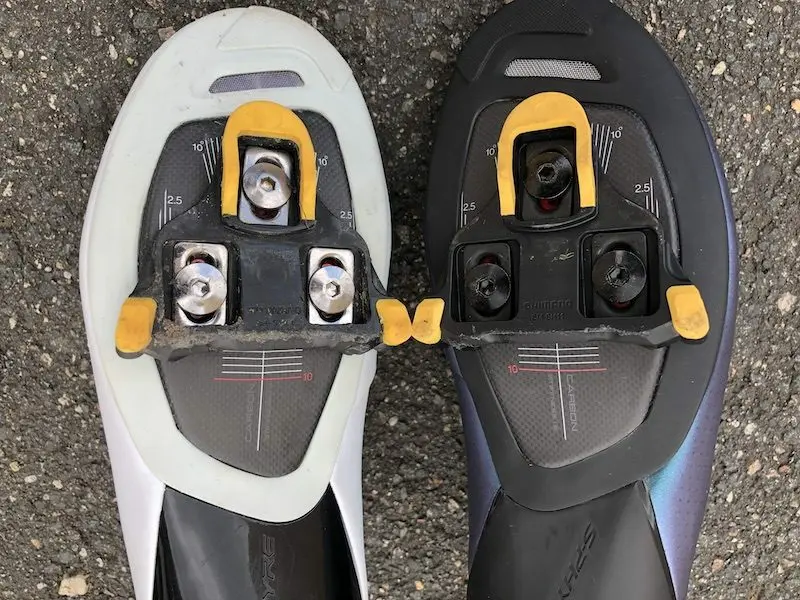
They benefit from a fairly wide cleat adjustment range, to accommodate all specific needs in this area. The graduation under the sole is appreciated when replacing a cleat or if you, like us, have two pairs of shoes; it is much more precise in any case than some competing models. The cleat positioning platform is wide enough to prevent the cleat from being cantilevered, as is too often the case on shoes that are both narrow and small in size.
The shoe’s upper is directly attached to the carbon sole, thanks to the absence of a midsole, which has the effect of reducing the distance between the foot and the pedal axle. The benefits in terms of efficiency of a foot closer to the pedal are not scientifically proven, but the benefit is certain in terms of stability.
The benefits in terms of efficiency of a foot closer to the pedal are not scientifically proven, but the benefit is certain in terms of stability.
The heel pad is replaceable. At the front, only a slight, very useful protection in case the shoe rubs against the front wheel replaces the traditional “toe protector.” At the front of the outsole, a small opening also promotes ventilation.
Tightening is still ensured by two independent Boa IP1 dials. The dials can be adjusted click by click in both directions, and simply pulling on the dial completely releases the tension.
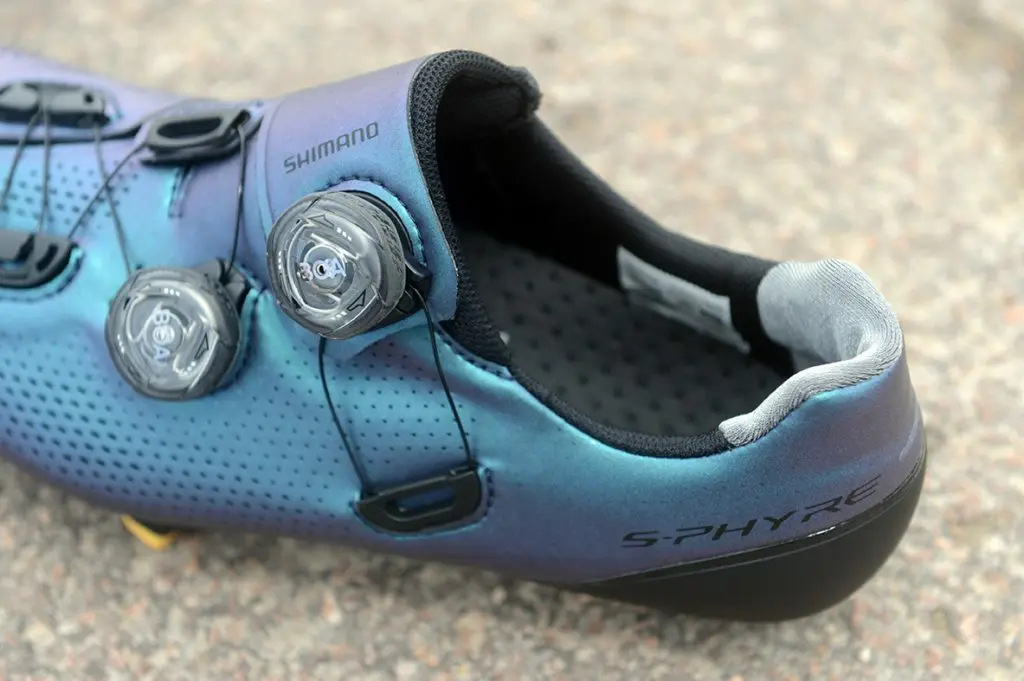
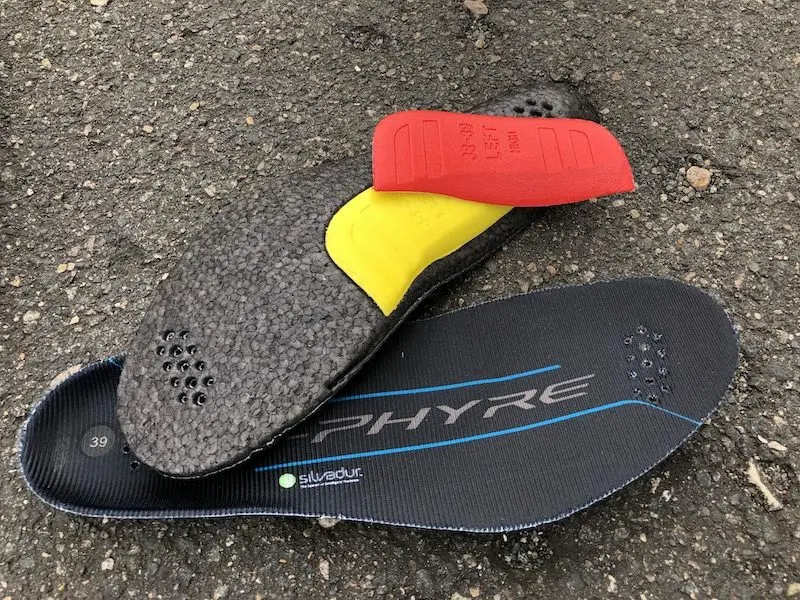
Finally, the insole is still customizable, with a choice of three arch support shapes. The shoes come with two types of reinforcements (medium and strong) that can be changed or removed with a simple Velcro.
What has evolved
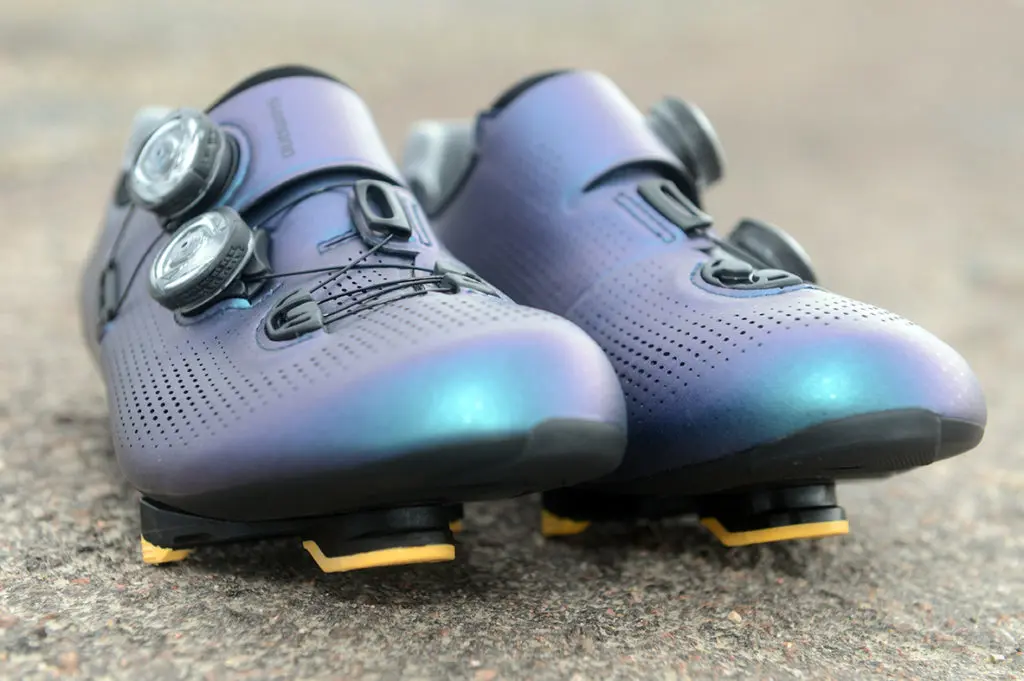
The one-piece upper, made of soft synthetic leather (Tejin Avail), still wraps around the foot when tightened, with a part located on the outside of the foot gradually sliding under the inner part. The traditional tongue is thus a distant memory, as are the risks of creases likely to create ridges, which are very uncomfortable and cause circulatory problems when the shoe is tightly fastened. This upper now benefits from more small holes for ventilation and moisture wicking. However, the additional holes on the tightening flap have been abandoned, which is not without consequences for the firmness of the support, as we will see later.
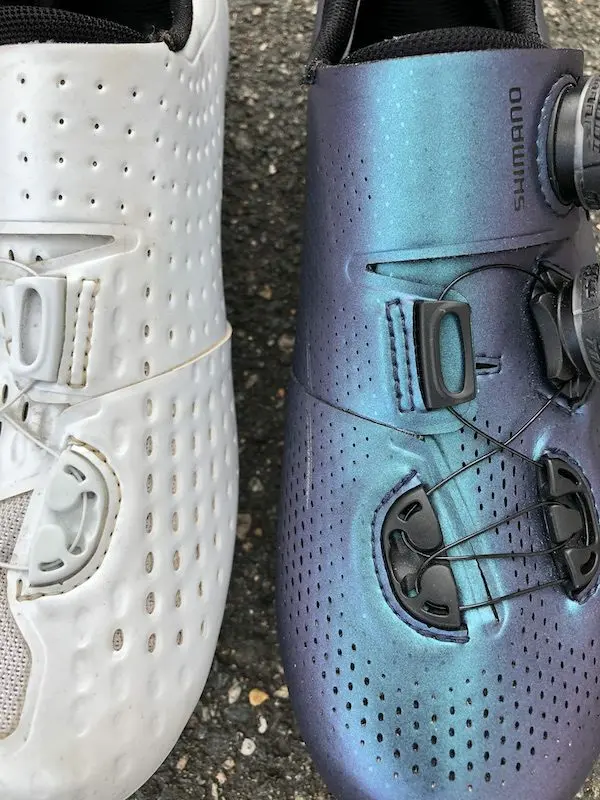
However, the biggest change is due to the abandonment of the mesh front part, which had two drawbacks: first, this part tended to deform slightly when tightened, sometimes creating a crease, and second, it was difficult to maintain.
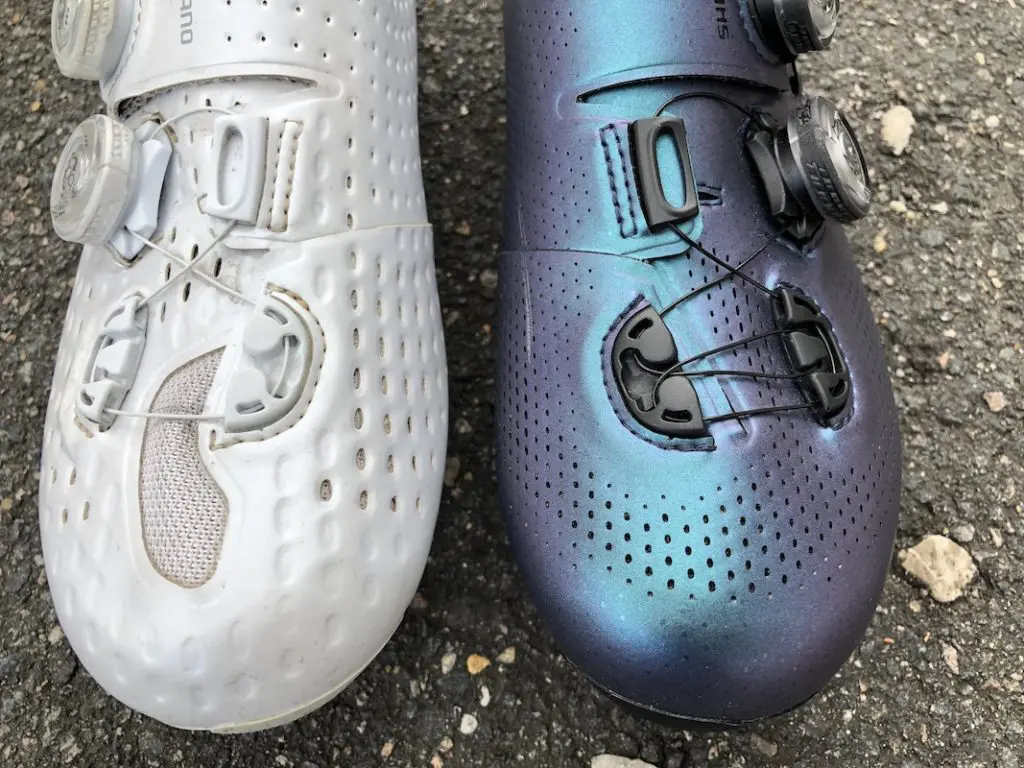
The routing of the Boa cable at the front, while not different, offers even more progressive tightening thanks to the abandonment of the mesh part and its replacement by a firmer upper. And without the cables pressing on sensitive parts of the foot. We also note the abandonment of the “golf ball” type surface at the toe, without knowing if there is a real influence on air penetration.
The outer part of the heel still forms a kind of shell, which offers firm support without being totally inflexible, allowing it to adapt to the contours of the heel. It seems less pinched on the new model than on the old one, normally with the aim of adapting to more different foot shapes. Inside, the anti-slip part that prevents the foot from sliding and ensures a good feeling of support seems to us to be slightly wider.
While the shoes look very similar, the part dedicated to foot entry seems to us to be slightly narrower. The Boa closure attachment points are in the same place, and the flap is the same size on both models.
Differences on the road
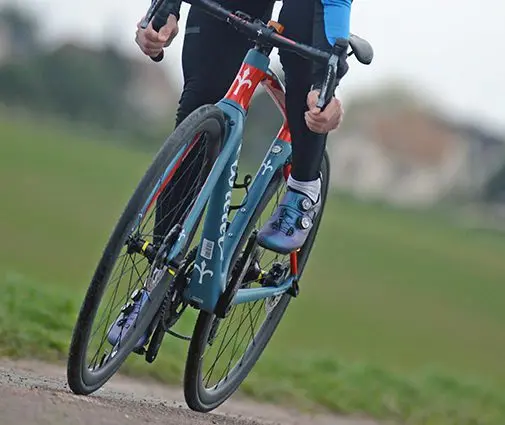
The new S-Phyre have minimal internal seams and almost no excess thickness, like the first model. The feel, however, is slightly firmer in the last shape, with the foot seeming better held than in the RC9s. Of course, our first model has several thousand kilometers on the clock (nearly 17,000 km), but according to our memories, it was already a little softer at the start. Let’s say the main difference comes from the fact that with the new version, it’s possible to ride with the Boa dials barely tightened, whereas our feet float a lot in the same conditions with the old ones. The absence of a rim on the sides seemingly leaves the foot without lateral support, whereas this is much less the case here.
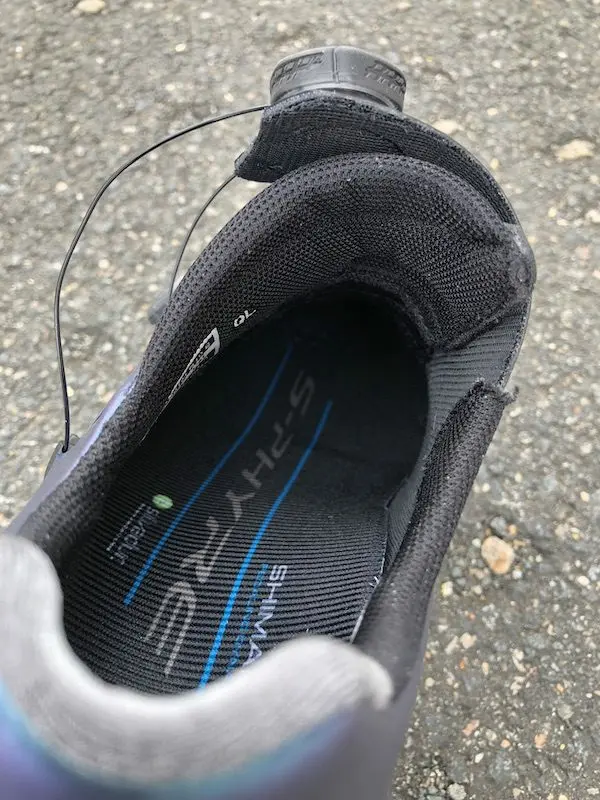
The foot is firmly held by precisely adjusting only the upper Boa dial. In our opinion, the flap here is stiffer, less prone to slight deformation or stretching, thanks to the absence of holes in this part. On the front part, there’s no need to overtighten despite our narrow foot, as the “closed” upper and the cable routing are sufficient to ensure very good support.
But above all, you can tighten the new S-Phyre very firmly if you feel the need, despite our narrow feet, and without quickly experiencing numbness, which is detrimental to comfort and endurance. The grip is progressive and affects the entire foot, which gradually becomes more and more supported.
The soles show no flex and you really feel like you’re pushing directly on the pedals, with excellent stability. The very thin upper does not retain moisture. In cool conditions, the millimeter-precise adjustment and numerous ventilation holes allow cool air to pass through, while leaving little room for thick socks. But while we already know they are not the warmest shoes for winter, we have not yet been able to test them in very hot conditions.
The soles show no flex and you really feel like you’re pushing directly on the pedals
Very stiff, lightweight (232 g in size 39, verified weight, 8 g more than the RC9), stable when pedaling and very effective in tightening, the RC901s add a bit of firmness and, paradoxically, a bit of comfort to the previous model. This is because the slightly stiffer upper, by design, while continuing to conform to the contours of the foot, primarily prevents any creases that could form when tightening firmly. For this, however, it is necessary to choose the right size, among the many available models. On the other hand, while this limited edition Aurora color is the same price as the other available colors, there won’t be enough for everyone.
| SHIMANO S-PHYRE RC901 |
| Pros: closed, crease-free upper, closure system, stiffness, comfort Cons: price Design: carbon sole (stiffness index 12/12), upper directly linked to the carbon sole, enveloping heel and toe reinforcement, two independent Boa IP1 closures for micro-adjustment, soft Teijin Avail microfiber synthetic leather, perforations for drainage or ventilation, enveloping cup insoles with arch supports, with Silvadur™ technology, extended cleat adjustment range of 11 mm. 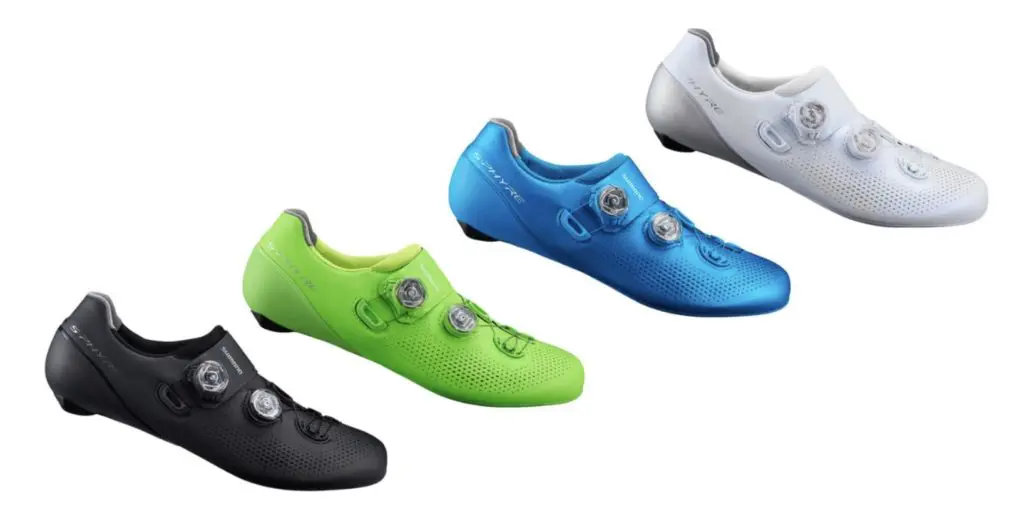
Retail price: €349.99 |
| Contact: rideshimano.com |
-> SEE ALSO: All our Gear articles
ADRIS SPEEDLINE 9.5
Share the post "Shimano S-Phyre new shoes review"