Share the post "ADRIS Speedline 9.5 Review"
By Pierre-Maxime BRANCHE – Photos: 3bikes.fr

I had some really good times riding and pushing this Speedline 9.5, energized by the speed and efficiency of a stiff and, to some extent, responsive frame despite its weight. I also had some less good times on its handlebars, jostled and shaken by the same unforgiving frame on damaged roads, but above all, bewildered and stunned by the lack of bite from the brake calipers in various more or less urgent situations. This is the story of a test during which, on every ride, I wondered if I was stepping out of my comfort zone or if I was taking my Speedline out of its own.
Adrisport becomes Adris and joins a distribution network
In 2019, for anyone involved in cycling, cyclocross, and triathlon, Adrisport needs no introduction. It would be an offense to Adrien and Romain Duault, these two dynamic Breton brothers who launched their brand in 2009. Ten years later, it’s no longer Adrisport, but now Adris (pronounced “Adreess”). Make no mistake, there’s a huge difference: while Adrisport specialized in direct sales, like the giant Canyon, Adris is now integrating a traditional in-store distribution network this year to boost its development. If you’re in the Greater West, Normandy, the North, the Paris region, Loiret, and Dordogne, you’ll have the opportunity to discover a completely renewed 2019 range. For others, you’ll have to wait a bit.

5 sizes and 5 builds
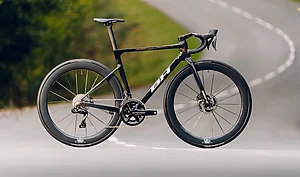
At the heart of this new range is the Speedline, the model oriented towards long-distance triathlon. Specially developed to integrate everything on the bike, it is equipped with a hydration system at the front of the handlebars, a NutriBox on the top tube, and a ToolBox at the rear of the seat tube, all three accessories being removable. This monocoque (over)curved frame, with impressive tubes, weighs 1,150 g in size M. It is made of Toray T800 Ultra High Modulus carbon fibers, either entirely or in part, we do not have the information.

It also features an Aeroline cockpit with a Speedline stem and seatpost that offer multiple adjustments to find the right position, and TRP brakes, all for 1,150 g in size M and priced at €2,690 for the frameset. Available in five sizes, it is offered in five builds from €2,990 (9.2, Shimano 105) to €6,990 (9.9 LX, Shimano Dura-Ace Di2 9150) and in two diametrically different colors: a very striking Red Vision and a softer, classier White Soft. Our test bike is the 9.5 equipped with Shimano Ultegra Di2 in the Red Vision version.

Well-built and ready to ride
There’s no secret about the frame’s origin: Adris buys frames manufactured in Asia, then assembles and decorates them to their liking. “It’s not our own development, but it’s not a generic one that everyone can get either. For this model, we work with a professional partner in China; it was chosen according to our criteria and in correlation with our expectations in terms of sizes, carbon type, and accessories,” explains Adrien Duault, in charge of design, range innovations, assembly, and adjustments at Adris. It’s true that this takes away some of the magic for the most passionate and keen enthusiasts, but the Asian continent is the carbon Eldorado for bicycles. That’s where most brands, no matter how reputable, “make it happen.” Adris’s benefit is receiving a clean, well-assembled, ready-to-ride bike and being able to offer a three-year warranty on frames and forks, and a one-year warranty on parts and accessories. The warranty is extendable by two years if the bike is registered online on the brand’s website.

An interesting build
In detail, and as its name suggests, the Speedline is designed to ride fast and straight to cover long distances at high speed. The tube sections of the front triangle are all very substantial, except for the flattened center of the top tube. Each joint is reinforced by large carbon fairings.

The fork legs are like the frame: wide and straight. The upper part of the fork integrates the front TRP caliper, the hydration system, and wraps around the front of the head tube. With the solid Speedline stem, the NutriBox, and the Aeroline TT handlebar extensions, the front of the bike is very dense and heavy, especially when the front “bottle” is full. That said, the goal is to cover distance, not to attack the Mur de Huy, so this density isn’t much of a hindrance. Further back, the profiled chainstays and seatstays also feature large sections, but what’s most impressive is the millimeter-perfect integration of the rear wheel into the seat tube. Not even a pebble would fit through!
All Adris products are UCI approved for cycling events
The flattened seatpost, which is tightened via an integrated pad positioned on top of the top tube, and its saddle clamp offer a wide range for adjusting saddle setback to advance your aerodynamic time trial position (all Adris products are UCI approved for cycling events) but especially for triathlon.

In terms of equipment, it offers the Shimano Ultegra Di2 drivetrain with its Synchro Shift system, 52-36 chainrings, and an 11-speed 11-28 cassette. It also features a fi’zi:k Arione R1 saddle, TRP brakes integrated into the fork at the front and positioned under the chainstays at the rear, and Newwave Ultra carbon wheels (60 mm front and 80 mm rear) with ceramic bearings weighing 1,610 g per pair (for €1,690 retail), equipped with Vittoria Corsa 320 TPI tires in 25 mm width. I admit my confusion and difficulty in reading the name of this wheel brand during bike assembly. No wonder: it’s actually a new accessory brand “created” by Adris.

An accessible bike
On paper, the Speedline 9.5 is hard to criticize, even if, at this price, one might be entitled to demand a more reputable wheelset than these Newwave. But after 500 km in the Cannes hinterland, the Estérel Massif, and on the Ironman Nice course, doubts about these wheels are dispelled, and the Speedline proves to be quite easy to ride. The first few rides require some precise adjustments to the forearm position to find the right angles, but once that’s done, speed increases quite quickly without forcing, on the flats as well as on rolling climbs.

The Speedline is accessible and doesn’t demand too much energy to launch and maintain high speed. It’s honestly not truly helped by the wheels; they could be more generous allies in terms of watts, but they don’t hinder it and will satisfy many good-level triathletes. On steeper climbs, they don’t weigh down the bike, which remains relatively easy to ride despite its 8.6 kg weight in size M. The whole setup doesn’t fall apart when you put a bit more power into it. Speaking of size, be careful to study the frame geometry thoroughly before purchasing and ask for advice. Although I’m usually accustomed to sizes 56-58 and decided to take a size L for the test, Adris ultimately guided me towards an M, which proved perfect for finding my position, perfectly aligning my measurements, and making me feel very comfortable.

Practical boxes
While it’s accessible on good roads, the Speedline is still very harsh as soon as the road surface deteriorates. The frame’s stiffness, which is appreciated on many rolling sections and undulating parts, is felt in the lower back, back, and neck as soon as you encounter a less smooth surface. The front of the bike hits quite hard, transmitting strong jolts to the shoulders and neck. These shocks are also a problem for the front “water bottle”: the rubber of the top cap is cross-cut to facilitate refilling during the race, causing it to lose precious liquid with every major bump on the road. During my first ride, after 25 km, I had already lost half of the content. Water splashes onto the thighs and crotch; if the weather is rather cold, it’s not the most pleasant, and above all, there’s no question of putting energy drink in it, otherwise you’ll quickly find yourself sticky and gooey. One last anecdote about this front hydration pouch: I had the (unpleasant) surprise, despite it being properly clipped in, to see it jump off, fall to the ground, and empty itself when I hit a wide construction groove a bit too hard, but without exaggeration. No more water!


Speaking of boxes, the other two are very practical: the Nutribox, on the top tube, allows you to carry a good amount of solid fuel; I was able to fit an almond paste bar, a classic cereal bar, a few Sporténine tablets, and a fast-acting carbohydrate gel. Knowing that for a long-distance race you can tape food to the top tube or slip it under your bib shorts (or into your jersey pockets if you put one on during transition), the volume of this Nutribox is sufficient, whether you’re doing an Ironman or even more so a 70.3; for its part, the ToolBox is also well thought out since I was able to fit a multi-tool, an inner tube, three tire levers, and a valve extender. And there was still room.


Gearing for energy saving
Every ride is a pleasure. The Speedline is a good road companion. On a 4h15 training ride, 120 km on the bike computer and nearly 2,000 m of positive elevation gain with a smoothed effort of medium intensity, I didn’t feel broken upon arrival, but rather eager to go for a short transition run. The Ultegra Di2 transmission is always a delight in terms of fluidity and speed of gear changes, the synchro shift system is interesting if properly adjusted beforehand and allows you to always maintain the right pedaling torque whether you drop to the small chainring or shift to the large one.

The range of gears offered, 52-36 at the front and 11-28 at the rear, is ideal for absorbing changes in gradient and maintaining flexibility. With 36-28, you have a gear that prevents you from getting stuck in a low cadence on difficult sections, which is important for energy saving over long distances. A stiff bike like this without this gear range would lead to major difficulties. Note the dual controls on the brake levers and at the end of the extensions, which allow you to adapt the gearing while maintaining your aerodynamic position.

Significant wind resistance
Riding this Speedline, however, requires attention, not to say experience. The wind resistance is very significant, especially with the integrated front hydration system and the rear ToolBox, which add even more surface area to an already voluminous triathlon frame.
With crosswinds and three-quarter headwinds (less tailwind), you quickly get caught by gusts and deviate from your trajectory. This is noticeable on the flats when on the extensions, but also with hands on the handlebars on technical descents with a series of curves and thus varying wind directions. Despite my build of 183 cm, 75 kg, and a position faithful to my habits, I felt on the verge of losing control when approaching certain tight hairpins, to the point of wondering if the Mistral wind wouldn’t win out and make me crash.

Absent rear braking
This discomfort was reinforced by faulty braking. The reasons can be multiple: riding conditions, of course, but especially the rim’s braking surface, the type of pad compound chosen, and the caliper placement. On this type of bike, the desire to prioritize aerodynamics is understandable, its purpose being to get you fast and far. But on this test, the impression of not having a braking system worthy of the name was constant, as soon as it was necessary to navigate in the city to get out of traffic, with the hazards everyone knows, or on the more or less steep descents of the Nice hinterland.
TRP, a Chinese braking component specialist, has proven itself for several years. Should we then point to the quality of these Ashima pads, which are nevertheless Shimano compatible and designed for carbon rim braking, the quality of the braking surface of these Newwave Ultra, or the positioning under the chainstays, with studies on the subject showing that the force of the rear wheel is greater at this point than at the top? I personally lean towards this last solution, but the combination of this rim and these pads does not inspire confidence in its effectiveness.

On the road, while I noticed a lack of bite at the front, I felt there was almost no bite at the rear. Not very reassuring on a descent at 60 km/h, even without taking risks. If you add gusts of wind, a slight lack of lucidity due to fatigue, and impatient motorists behind you, despite experience, these moments are not at all pleasant. This flaw requires a lot of anticipation of trajectories, your speed, and road hazards, even more than usual.

Ideal for 70.3 format
This is truly the major drawback of this test, which is, admittedly, less bothersome on coastal roads, for example. Some will tell you that this type of bike isn’t made for braking. And others, that in Hawaii, at the Ironman World Championship, there’s only one brake application needed over 180 km at the turnaround point. So be it. Except that the lives of most triathletes don’t revolve around Hawaii, and it’s disturbing to think that the braking isn’t at the expected safety level on all types of terrain. And this is especially true since carbon rim braking is a high-performance technology from other manufacturers! In certain usage contexts, the Speedline 9.5 therefore seems to be well out of its comfort zone.
If you are considering an event with fast and technical descents, this is a point you will need to pay particular attention to. And if this problem is resolved, the Speedline 9.5 remains a great ally to accompany you on the triple effort, whatever your level. It makes you want to devour the road, spin your legs, and pick up speed in an aerodynamic position. It is perfect for short courses up to the Ironman 70.3 format or long distance, to be seen on Ironman or XXL format depending on your level and physical capabilities in terms of core strength and flexibility. Because whatever the bike, it is never insignificant to spend several hours on machines of this caliber.

| ADRIS SPEEDLINE 9.5 |
| * THE + : accessibility, drivetrain, cockpit adjustments, NutriBox, ToolBox FRAME : Speedline Carbon Toray T800 UHM
PRICE : 5,290 € |

| CONTACT : https://www.adrisport-bike.com |
=> SEE ALSO : All our Gear articles

Share the post "ADRIS Speedline 9.5 Review"