Share the post "Focus on the so-called Gimenez workout"
By Guillaume Judas – Photos: DT Swiss / Mavic / Shimano / 3bikes.fr / Flickr / DR
The Gimenez is the name of a specific training session that consists of chaining four minutes at 70% of your capacity with one minute at 100% of your MAP – Maximal Aerobic Power – and doing this nine times in a row without recovery. Let’s be clear, it’s almost torture! It’s an extremely demanding session, popularized in the late 90s and early 2000s by Frédéric Grappe, the coach of the Française des Jeux team, and also adopted by many certified coaches. It’s a model found in other sports, such as running or cross-country skiing, which, like cycling, require very high levels of high-intensity endurance.
This session, or rather a series of this type of session, aims to raise the MAP level, in addition to raising the power level at FTP (critical power that can be sustained for one hour) and preparing for changes in pace before competition. The idea is, of course, to improve or maintain fitness levels. The advantage is that the results are significant, and above all, it can be done on an indoor trainer, all year round, in relatively short sessions. Count 15 minutes of warm-up and 15 minutes of cool-down before and after the 45 minutes of exercise, and you’re done. On an indoor trainer, the intensity is much better calibrated than on the road, with the unpredictability of traffic. Indeed, the whole point lies in respecting the intensities: if it’s not too difficult to understand and respect the nine one-minute intervals at MAP (or I5 intensity on a scale of 1 to 7), the four-minute counter-exercise at 70% (or I3 intensity) requires a lot of concentration and physical and mental resistance for the session to be beneficial. The drawback is the difficulty, both physical and mental, and the imbalance compared to the volume of base training that can occur if you repeat this type of session too often.
-> SEE ALSO: The importance of endurance
-> SEE ALSO: The different training intensities
Reminder: The Subjective Scale of Effort Intensity
|
Ideal with a power meter
Obviously, this type of session makes perfect sense when you are equipped with a power meter. First step, if you don’t know your MAP (it can be evaluated in a laboratory during a stress test): do a 5-minute test. This consists of trying to achieve the best possible performance over 5 minutes, and then noting the average power in watts over these 5 minutes. This is your MAP, an intensity that is difficult to sustain beyond 5 minutes (after which the power delivered inexorably decreases). From this MAP, you can determine your I3 intensity, which is around 65 to 75% of your MAP power. This is the Tempo intensity, which allows you to ride quite fast but for a long time, like a long breakaway, or adopted when climbing several passes. It is slightly below and more comfortable than the “threshold” pace (or I4), which is the intensity adopted during a short time trial (and which is determined by a 20-minute test). Note that the more naturally enduring or endurance-trained you are, the higher the I3 power is relative to MAP.
From these determined wattages, the exercise is relatively easy to calibrate.
In short, from these determined wattages, the exercise is relatively easy to calibrate: you start with four minutes at I3 (without exceeding the target power), you follow with one minute at I5 (again, without exceeding your MAP power, because it’s always possible and tempting for one minute, but it’s guaranteed to blow up after two or three repetitions), then you immediately resume with four minutes at I3, and so on. Up to nine repetitions in total, or 45 minutes of effort.
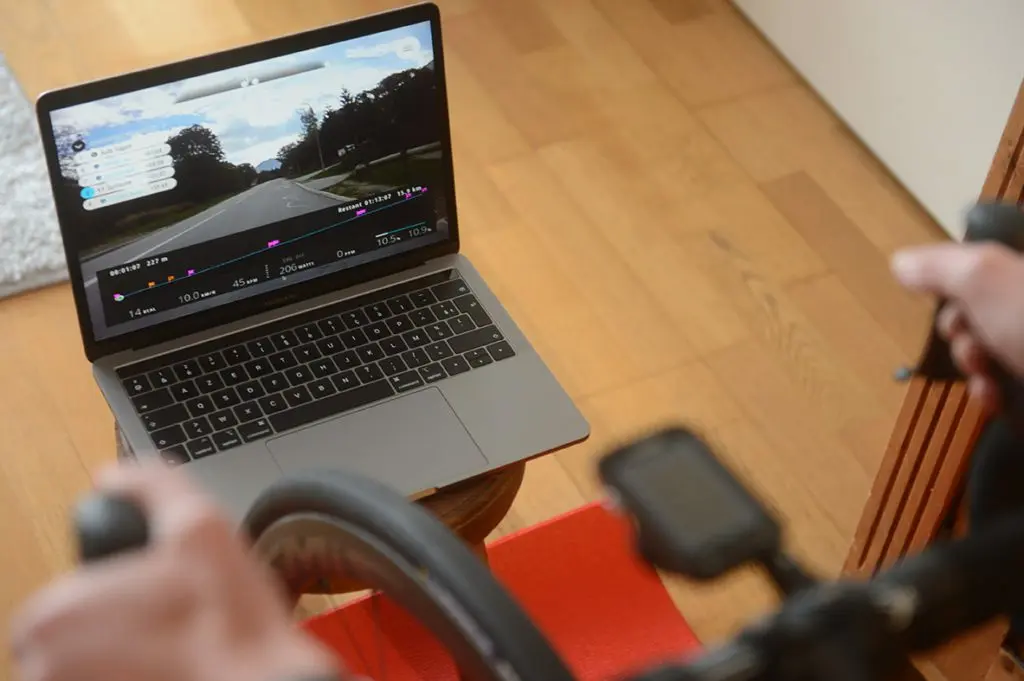
The difficulty of this type of session, when you maintain the target powers well, increases progressively, becoming very difficult at the end of the exercise. In terms of heart rate, you will notice an upward drift: not only will you reach your maximal heart rate during the last I5 repetitions, but above all, your heart rate will barely drop during the I3 counter-exercise, even if you maintain this average intensity. And this is precisely the difficulty of managing this type of session with heart rate alone, unless you know yourself perfectly. Because if you content yourself with doing this session with heart rate and respecting your theoretical zones that correspond to a heart rate, you are certain to drop very significantly in terms of power output as the session progresses. This is also why we talk about I5 and I3 intensities, because ultimately the most sensitive practitioners can also calibrate the session according to their perceived effort. If you intend to perform this type of training only on an indoor trainer for the reasons mentioned above, be careful to determine the required powers on this type of device beforehand. Indeed, the MAP on an indoor trainer is lower than that actually observed on the road, for the same perceived level of difficulty. This is because on an indoor trainer there are never the same frictions as on the road.
– SEE ALSO: Eight indoor trainer sessions
The Gimenez outdoors
Fortunately, it is possible to adapt this session to the road, to at least partially reduce the feeling of psychological difficulty, while producing similar results. The ideal way to do this is to climb a long pass with a gradient of around 6/7%. The pace to adopt at I3 is quite easy to determine if you regularly climb in the mountains. Stay seated and relatively supple during the four minutes at I3. Then, drop two gears and ride out of the saddle without sitting back down for the minute at I5, as if simulating an attack. Before resuming your supple but quite sustained pace at I3 and so on. It’s demanding, of course, but more enjoyable than on the indoor trainer. And much less mentally draining, especially if you have to repeat this type of session.
What you need to remember is that you can adapt the so-called Gimenez session according to your level or experience.
Other variations exist, for example, if you are lucky enough to be able to ride behind a derny or a scooter. For this, you need to settle into the slipstream of the vehicle at a rhythmic I3 pace, and every four minutes, move up to the height of the scooter for one minute (and thus no longer benefit from its slipstream). What you need to remember is that you can adapt the so-called Gimenez session according to your level or experience. For example, by doing only six or seven repetitions instead of nine, or by slightly extending the duration of the counter-exercise. Anything is possible, and even if the effects are theoretically less good than the original model, the important thing for progress is to advance in stages and with at least the will to do well.
| The benefit of the Gimenez session For Yoann Offredo, professional cyclist: « The Gimenez simulates race finishes, when I participate in relays at the front of the peloton to lead out a sprint. The I3 moment is the high intensity in the wheels when riding at over 50 km/h. And the I5 moment simulates the duration of my relay at the front of the peloton. I worked a lot on the Gimenez on the indoor trainer for several years. There aren’t many questions to ask. I just had to connect my SRM to the computer linked to the indoor trainer, and only look at the power curves. However, the disadvantage of the indoor trainer is excessive sweating during the session, and therefore a significant loss of mineral salts if this type of session is done too often. That’s why I also like to do this exercise behind a scooter. Ultimately, the goal is always to improve MAP power. » |
When to schedule this type of session?
You risk physical and mental fatigue if you repeat this type of session too often. A Gimenez session is primarily performed when basic physical condition is already good. Then, it should be done away from competitions, meaning after recovering from the previous race, and with enough time to recover after the session (at least 72 hours).
-> SEE ALSO: Supercompensation, recovering to progress
In addition, active recovery or pure aerobic rides should be interspersed between each session of this type. Finally, this type of exercise should only be repeated periodically throughout the year, in periods interspersed with other periods aimed at developing other qualities. Ideally, you can schedule a session of this type at the beginning of the season once a week (on Wednesday, for example) if you feel you lack rhythm, for four or five weeks. You can also place a session on the weekend if you are not racing. But no more, at the risk of achieving the opposite effect to what is expected.
– SEE ALSO: All our Coaching articles
Share the post "Focus on the so-called Gimenez workout"