Share the post "Wahoo Kickr Smart Trainer Review"
By Sylvain Pigeau. Photos: S.P and Wahoo.
No more series on the good old roller, forgotten attempts to relieve boredom during sessions (often less than an hour) that seemed endless on a noisy and bulky indoor trainer. For several seasons, the appearance of smart trainers has totally changed the vision of indoor cycling. These sessions are no longer “default” workouts, but real qualitative exercises that complement outdoor training.
For several seasons, Wahoo has been one of the manufacturers to have revolutionized this activity. And among their contracted athletes, we find, notably, Team Sky, as well as triathletes Jan Frodeno, Heather Jackson, and Lionel Sanders.
The Kickr is a very accomplished smart trainer, and the two accessories that complete it make training even more fun and comprehensive. With the Kickr Climb, it is possible to precisely reproduce the gradient displayed on the software used for the session. As for the Headwind fan, it blows air according to your speed and the effort developed.
We tested the whole setup throughout February, and it must be said that apart from all these elements in our living room, all that was missing were the cheers of the spectators on Alpe d’Huez!
The Kickr
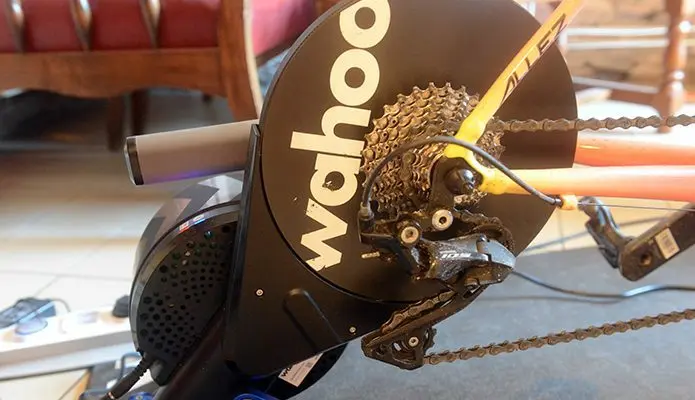
Three devices are present in the Wahoo range, with the Kickr at its top. It is, along with the Kickr Core, a wheel-on smart trainer, meaning you place your bike directly on the unit. The Kickr Snap is a “classic” indoor trainer, but still retains connected functions.
Equipped with a handle, the Kickr is very easy to transport and, added to the 5.7 kg of the rear flywheel, the total weight of the unit reaches almost 15 kilos. The unit is very stable, with its two retractable feet, and the central pivot allows the use of all bike models. This allows for height adjustment. It is then unnecessary to use a block for the front wheel. This offers a definite advantage, especially when traveling, for warming up before an event, for example. The Kickr is sufficient.
Steel and aluminum are used, which has consequences for the weight but gives an impression of significant reliability and solidity.
Still on the technical side, the system is ANT+ and Bluetooth compatible, for iOS, Android, and PC (so you can connect the Kickr to applications such as Zwift, TrainerRoad, Bkool, Rouvy, or Kinomap for example). The resistance is electromagnetic (important for what follows and especially for the noise) and the accuracy for power measurement is announced at plus or minus 2% (max 2,200 watts). The freehub body is Shimano 11-speed standard.
Let’s go!
Make room in the living room, lay out the mat, place the laptop on a chair, and the elements. But first of all, plan for a power strip with an extension cord. You will, believe it or not, have four elements to plug in. The 3 Kickrs as well as your computer (virtual training is energy-intensive).
After that, let’s go! Two options are possible, with connection to your usual ANT+ compatible training GPS or via a virtual training interface (see below). In both cases, the connection is instantaneous. The elements are recognized immediately and training can begin.
The “feel” of the pedaling is incredibly smooth. And this is due, in particular, to the electromagnetic system. There are therefore no jerks and the rendering is similar to the sensations of the road. It is possible to control the resistance via your bike computer (if you are not using the interface). From there, all exercises are possible and the rendering is exceptional. In terms of resistance, it is possible to simulate up to 20% gradient (without using the Climb).
The rendering is similar
to the sensations of the road.
In terms of power, we noted an average difference of about 3 watts with our sensor installed in the bottom bracket. This proves that the system is quite accurate in its measurements. During a virtual training session on Alpe d’Huez (BKool), the watts displayed were consistent with our current fitness level and our previous references on the road.
The stability of the whole is astonishing, even out of the saddle and in a sprint. The system is also very quiet, a real advantage for you, and the neighbors!
But we obtained the best training sensations with the use of the Climb and the Headwind. The first element faithfully reproduces the gradient that appears in your virtual training. All that’s missing is the swaying of your bike, if you get out of the saddle, to exactly transcribe what you experience on the road. The incline therefore allows you to work ideally in almost real climbing conditions, with, as a bonus, core work and mountain pedaling technique. No more phone books placed under the front wheel to simulate the bike’s incline!
Depending on your speed and the course, the fan blows the corresponding air. Forget your standing fan, here the air is powerful enough to cool you down as your temperature rises. It will not, however, add any difficulty, even if you target a virtual course at Pointe-du-Raz!
A high price
The most painful part remains. Much more than a VO2 max session or climbing the Galibier. At €1,199, just for the Kickr, the bill is steep. The complete set, if you add the mat and the desk, exceeds €2,000. But at this price, you have gym equipment, with, as with all connected indoor trainers, a much more fun vision of indoor training.
| Welcome to Zwift To test the Wahoo, we also chose to try the Zwift experience. Here, no real video (as on BKool), but fun workouts on reproductions of courses. You need to create an account on zwift.com then download the application. From then on, you can test the system for about a hundred kilometers. Everything is displayed on your screen: watts, cadence, heart rate, speed, and mileage. You then just have to choose a free course, where you can ride with other riders evolving at the same time as you, as well as scheduled races. Beyond this community aspect, Zwift also offers the construction of training plans and sessions. You can also set weekly or daily goals. The software is a complete training partner. Rides are exportable and can be published on Strava, for example. Once the trial period has expired, it is possible to purchase access cards online. For 12 months, it costs 180 euros. The system therefore allows you to evolve at your own pace in the Zwift universe since 3-month versions are also available.  |
| Rating: ***** Kickr: €1,199. Delivered with Shimano 11-28 cassette (Campagnolo 12-speed freehub body not yet available). Compatible with all wheel sizes, thru-axles, and all bikes (road, mountain, gravel): 130/135 QR, 12×142, 12×148. Floor dimensions: 51 cm x 71 cm. ANT+ and Bluetooth compatible, for iOS, Android, and PC. Carry handle. Power measurement: +/- 2%. 2200 watts maximum power. Kickr Climb: €549. Incline up to 20% uphill and 10% downhill. Manual control possible. Compatible hubs: QR, 12×100, 15×100, 15×110. Dimensions (H: 65.4 cm / W: 12.9 cm / L: 43.1 cm). Kickr Headwind: €229. Wind speeds based on acceleration or manual. Adapts to effort intensity. Four fan levels. Also available: Kickr mat at €6.99 and Kickr Desk (tall desk) at €279. Pros: Quiet, ergonomic, realistic road feel, small footprint, very stable unit, quality materials, compatibility. Cons: High price Contact: Wahoo |