Share the post "Fighting cramps"
What athlete has never experienced this debilitating phenomenon for a few minutes, even though everything seemed to be going well just moments before? Cramps are involuntary and violent muscle contractions, more or less painful and fortunately temporary, which can even force you to stop pedaling or running. Where do they come from and how to deal with them?
By Guillaume Judas – Photos: Brooks / RH+ / Shimano
“I’m all cramped up!“: I remember one of my 3bikes.fr colleagues (we were far from imagining the launch of this joint adventure at the time) saying this during an event we were both participating in under execrable weather conditions, which made me smile as much as it surprised me. Not that I didn’t know the phenomenon, of course, but because I’ve never had cramps in the cold and rain (just heavy legs), but rather in hot weather and when I’m in excellent physical condition. Does this mean that we don’t all have the same definition of what a cramp is, or more likely that depending on the individual, they can occur under different conditions? Cramps can surprise you at rest, but especially during exercise, causing a handicap that is difficult to overcome in the moment. We can therefore ask ourselves what their mechanisms are, and how to avoid or combat them.
The origin of cramps is complex. Most of the time, several factors combine.
It appears that the origin of cramps is complex. Most of the time, several factors combine: blood circulation disorders, dehydration, mineral and vitamin deficiencies, and/or excess lactic acid. They often occur (or sometimes just a single cramp that can be very localized) without warning, even when you feel capable of continuing to ride.
On the bike, cramps can come when you are in great shape, precisely because you can push yourself very hard, and accumulate periods where you produce lactic acid. It is then a sharp and involuntary contraction of a muscle or group of muscles (sometimes very localized, sometimes in “symmetry”, for example both thighs or both calves) which leads to a functional incapacity of the muscle in question for a short period. Some are more easily affected than others. But there are several causes of cramps.
The origin of cramps
Cramps can be linked to conditions such as diabetes, multiple sclerosis, poliomyelitis, Parkinson’s disease, or more commonly arterial circulatory disorders. But there’s no need to imagine yourself sick, because cramps can also have origins that are easier to stop.
- Cramps linked to an overestimation of current abilities: cramps during exercise are generally linked to intense and repeated effort, with an accumulation of demands that lead to lactic acid production following sustained and prolonged muscle contractions. They can be linked to a botched warm-up, or insufficient physical preparation. You feel energetic and “on fire”, but your body is not quite prepared for the intensity required. Or on the contrary, you feel so good that you push beyond your current capacities.
- Cramps due to dehydration: cramps can also come from excessive sweating, associated with dehydration and a loss of mineral salts. These are then cramps of metabolic origin, with a potassium deficiency or an insufficiency of vitamins B1, B5 or B6. You can then be in great shape, but still find yourself in deficit at one time or another.
-> SEE ALSO: The secrets of a blood test
- Cramps due to excessive stimulants: in addition to a lack of hydration, cramps can be caused by excessive consumption of coffee, tea (which have a diuretic effect and therefore promote dehydration) or other stimulating drinks, alcohol and tobacco. Night cramps or post-effort cramps are more likely to originate from this type of imbalance, associated with incomplete recovery after exercise.
- Cramps due to a meal that is too rich and eaten too late before exercise: this is also a risk factor, as the muscles are not then perfectly supplied with blood, which is concentrated on the work of digestion.
- Cramps due to a blood circulation problem: without going as far as arterial disorders, cramps can occur when it is cold, for example, and the vascularization of the muscles is reduced.
- Cramps can also occur after a change of equipment, due to unusual contractions.
Taking certain medications can also be associated with more frequent occurrences of cramps. Note, however, that none of these explanations are scientifically validated.
Specialists speak rather of an alteration of neuromuscular control linked to localized muscle fatigue.
Specialists speak rather of an alteration of neuromuscular control linked to localized muscle fatigue. In all cases, regular and abnormal muscle pain should prompt you to consult a doctor to rule out an underlying pathological condition and ensure that it is indeed muscle cramps.
How to prevent them?
Apart from cramps linked to particular pathologies, there are no miracle cures for cramps, except for a few empirical solutions that can save your life. Taking substances like quinine or magnesium is no guarantee of avoiding or relieving cramps.
The same goes for wearing compression socks. If you are regularly prone to cramps, you should first act preventively:
- By physically preparing yourself for the difficulty of an event, with training that solicits the muscles at the desired intensity, and not just relying on simple endurance rides to hope for a performance.
-> SEE ALSO: The different training intensities
- By avoiding alcohol, and reducing the consumption of stimulating drinks.
- By taking the last meal (not too heavy) at a distance from the effort.
- By covering your legs if the temperature is low.
- By hydrating yourself before, during (from the beginning of the ride or race) and after the effort, especially if it’s hot (and the day before mainly).
- By not hesitating to consume energy drinks, with vitamins and minerals during significant efforts.
- By avoiding stress the day before a race, by resting and thinking about it too much. This promotes muscle tension, whereas on the contrary, a small quiet ride relaxes and prepares the muscles.
- By gradually warming up before one or more violent efforts.
- By checking your position, your cleats, saddle height and setback.
- By being wary of bikes or wheels that are too stiff, as well as the rest of the equipment. Stiffness is favorable for efficiency, but also increases muscle contractions (it’s the body that absorbs the shocks from the terrain, rather than the bike).
- By not alternating violent efforts with two different bikes, if they are not adjusted in exactly the same way (same for shoes or pedals).
- For triathletes, by checking your running shoes, their wear and tear, the tightness of the laces.
- By avoiding starting too fast at the beginning of the race. Those who suffer from cramps are often those who bit off more than they could chew when starting.
- By respecting a sufficiently long tapering period (relaxation before the event), because a session that is too long and/or too hard in the last three to five days before the race can cause an alteration of muscle fibers and a modification of muscle enzymes.
Making the cramp go away
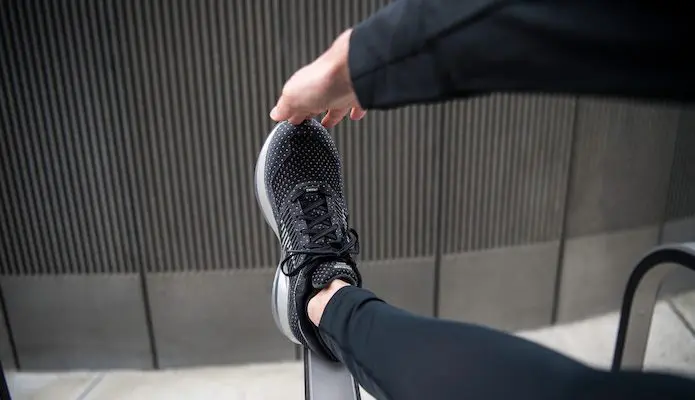
Once the cramp occurs, the first reflex is to stop pedaling, or even unclip one or both legs from the pedals to relieve the violent contraction of the muscle(s) concerned. While it is as surprising as it is violent, a cramp is temporary, and often goes away on its own. You can make it go away a little faster by stretching the muscle in the opposite direction of the contraction, or even by massaging it. But while all this is possible during training or a ride, it is much more complicated in competition, especially at the end of the race when you are playing for the win.
You can make it go away a little faster by stretching the muscle in the opposite direction of the contraction, or even by massaging it.
In this case, you can try to make the cramp go away, hoping that it occurs during a phase of relative relaxation and that it doesn’t force you to lose the wheels:
- By slapping the affected muscle hard with the palm of your hand several times, to bring blood and irrigate the muscle. Not very discreet towards opponents and impossible to do if several cramps occur at the same time. But it can provide lasting relief.
- Change gear: if you are riding with too large a gear, with strong muscle tension, shifting to the small chainring and relieving the pressure allows the cramp to subside. But don’t shift all the way to the left either, because a high cadence can also cause cramps if your body is already very fatigued.
- By decreasing the length and frequency of strides in running: to limit strong muscle tension, significantly slowing down the pace allows the cramp to subside.
- Change position: sitting, out of the saddle, a little forward, a little backward, a different position for a few moments relieves and can be enough to make the cramp go away.
- Stretch: while keeping your shoes clipped to the pedals, this is possible during moments of coasting, for example by lowering your heel as much as possible with your leg extended (and thus stretching your calf).
- Shake: still coasting, with small movements to shake the extended leg by sweeping from right to left with a relaxed knee relaxes the muscles.
- Finally, if the cramp becomes truly debilitating and prevents you from pedaling, you can unclip one or both pedals while riding and take your ankle in your hand to stretch the quadriceps. Be careful, however, that other cramps do not occur on the other side at the same time (the other leg or the hamstring).
You shouldn’t believe that cramps are inevitable. They should in any case remain exceptional in a season with a minimum of prevention, even if you don’t always master all their causes.
-> SEE ALSO: All our Coaching articles