Share the post "Long-Term Test: The New Shimano 105 R7000 Groupset"
By Sylvain Pigeau. Photos: S.P, G.J, 3Bikes and D.R.
As usual, the technologies developed for the high-end groupsets (Dura-Ace and Ultegra) are carried over to the 105. What remains are the materials used for certain parts, which are less premium (no titanium, for example), resulting in a slight increase in weight. The goal, of course, is to bring down the bill without compromising performance.

That’s what the spec sheet says. But what about quality and reliability? Received at the end of 2018, we rode more than 5,000 km with this new 105 groupset, in very harsh conditions: tropical heat, humidity (sometimes with 5-hour rides in the rain and on dirty roads), and cold. Water and mud were therefore not spared. Neither was our pedaling style, with very frequent gear changes and cross-chaining, and we often even skipped cleaning the drivetrain for several days, to speed up wear on the components. Nothing made a difference! The indexing never moved, and no noise appeared.
The main new features of the groupset

First of all, the derailleurs change significantly. The rear derailleur uses a new kinematic design, like its bigger siblings, and takes technologies from the mountain bike models (Shadow system). Available in short and long cage, it now has a minimal footprint in all shifting positions. This is made possible in particular by the new cable routing, which now tucks inside rather than running along the outside as before. The whole thing is compatible with Direct Mount and available in two cage sizes. We had the long cage, which can handle up to a 34-tooth cog, whereas the other option is limited to 30.
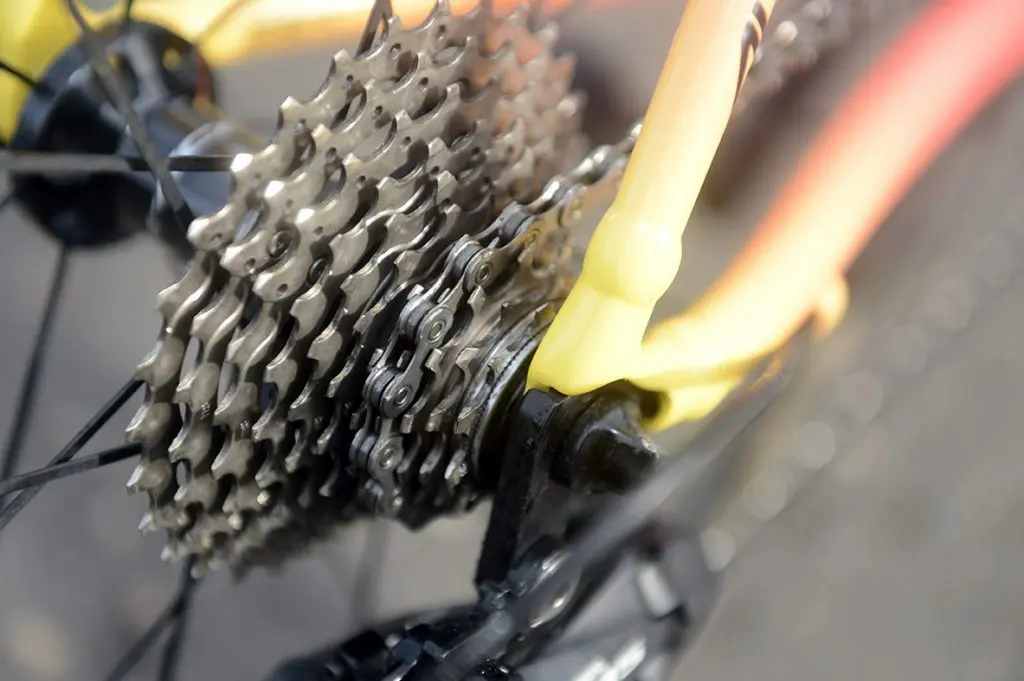
With the 11-30 cassette, shifting is very smooth and precise. This even makes us think the long cage derailleur would also work very well with cassettes that have smaller cogs. Worth considering when buying, since as the saying goes: “he who can do more can do less”. With this cassette, we could also have used a standard cage. There are four possible combinations (11-28, 11-30, 11-32 and 12-25) plus an 11-34 (compatible with the cassette bodies on mountain bike wheels).
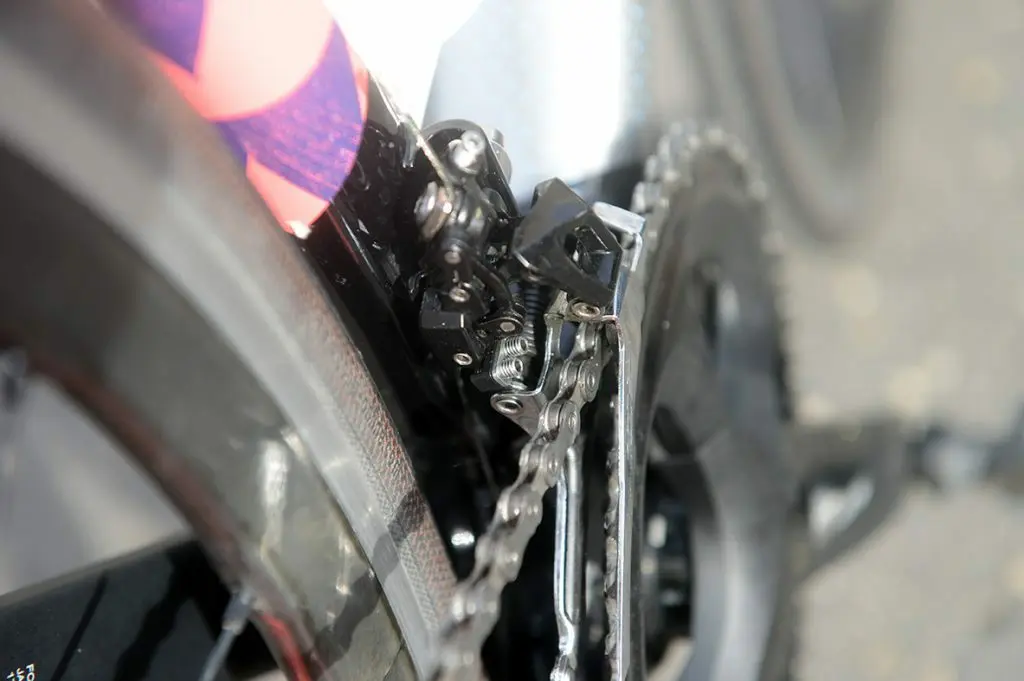
At the front, the parallelogram has been reduced. The long lever arm is gone; the cable routing has changed slightly, but shifting precision between chainrings is still just as good. More compact, the front derailleur above all allows wide tires at the rear (over 28 mm) to be used without difficulty. The positioning with the limit screw (which rests on the seat tube via a protective pad) is still in place.

The new chain comes with a quick-link SIL-TEC closure (single use). Goodbye, then, to the legendary closing pin. You cut the chain, place the link and close it.

The calipers adopt the same design as the Dura-Ace and Ultegra models, and give a real sense of power. One drawback, however: the release lever, though good-looking and more discreet, is hard to handle in the rain and cold in particular. Note that a Direct Mount version is available.
On the levers, there aren’t many changes. The ergonomics have been revised, and the grooved hoods provide more comfort and grip.

Still, there are a few small protruding parts placed under the fingers. This can be bothersome under the middle finger and unpleasant over time. The cable routing inside the lever has been simplified, however. This should make maintenance easier, especially for removing a damaged cable.

The crankset, made of aluminum, is also a version of the concepts from the higher-end models. It has a four-arm spider, with the bolts accessible from the inside. Available in 3 combinations (50-34, 52-36 and 53-39) and five crank lengths from 160 to 175 mm, the whole set, like the rest of the groupset, comes in a black finish (our test model) and a satin silver. Q-factor is 146.

Also new is the return of the satin gray finish. A treat for loyal fans of the brand, and for riders tired of the black finishes that are everywhere today.

On the Road
As for gearing, we used the 53-39 combination at the front and the new 11-30 cassette at the back, with a long cage derailleur. Beyond the precision of the gear changes, we were pleasantly surprised by how smoothly the chainrings shift. The most impressive was on a 39-30 combination. Using the left-hand lever, the chain moves across without difficulty, as if it were in the middle of the cassette. This maneuver was often difficult on the groupsets of previous generations.
It is possible to ride with the chain cross-chained without hearing the slightest noise
Still on the “extreme” side, it is possible to ride with the chain cross-chained without hearing the slightest noise. And indeed, mounds and short bumps taken with momentum can easily be absorbed without dropping the chain, on the 53×27 and even on the 30. Everything goes through perfectly.

Even after 4,000 km, the chain has not moved, and there is every reason to believe we could, even in difficult conditions, keep going for about 2,000 km without changing it. But for the test, we preferred to switch to a new chain. However, the chainring teeth showed some signs of wear. Nothing to report on the cassette, however.

The brake calipers have the same bite as their big brothers in the higher groupsets. They do their job very well, on both aluminum and carbon rims (with the appropriate pads).
Even after 4,000 km,
the chain has not moved
Who is it for?
The 105 groupset has often attracted curiosity for its affordable price, rarely for its looks or performance. Yet this new version could change the minds of many users. The design has little to envy from the Dura-Ace and Ultegra. As for the price, it is very well placed. With promotions, it is often possible to find deals better than the recommended retail price. The 105 is mainly fitted to production bikes, but thanks to the qualities mentioned above, it could also be a choice for custom builds.
Which leaves weight, always a central question when equipping a bike, but on that front, we could advise you to simply drop the crankset and thus “easily” save 150 g (for a few extra euros). But is that the most important thing for the 105 groupset? Moreover, it is always possible to invest in a power meter later on. That was our case, and it allowed us to save a few dozen grams without detracting from the bike’s performance (or the rider’s!).
Share the post "Long-Term Test: The New Shimano 105 R7000 Groupset"