Share the post "Factor One Review"
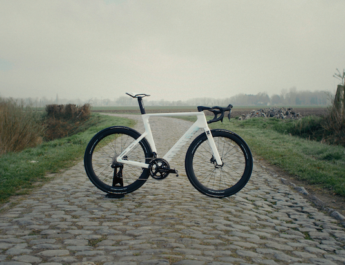
Among all the aerodynamic road and triathlon bikes available on the market today, the Factor One stands out for its original design. As we found at the end of our test, this is not the least of its qualities.
By Guillaume Judas – Photos: Sylvain Pigeau @3bikes.fr
If the reactions from cyclists we met on the road or who joined us on our rides with the Factor One are anything to go by, this is a bike that arouses curiosity, desire (without being pejorative) and sympathy. An expensive bike – probably too expensive – but one that reveals an innovative and original side, which is explained by the very history of the Factor brand and its current owners. Because beyond the totally subjective impressions that a well-executed marketing campaign and a very attractive general presentation can leave, it must be acknowledged that the Factor One, like the brand, possesses a strong identity.
| Factor, an international brand Factor is originally an English brand, launched by engineers from the automotive world, and which distinguished itself in 2012 by creating a totally innovative bike, breaking free from UCI rules, but extremely expensive (nearly €30,000) and probably too far ahead of its time to be successful. The One-77 was then supplanted by the Vis Vires, a little more consensual and above all a little more affordable. This bike, however, retained some of the original characteristics established by the brand’s creators, in terms of aerodynamic qualities and handling. Then followed two versions of the One, including the model we are testing here, before exploring other terrains with the O2 for climbing (with which Romain Bardet finished third in the 2017 Tour de France), the Slick purely for time trials, and more recently the Vista for Gravel. It was at the time of the Vis Vires that Factor sought a carbon specialist manufacturer, and found him in Rob Gitelis, a Briton who had been living in Taiwan for 25 years, owner of a factory that employs 1000 people to manufacture for Cervélo, Scott, Canyon, Argon 18, Zipp or Enve. Tired of the profitability demands of some of his clients, he seized the opportunity to take control of Factor, partnered with former pro Baden Cooke, chose David Millar as ambassador, and became its owner. Although he now only has about a hundred employees, all are now dedicated to the Factor brand, between R&D and manufacturing itself. Between the design offices and production, there is only one step, both in terms of decision and geographical proximity, from prototype launch to field testing, or from feedback to manufacturing evolution. This direct relationship is extremely rare in the bicycle industry, even at the high end. |
A two-part down tube
Among the two striking originalities of the One, directly derived from the brand’s first models, is this famous Twin Vane Evo down tube, separated into two parts.
Initially designed to increase rigidity without sacrificing weight, it actually proved to be very high-performing aerodynamically. This is easy to imagine without even going through the fluid dynamics study that was necessary to validate the concept: the airflow is thus diffused around the double tube, and the opening offers less resistance. This same external airflow to the Twin Vane Evo, coming from the slightly arched fork legs, is then directed towards the seatstays, which are also slightly offset from the frame’s axis.
The “central” flow, which passes inside the tube, in turn bypasses the profiled seat tube. Ultimately, the air is channeled to offer less resistance, and therefore more performance. However, this particular architecture exposes you in case of rain, with splashes that may come directly from the front wheel, theoretically soiling the water bottles. We should note, however, that we did not have the opportunity to test these conditions.
A complete front system
The other originality of the Factor One is its entire front section called OTIS, featuring an external steerer fork, a monocoque cockpit, and a mounting system independent of the headset adjustment. Thus, cables, wires, or hoses for the drivetrain or brakes pass inside the head tube to enter directly into the tubes.
Here we have a One equipped with rim brakes and an older generation Shimano Dura-Ace drivetrain, but with a hydraulic Di2 disc group, no cables would be visible. To adjust the cockpit height, a shim system allows for raising it without having to disassemble the cables or wires, which run inside the handlebar if applicable, then into the head tube by passing through the inside of the stem.
This external steerer fork, in addition to its tapered shape at the front of the frame’s head tube, provides rigidity and stability to the cockpit and the entire bike.
This external steerer fork, in addition to its tapered shape at the front of the frame’s head tube, provides rigidity and stability to the cockpit and the entire bike.
The only inconvenience in use comes from the inability to turn the steering: this is not a problem when riding, but it complicates storing the bike in a car trunk or a travel bag. Note the presence of small pads to prevent the external steerer from damaging the head tube when turning the handlebars all the way. A precaution that highlights the high technicality of the carbon fibers used, which are light and very rigid, but can also be brittle in the event of an impact.
Elaborately shaped tubes
Factor also specifies that they have reworked the resin that binds the carbon layers to reduce the risk of breakage in the event of a fall, for example. As with all high-end frames, it would also be reductive to speak of a single type of carbon fiber for the construction of the One, given the different stresses a frame is subjected to.
Shapes, diameters, and composition of the tubes are designed to manage airflow as well as lateral rigidity and vibration absorption. The result is a wide and slightly asymmetrical BB Right bottom bracket shell, chainstays directly in line with the down tube and bottom bracket, a concave top tube at its apex, and a recess in the seat tube to accommodate a tire up to 28 mm wide and a seatpost clamp concealed in a triangle connecting the seat and top tubes. A complex design, but effective on the road.
Speed and stability
Initially sold as a frameset (with the cockpit) for €5590, the Factor One on test here is assembled with an older generation Shimano Dura-Ace Di2 R9050 groupset, but complemented by the very latest Black Inc. Fifty clincher wheels, with their 45 mm rim depth and original Ceramic Speed bearings.
Moreover, the One is also supplied with Ceramic Speed bottom bracket bearings, while for the occasion the derailleur of the groupset is also upgraded with derailleur pulleys from the same brand.
Aside from the visible cables and Di2 junction box in front of the cockpit, it’s worth noting that there’s nothing to say in terms of drivetrain precision, fluidity, and efficiency. The same goes for braking, as the Direct Mount calipers perform very well with the Black Inc. rims. Although inherently fixed, the monocoque cockpit proves particularly comfortable regardless of the hand position adopted. In any case, it is very rigid, as is the entire front part of the bike.
While the initial sensation out of the saddle at low speed is surprising due to the fork steerer being offset forward of the head tube, the bike seems to come alive as speed increases.
The bike seems to come alive as speed increases
On descents and at high speed, it’s a delight. It is stable, precise, and reassuring, and encourages leaning into corners. It is well aided by the comfortable feel it exudes, which is particularly surprising for a bike of this type. Road imperfections are very well absorbed, both at the saddle and the cockpit. And the bike never seems to want to bounce on the road. It is laterally rigid enough to effectively support strong accelerations, without being as lively and nervous as some of its competitors.
On the other hand, if the central part of the bike does not seem totally locked around the bottom bracket, it forgives some gearing errors. The bike is thus quite versatile, and can take you to tackle some steep percentages. Only its weight, a little above average for a bike of this price, prevents it from being truly airy. But there is the O2 for that in the Factor range. The One, for its part, is a bike designed to ride fast on the flats with minimal energy loss, or to cruise on a hilly course while maintaining a very good average speed. All with class and distinction while preserving comfort and a sense of security. With the latest generation One, Factor does not betray the Grand Touring spirit dear to the brand’s creators, who came from the world of luxury automobiles.
| FACTOR ONE |
| RATING: ***** PROS: stability, comfort, braking, tube design, Grand Touring spirit, technical solutions, colors CONS: weight, price FRAME: RGi Carbon
PRICE: €5590 frameset and cockpit (approx. €11,500 complete) |
| CONTACT: www.factorbikes.fr and www.dagg.fr |
-> SEE ALSO : All our Gear Reviews
Share the post "Factor One Review"