Share the post "Pinarello Dogma F10 Disk Review"
Launched less than two years ago, the Pinarello Dogma F10 is already an icon, helped by the brand’s prestige, but also by the successes of Chris Froome and Geraint Thomas’s Team Sky. To follow the trend, it was inevitably going to be offered in a disc brake version. Let’s see if it’s as good as the first variant of this very high-end bike, which combines performance and versatility on all terrains.
By Guillaume Judas – Photos : 3Bikes.fr

Without being particularly spectacular compared to some competitors, the Dogma F10 immediately established itself as a benchmark among high-end bikes. Firstly, because independent wind tunnel tests showed it to be one of the most efficient on the market in its field when it was introduced in early 2017, but also because it is not exclusive, in the sense that Team Sky riders use it on all terrains, from flatlands to the steep climbs of the Dolomites, and even the cobbled roads of Flanders. From there, it’s a small step to conclude that it can suit almost any sporty rider on almost any terrain.

While the brand has remained faithful to certain simple technical choices, such as the routing of brake cables, compatibility with mechanical or electronic drivetrains, or external bottom bracket cups, it has optimized its expertise in several areas: the use of extremely light and rigid Torayca T1100 carbon fibers, the asymmetric frame design to respond to higher stresses on the right side of the frame (drivetrain side), FlatBack profiled tubes with a down tube inherited from the Bolide TT that encompasses airflow around both water bottles, and two appendages named ForkFlap at the bottom of the fork to cancel the aerodynamic drag of the wheel quick release lever.


While it’s not quite the lightest on the market (820g unpainted), the frame is very stiff, and most importantly, offered in 13 sizes, which is practically unique on the market. And above all, it maintains high-speed handling, with unwavering stability. In short, a must-have, we tell you! Even if he wasn’t a fervent advocate, Fausto Pinarello still had to offer a disc brake version, if only to follow market trends.

It was therefore interesting for us to test this latest version, in comparison with the Dogma F10 that we know very well, having ridden 25,000 km on it.
An adaptation
Unlike other recent bikes built around the braking concept (see: Specialized Venge test), the F10 Disk is an adaptation of the rim-brake F10. As proof, it does not benefit from fully internal routing for the brake hoses, which would nevertheless be easier to achieve with a hydraulic system than with cables.


While it is reinforced at the fork and chainstays, notably with the adoption of a 12 mm thru-axle clamping system, and it moves to a 142 mm rear spacing to accommodate the drivetrain and the disc, it retains all the characteristics of the rim-brake F10.

Starting with the geometry, which is identical here, except that there are now only 11 sizes instead of 13. No longer chainstays or longer wheelbase then, and tire compatibility remains at 25 mm instead of 28 or 32 mm for some competing models. A simple adaptation of the model that still shows a resolutely sporty orientation.

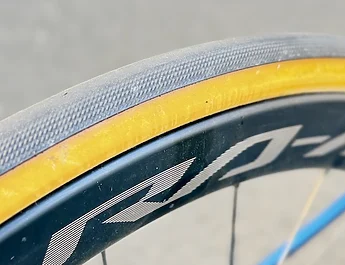
To counteract the superior braking power, especially with 160 mm rotors here, Pinarello relies on the quality of the rubber rather than its width. Note, however, that with 27 mm wide rims, 25 mm tires actually measure 28 mm. And that’s a good choice with Pirelli PZero 4S tires, which offer excellent road holding even and especially in wet conditions.

The build is, of course, high-end, with a full Shimano Dura-Ace Di2 Disc R9170 groupset, featuring electronic shifting and 160 mm rotors (140 mm would probably have been sufficient on a small frame like this), and Mavic Cosmic Pro Carbon UST wheels with 45 mm deep rims.

That works out quite well, as the build is comparable to the 2017 F10 we have, with a rim-brake Dura-Ace Di2 groupset and Mavic Cosmic Pro Carbon SL (40 mm) wheels.
Weight
The scale’s verdict is clear. Weight of the Disk version (complete): 7.850 kg. Weight of the non-disc version: 7 kg exactly. But it should be noted that some components are not quite at the same level of range. The Cosmic Pro Carbon Disc wheels are first 150 g heavier than the Cosmic Pro Carbon SL. Then, there is a 130 g difference on the cockpit, 20 g on the pedals, and 25 g on the bottle cages.

Ultimately, the actual weight gain amounts to 500 g, 340 g of which is for the disc brake groupset alone. This difference can influence the feel in certain conditions (steep climbs or accelerations). Nevertheless, it’s almost imperceptible on our usual routes in the Chevreuse valley.
Aero
While discs can sometimes prove more efficient in this area for some bikes by streamlining the cockpit (with internal routing) and the fork crown, this is not the case here. Since the F10 Disk is “adapted” from the F10, it theoretically loses 2 to 4 watts at 45 km/h, mainly due to the prominence of the front disc, and this is not compensated for by the cable routing or the ForkFlap at the bottom of the fork.

Again, it’s imperceptible on the road in terms of feel. However, these minor details, combined with the weight, may explain why many pros are still reluctant to adopt this technology, purely for performance reasons.
Comfort
The Dogma F10 is not exactly a model of longitudinal comfort. Forget it for long distances at a touring cyclist’s pace. Rather compact in its reactions, the F10 Disk is very close to the rim-brake model. We greatly appreciate, however, the comfort and pleasure provided by the groupset, both in terms of shifting and the shape of the brake levers, which are almost identical to the non-disc version.

A real achievement from Shimano. The quality of the braking is also part of the comfort. It is to be highlighted here.
Braking
While Shimano Dura-Ace calipers are renowned for being very powerful, and largely sufficient for many of us, they absolutely do not compare to the disc version. This is remarkable when switching from one bike to the other, where the rear caliper seems to just slow the bike down, while the disc inspires confidence and sets new standards in the field. The 160 mm rotor is a bit oversized for our weight and riding style, and the rear wheel locks up very quickly in case of emergency braking. According to Shimano, a 140 mm setup offers very similar braking performance to classic calipers, so as not to disrupt users. From our point of view, it’s not certain that this is the best solution, as we have seen 140 mm rotors heat up and warp quickly in the mountains after prolonged use. Although very (too) powerful, the 160 mm is more suitable from this perspective.

The F10 Disk, although without specific geometry, proves to be fully up to the technology, reassuring and stable under braking, whatever the circumstances.
Stiffness
We had already noticed it with the Specialized Venge S-Works, but it’s a bit clearer here when comparing the disc and rim-brake versions: thru-axles provide a very slight advantage in terms of lateral stiffness, thanks to a more efficient connection between the frame and the wheels. Is it enough to counteract the slight extra weight of the disc bike on moderately hilly terrain? Yes, it’s highly probable. But what’s most important to remember is that this F10 Disk is not fundamentally different from the original Dogma F10 in terms of handling. It is stiff, dynamic, and perfectly planted on its two wheels. It benefits from the brand’s renowned rolling qualities, which give it positive inertia when the machine is launched, but it remains very compact in its reactions during changes of pace. A true Formula 1!
“Stiff, dynamic, and perfectly planted on its two wheels, the Dogma F10 Disk benefits from the brand’s renowned rolling qualities.”
The downside
However, it’s impossible to ignore the rubbing noises of the discs against the brake pads. And yet, it’s not for lack of having sought the right adjustment. Not really bothersome in terms of efficiency, or even all the other qualities of the bike. But it rubs when riding out of the saddle on the front wheel, with a small metallic noise that could quickly annoy purists. The brakes also manifest themselves when riding on dirty roads, with a sandy noise on both calipers this time. Fortunately, the 160 mm Shimano discs are less sensitive to overheating than the 140 mm, and thus much less noisy during hard braking.
Price
If we stick to the catalog price, a little mental gymnastics is necessary to compare the two bikes. The F10 is offered at €10,800, but with Mavic Cosmic Pro Carbon SL wheels, while the F10 Disk is €10,500 with Cosmic Pro Carbon, all other equipment being equal (except discs vs. rim brakes). However, the SLs are sold for €600 more. We can therefore conclude that the F10 Disk is €300 more expensive than the rim-brake F10.

Verdict
The Pinarello Dogma F10 Disk retains most of its qualities when switching to disc brakes, remaining just as performant on most terrains. A little heavier and slightly less aero, it also seems very slightly stiffer. But we easily find our bearings on both machines. The switch to disc, however, is less exciting here than on some competing machines, due to the lack of integrated hose routing in the cockpit.
| PINARELLO DOGMA F10 DISK |
| RATING: ***** PROS: handling and character preserved compared to the rim-brake F10 (very high-end), sporty geometry, versatility, number of sizes, number of colors FRAME: Dogma F10 Disk carbon Toyayca T1100 1K, nanoalloy technology
PRICE: €10,800 for the production version with Most Talon combo |


| CONTACT: pinarello.com |
-> SEE ALSO: Our other gear reviews
Share the post "Pinarello Dogma F10 Disk Review"