Share the post "3T Strada Pro Disc Review"
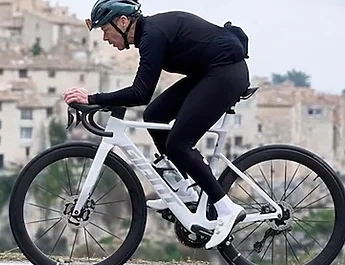
As lively as can be, the 3T Strada, in its complete Pro version, is a bit of an anomaly in today’s aerodynamics-focused market. Beyond its unique frame, it offers disc brakes and the Sram Force 1 1x drivetrain. A setup that piques curiosity and has the merit of opening minds.
By Pierre-Maxime BRANCHE – Photos: 3Bikes.fr

Divisive. Disconcerting. Faced with the 3T Strada Pro Disc, reactions pour in. Some dislike it intensely and make it known bluntly. Others are divided, unsure. The rest embrace it with varying degrees of enthusiasm. It’s indeed difficult to remain neutral when discovering the geometry of this bike equipped with disc brakes and a 1x drivetrain.
Somewhere, by unsettling everyone, Gerard Vroomen, the head of design for the Italian brand, has already won his bet by stirring emotion, whether positive or negative. That’s the mark of artists. And since pleasing everyone means pleasing no one, it’s better to create according to one’s own vision, even if it means thinking outside the box. Except that the goal of the game is still to sell bikes to the widest possible audience.
Premium bike
On this point, 3T and Gerard are not entirely on the same page. Sell, yes. To the widest possible audience, yes, but while remaining in the high-end segment. One of the objectives of the Strada project is to sell complete premium bikes at a reduced price, obviously without compromising performance, to make them available to the greatest number. At nearly 5,000 euros, we are indeed far from the prices of the largest global manufacturers, but this bill still remains steep for many.
This Strada project was born in 2017 with a frame kit called Team, featuring aerodynamic lines, designed to accommodate disc brakes, a 1x drivetrain, and large 28 mm tire widths. Initially discreet, interest grew, then several industry awards recognized the innovation and pushed 3T towards a second complete opus presented in May 2018.
Sram Force 1
This Pro version therefore benefits from the same geometry as the Team, but uses a slightly less qualitative and 130 g heavier carbon fiber. Five sizes are offered, from XS to XL. We obviously notice the work on each frame tube, especially the seat tube which completely, almost unreasonably, encompasses the rear wheel and connects to an enormous bottom bracket shell. Here we find the lines of a Cervélo S5, which is not a pure coincidence since our Mr. Vroomen is an alumnus of the Canadian manufacturer. The same goes for the wide down tube that hugs the front wheel, but more discreetly under the head tube, which in turn accommodates the wide, straight fork legs.
The Sram Force 1 drivetrain
offers a 50-tooth chainring
and an 11-36 cassette.
The connection of the sloping top tube to the seat tube has also been reinforced, while the chainstays and seatstays remain very thin, with the latter joining the seat tube quite low. The millimeter-precise tire clearances at the fork crown and seat tube are impressive even with 25 mm tires as our test bike is equipped, but it fits. The Sram Force 1 drivetrain offers a 50-tooth chainring and an 11-36 cassette, the in-house 3T Discus C35 Pro aluminum wheels are equipped with Pirelli PZero Velo 28 mm tires and 160 mm Sram rotors. The cockpit consists of the Apto aluminum stem and the Aeronova Team carbon handlebar available in three widths (38, 40, and 42) which offers a beautiful airfoil profile. Finally, you sit on a very classic San Marco Aspide measuring 270×132 mm. All for a price of €4,990.
The setup of the future?
On paper, 3T and its designer feel legitimate with a model that represents for them the clear future of the bicycle: increasingly aero frames, 1x drivetrains, and the essential disc brakes. No one knows yet if they are right, but the desire to test this little anomaly is pressing, especially when the bike shop gives you their little speech: “You’ll see, it’s super stiff and responsive, it rides well, it’s a real experience,” they told me.
This experience begins with a positioning detail that is important. The seatpost axis being positioned very far back from the center of the bottom bracket shell, the pedaling position is also very set back. Add a significant reach of the handlebar and you get a painful first ride for the sit bones, lower back, shoulders, and palms of the hands with new pressure points that challenge your usual settings. If the Strada is already your choice, pay attention to the choice of your stem which might differ from its traditional length.
An exhilarating performance
Once the position is adopted, the Strada Pro proves very pleasant to ride. The first straight lines and series of curves are dynamic, the rolling is fluid and efficient with the sensation that there is very little energy loss. This is even more true in uphill accelerations where the frame’s stiffness allows for sharp changes in pace with an almost immediate response. It’s almost exhilarating because you feel very little lateral deformation with a bike that tracks straight under pedal strokes, especially when out of the saddle, without feeling like a big block of wood. When the watts speak, the whole is stable, the steering is nimble and precise in tight turns as well as in the city for changes of direction.
At medium speed, the Discus C35 are neutral
and do not limit the frame’s performance.
This is less the case at high speed.
This stiffness and efficiency are its strengths. This is undeniable during the first rides, despite 35 mm deep aluminum rims weighing 1335 g which do not help push the Strada to its limits. At medium speed, these Discus C35 are neutral and do not limit the frame’s performance. This is less the case at high speed where once the bike is launched, you have to regularly re-accelerate to maintain the pace. Braking is safe and flawless with its two 160 mm rotors which nevertheless rub the caliper when the bike is leaned too much, which, however, practically never happens. As always, this disc braking requires finesse, especially on wet roads, and particular attention because a small crosswind is felt and impacts your handling. Precisely, the Aeronova handlebar requires finding the right reach between the depth of the reach, that of the Sram lever, and a semicircle that extends outwards. The flattened airfoil shape on the top is very aero, but the grip is not the most pleasant, especially for small hands. On the other hand, the curve around the stem allows for the positioning of extensions if needed for triathletes.
Comfort in decline
In terms of comfort, it’s quite a disappointment. Aerodynamics rarely rhymes with comfort. 3T is aware of this and certainly wanted to rebalance this deficit by designing the Strada for 28 or even 30 mm tires. Despite this large section, the absorption of the rear triangle leaves something to be desired. It hits hard under the buttocks, slightly damaged or gravelly roads are tricky to negotiate, and fatigue sets in quite quickly after two hours of riding, knowing that you also have to find the right pressure points due to the seat tube – bottom bracket offset. The back and glutes suffered on both cool and more intense rides. For their part, the Pirelli PZero Velo do the job well: the efficiency is decent although they lack a bit of responsiveness, cornering is reassuring, and they offer good wear resistance. The enigma of the 1x drivetrain remains…
1x drivetrain, a limitation?
The technology is pleasant to use: you run a single chainring at the front and use a wide range of cogs at the rear (here 11-36) which allows you to go almost anywhere. It’s nice and fun on training rides on varied terrain, but the gear gaps are really significant at the top of the cassette, as you go from 50-25 to 28, 32, and finally 36. 3T explains on its website that today, it is possible to have two times 11 or even 12 speeds, meaning up to 24 possibilities, and that having more choices is not necessarily better, but just “more”. On the contrary, the 1x drivetrain offers only the gears you need, with less complexity, weight, aero drag, and potential mechanical problems. Certainly, but it is also objectively very limiting.
I cross the Col de l’Izoard and descend towards Briançon, via long descending straight lines for those who know it – do I spin my legs off or do I just coast? I’m a racer, the final sprint is coming, there are three of us in the breakaway, what are my chances with a 50-tooth chainring? Finally, I’m participating in the Alpe d’Huez L Triathlon, does the 50-36 (2.93 m, equivalent to a 39-28) with the fatigue of this 120 km course allow me to climb and project myself onto the run without breaking my legs even more?
Knowing how to recognize the desire
to offer something new.
I am certainly overemphasizing the competition aspect, but then a final question: if I am not in race mode, but on a touring or casual ride with friends where a 1x drivetrain could be justified, what is the point of having such an aero bike and, in my opinion, with a lack of comfort? Everyone buys the bike they want, you might reply, and that is absolutely true. But it seems to me there is an inconsistency between the frame’s orientation and this setup, while noting the desire to innovate, to forge its own path, and to offer something new, which should be recognized.
For those who might also be wondering, it is always possible to opt for the Strada Due (frame kit at 3,800 euros), optimized for a more “classic” Shimano Di2, Sram eTap, or Campagnolo EPS electronic drivetrain, but which slightly increases aero drag with the presence of the front derailleur and the second chainring. It seems 3T may have thought of everything after all. There is no problem. There are only solutions.
| 3T STRADA PRO DISC |
| CONTACT: https://www.3t.bike/en/ |
Share the post "3T Strada Pro Disc Review"