Share the post "Why do we ride slower when it’s cold?"
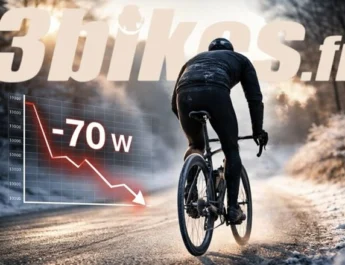
Cold weather reduces cycling performance, and not just due to a lack of winter training. Explanations.
By Guillaume Judas. Photos: PeDALED – RH+

In addition to being unpleasant and impacting our motivation, cold weather reduces our instantaneous performance due to several physiological adaptations to external conditions. These conditions also directly affect our air penetration. Obviously, the primary reason we are slower in the heart of winter remains a decrease in the volume and quality of training in the preceding months, after a much-needed transition phase between two cycling seasons, and sometimes a laborious recovery phase. Nevertheless, depending on temperature variations, sensations and average speed can be seriously disrupted from one week to the next.

Furthermore, as with all difficult conditions, some bodies adapt better than others. Note that those who seem quite comfortable in the cold compared to their riding companions are rarely the same ones who prefer intense heat!
A Higher Heart Rate
To combat the cold and primarily preserve its vital organs, which it must maintain at the correct temperature at all costs, the body is heavily stressed when physical exercise is imposed. To try and compensate, the heart rate is higher than usual, and the body consumes more energy than when pedaling at the same intensity under normal conditions. Maximum capacities are limited by this superficial elevation of heart rate, just as they are in intense heat.

Muscles with Reduced Blood Flow
In the cold, muscles contract less effectively because they receive less blood flow for the reasons described above. They are therefore less efficient. Some individuals with slightly thicker skin on their legs may be less sensitive to this phenomenon than “lean” individuals with muscles close to the surface. However, it must be admitted that a lower average speed in winter is also explained by a lack of rhythm. In peak season, the intense efforts already made facilitate muscle excitability and their ability to produce small accelerations, which seem so complicated in winter.
Higher Energy Expenditure
To maintain the correct temperature in the cold, the body expends more energy and thus draws more quickly from its reserves. Caloric expenditure is higher than under normal conditions, as is the risk of bonking. Liquid and solid nutrition during exercise therefore becomes crucial here. Not only do we ride slower when it’s cold, but we also ride for less time.

Higher Air Density
Aside from elevation changes, air and wind are the main obstacles to a cyclist’s progress. Cold, dry air is denser than warm, humid air. This explains the sensation of fighting against an invisible wall in anticyclonic conditions and a North-Easterly wind in the middle of winter, whereas a light oceanic wind of the same strength in spring is almost imperceptible. This directly translates into greater aerodynamic resistance, which is, of course, exponential with speed. We can also verify this directly by using a power meter. Winter wind is also directly responsible for the actual perceived temperature and the adaptation mechanisms described above. At 0°C, the perceived temperature is -3°C when the wind blows at 10 km/h, -5°C when it blows at 20 km/h, or even -8°C when it blows at 50 km/h!
Optimally Adapted Clothing

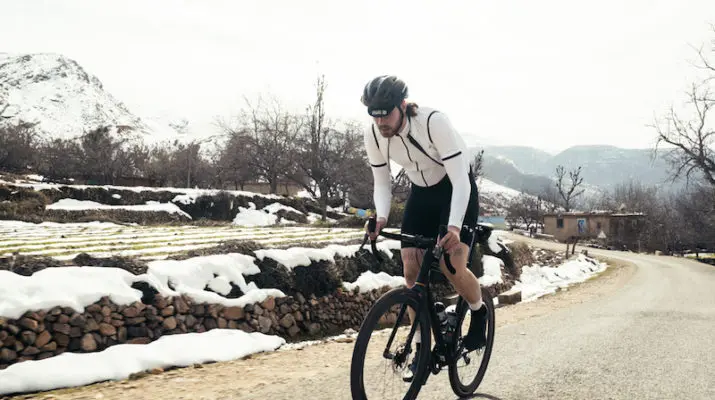
Clothing also has a significant impact on speed. More or less fitted jackets, thick overshoes, long gloves, etc., modify our freedom of movement, as well as our aerodynamics. While they have progressed a lot, winter cycling clothes still need to meet often contradictory needs that influence our comfort during effort: protection against cold, wind, and humidity, but also flexibility and breathability. Because depending on the difficulty of the route, we may find ourselves sweating and shivering during the same ride.
Be Patient
Ride it out by maintaining a regular pace, and prefer the indoor trainer for more intense sessions. Spring is not far off.

-> SEE ALSO : All our Coaching articles
Share the post "Why do we ride slower when it’s cold?"