Share the post "Work on your weaknesses"
It’s the right time, before the season truly begins, to take a step back and think about working on your weaknesses, in a fun and stress-free way. Because before talking about training itself, you can set everything up to start 2019 on a good foundation.
By Guillaume Judas – Photos: PEdALED / DR
While not all of you are racers with a packed calendar from February-March, your goals can still be varied: summer sportives, Étape du Tour in July, team events, or even rides with friends for cyclists; Half Ironman or discovery events from late spring for triathletes… The idea behind the goals you set is always to progress, or to avoid regressing for older riders, to feel better, and to enjoy riding, running, and swimming. Winter is the ideal period to focus on your weaknesses because later in the season you will primarily think about optimizing your strengths based on what you already master and what you have as a reference. Which is completely normal. Identifying and working on weaknesses during winter also helps avoid overly tedious activity, especially if you prioritize technical work.
Limit weight gain
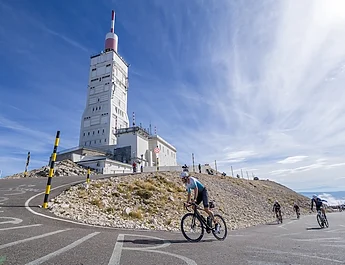
Weight – or rather overweight – is the number 1 enemy of the cyclist, on climbs, and especially in the mountains, and of the runner in all conditions. And every year it’s the same: you start the season with a few extra kilos that are difficult (and harmful) to lose quickly in the first weeks of spring. The result: you are always too “short” in summer and the infernal cycle repeats every year. There is only one solution, which is to avoid gaining weight in winter, when you finally finish the season at your ideal weight. Let’s first talk about a break, meaning a period where you stop all physical activity to rest. This should depend on your usual weekly activity. A professional racer who rides 11 months out of 12 for 25 hours a week needs a real break to allow their body and mind to regenerate. The amateur who only manages one or two sessions a week cannot use physical fatigue as an excuse.
The rule is simple: the less you ride during the year, the less you should take a break, at the risk of losing a good part of the training benefits.
The rule is simple: the less you ride during the year, the less you should take a break, at the risk of losing a good part of the training benefits. But that doesn’t mean you should continue riding at the same pace regardless of the season. Other physical activities can substitute for cycling and keep you in good shape. By maintaining regular activity, you avoid excessive weight gain, but you also take the opportunity to review your eating habits. It’s not about depriving yourself of good meals occasionally, but this period of relative slowdown (a one-hour run costs less energetically than a big mountain bike ride) will also help reduce your appetite. So you can take advantage of it to eat lighter, reduce quantities, and review the overall balance of your diet.
Improve your position
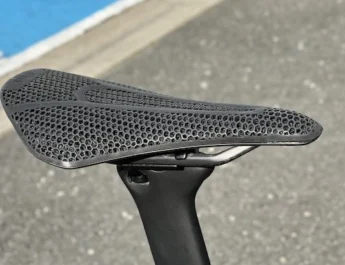
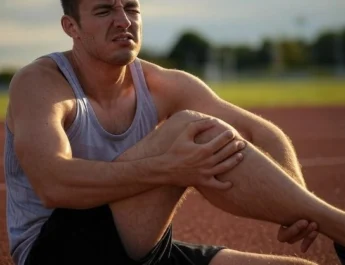
Various minor pains (feet, glutes, knees, back, neck, hands), discomfort, lack of strength, power, cadence, or efficiency are often signs of a poor position on the bike. Sometimes just a few millimeters can change everything. Winter is the right time to tackle the problem, before starting intense efforts. Visiting a bike fitting specialist is a good long-term investment. They will guide you towards the right adjustments and the equipment that suits you. It’s a matter of comfort and performance.
Start core training
Core training helps stabilize the center of the body, and thus better transmit forces to the extremities (arms, legs). Good core strength stabilizes the pelvis on the saddle during effort and makes riding out of the saddle both more economical and more efficient. It allows you to develop more power, adopt a more aerodynamic position with less discomfort, or ride longer with less fatigue. It improves through strength exercises that can be performed daily and without equipment, taking very little time. The idea is to engage most of the trunk muscles, but mainly the superficial and deep abdominal muscles, and the para-lumbar muscles. The effect is to protect the intervertebral discs and improve the transfer of impulse forces between the upper and lower body. These are exercises you can do at home in a few minutes, and which can be continued throughout the cycling season. These include push-ups, pull-ups, and classic abdominal exercises, but especially isometric contractions by maintaining a fixed position like the “plank” on your forearms, contracting your abs to lock your torso. If you can’t hold it for 30 seconds, you have work to do!
Gain strength
Strength is one of the components of power. It is indeed difficult to produce power, even with good cardiovascular capacity, if you lack muscular strength. Unlike true power training, which places a high demand on the body and should therefore be reserved for the beginning of the season as a complement to proper endurance work, strength can be trained during the transition period without needing to be in peak physical condition.
Strength can be trained during the winter period without needing to be in peak physical condition.
For this, you can join a gym and follow the advice of a specialized coach. Because you must be careful about the risk of injury in case of poor posture on the machines or inappropriate load. Moreover, the transfer of the strength thus acquired to the pedaling motion is not always obvious. Gaining strength does not necessarily imply gaining bulk, and for this reason, we will remain cautious about this solution. On the other hand, cycling itself can be sufficient for specific strength gains. Strength is worked in two ways, and not necessarily by riding fast. First, by seeking “max strength,” performing very short sprints (maximum 7 seconds) starting from a very low speed and with a large gear. You can thus perform between 10 and 20 sharp accelerations during a ride, out of the saddle or even seated if you have good core strength. In addition, you can work on what is called strength endurance or “sub-max strength,” by chaining several climbs while riding seated with a large gear, but at a slow pace and staying around 80% of your maximum heart rate. The most experienced and those with the best upper body core strength (the two types of work are complementary) can climb hills at a very low pedaling cadence, around 40 rpm with hands on the drops. This will progressively optimize your pedal stroke, as these low cadences force you to effectively overcome the dead spots of pedaling. When you need to accelerate in spring, this posture and this gain in muscular resistance to the tensions induced by the exercise will be beneficial. You can thus perform two two-hour sessions per week from November without premature fatigue.
Leg speed work
Cadence is the other component of power production. But being able to spin your legs quickly also has another advantage: it saves muscle at a given speed. Perhaps you already ride correctly but overuse low pedaling cadences and thus strength work? Gaining a little cadence will allow you to go further with less fatigue, and will also make you more dynamic during changes of pace. Be careful, it’s not necessarily about mimicking professionals who can climb a 10% gradient at 90 RPM. But at least to ride easily at 100 RPM on the flats in a peloton. All cadence work curiously begins with work similar to the strength endurance mentioned above. Indeed, it is first with a clean and round pedal stroke that one can then spin the legs well. Start with a few weeks of climbing hills seated and with a large gear to properly break down the pedaling motion. Then, gradually increase the cadence on the flats, but in series. For example, by doing three 10-minute intervals at 120 RPM, staying around 80% of your MHR. Recovery is done at a “normal” cadence of 80 to 90 RPM. Some prefer fixed gear for a few hundred kilometers, but this solution has the disadvantage of forcing you to pedal regardless of the conditions, driving the pedals without you having to smooth out the dead spots yourself. We are therefore more in favor of complementary training that would involve track cycling for those lucky enough to have a velodrome available, in addition to road training. Finally, for those who really struggle to grasp the importance of a fluid pedal stroke, alternating one leg with the other (or “one-legged” drills) also promotes muscular coordination. Light flexibility work with stretching (because more flexible muscles and tendons contract and retract more easily during effort) can also be considered for the stiffest among you. The fact remains that in the course of the winter period, cadence can be addressed a little later than questions of weight, core strength, or strength. Because once these foundations are acquired, spinning the legs easily can come very quickly.
Improve your technique
Often neglected, everything related to bike technique can nevertheless prove very useful to allow you to ride faster, or with less fatigue. When we talk about technique, we think of issues with trajectory, fluidity and relaxation on descents, and what causes difficulties for many sportive riders: riding out of the saddle. A trained rider, for example, sees no variation in heart rate whether climbing seated or out of the saddle, when alternating positions to limit muscle contractions. This is of course different during an acceleration or to tackle a steep gradient. The standing position temporarily increases power, by using the power of the quadriceps and body weight alternately on each pedal. To optimize the movement, you first need a strong core, to keep the pelvis suspended without swaying when you leave the saddle. And toned arms with triceps that are not necessarily developed, but resistant.
A trained rider sees no variation in heart rate whether climbing seated or out of the saddle.
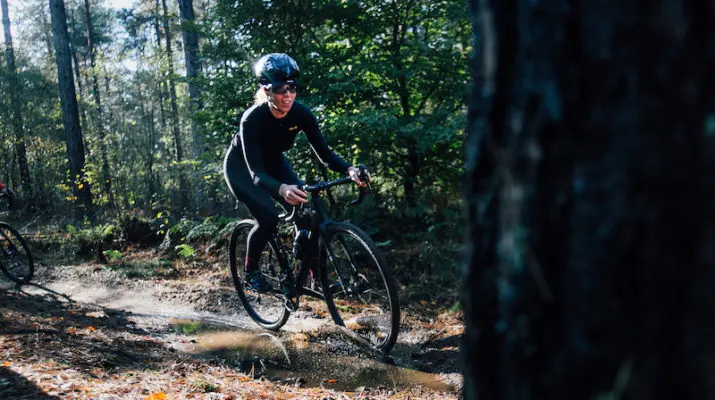
Finally, you need to find the right movement, which consists of moving the bike from right to left between your legs, but with your upper body as still as possible. To do this, you point your feet downwards, trying to lock your ankles, you place your hands on the brake hoods but without gripping them firmly, and you position your shoulders perpendicular to the handlebars with your arms as straight as possible. And with a coordinated movement of your wrists and elbows with your legs, you draw a small figure 8 with the front wheel. Easier said than done, but winter is when you have the necessary time to get used to this technique. Regarding problems with trajectories, braking, or fears related to bike grip, practicing mountain biking and/or cyclocross is a good way to progress and feel comfortable on the bike. Repeating a fun and slippery small circuit (on a camber, for example) is beneficial. And for those who want to improve their time trial, they can invent a small winding circuit to perform with the TT bike, but riding at a controlled heart rate. The goal is to try to achieve a better time on each lap, but while maintaining the same (light) intensity. The weakness of many triathletes, for their part, is often on the swimming side.
This is a good time to work on all the drills that will help you glide better in the water, and thus be much more energy efficient in your future events. Do not neglect this fundamental work, which is not necessarily very tiring, but so important for what comes next.
In practice
Whatever your weakness(es), you can organize your winter to work on them, without getting tired and depleting the reserves you’ll need for the next season. This way, you stay active with short but not exhausting sessions, which you organize according to your needs. And don’t forget that to progress in the long term, you need to regularly change your training habits. It’s by surprising your body while respecting basic physiological rules that you will boost your performance.
-> SEE ALSO: All our Coaching articles
Share the post "Work on your weaknesses"