Share the post "Shimano RC-9100-P Power Meter Review"
Finally available after a few long months of waiting, the Shimano power meter delivers on all its promises: perfectly successful integration on the bike, simplified installation and use, as well as reliability that seems to live up to Shimano’s reputation. Isn’t that the simplest definition of an affordable power meter?
By Guillaume Judas: Photos: Irmo Keizer/DR
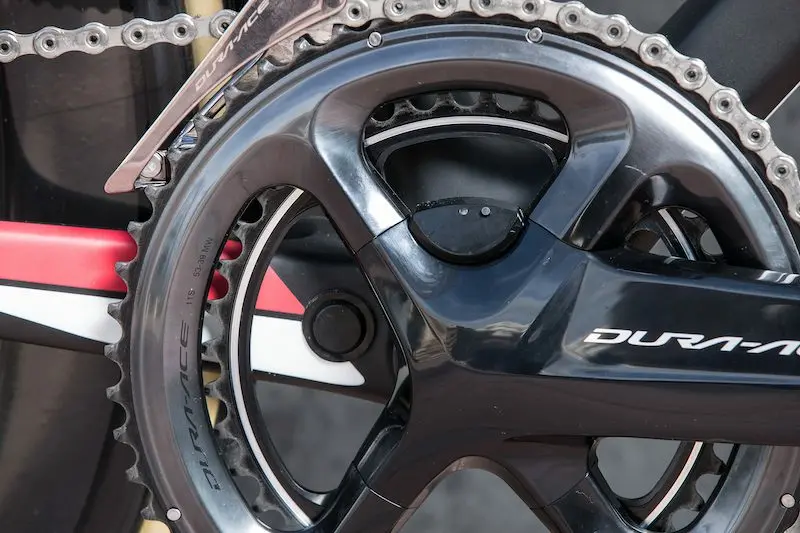
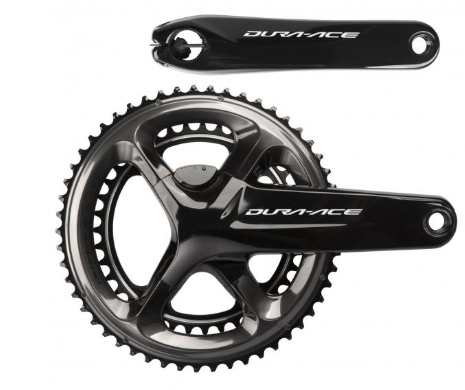
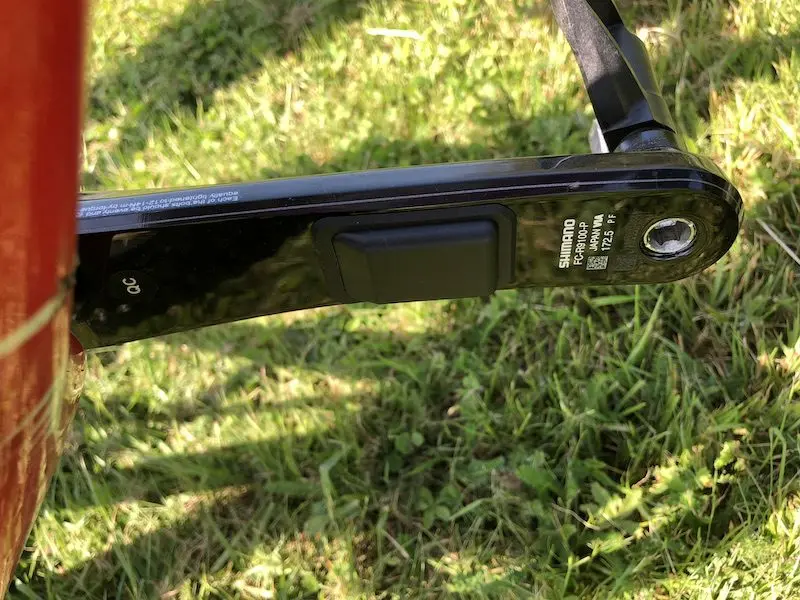
The RC-9100-P power meter comes in the form of a Shimano Dura-Ace 9100 crankset (latest generation), with a small sensor integrated into the left crank arm and a small housing located between two crank spider arms on the right. It really takes a trained eye to distinguish it from a more classic crankset. It therefore integrates perfectly with a mechanical or Di2 Dura-Ace groupset, an Ultegra groupset, and even with a disc-brake bike, knowing that new Shimano models are all designed to ensure a good chainline regardless of the rear triangle spacing. It is also discreet in terms of weight: the embedded technology adds only 65 g (verified weight) to the same crank arms/chainrings assembly without the sensor. Apart from a small magnet that needs to be glued to the right chainstay of the frame to measure pedaling cadence, nothing else protrudes. While other brands use an accelerometer to calculate cadence, Shimano chooses to keep a magnet for greater reliability, especially on poorly surfaced roads.
Easy Assembly
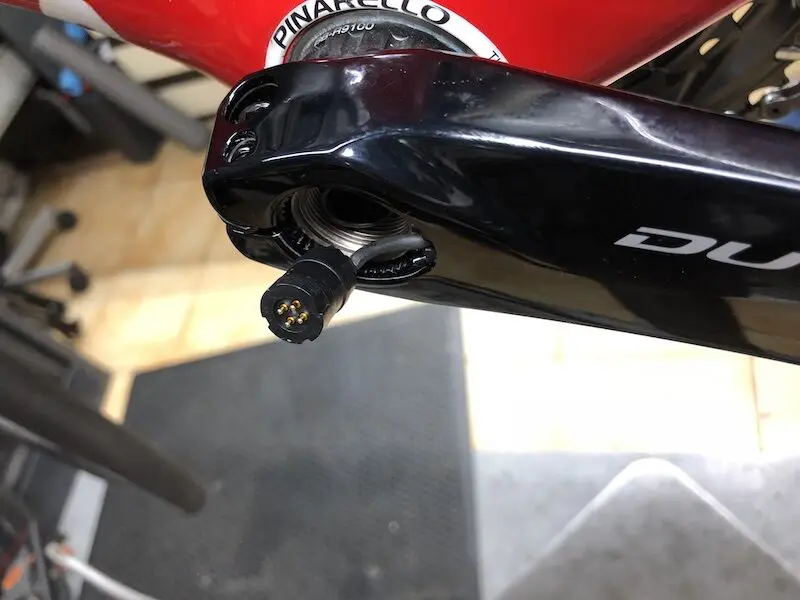
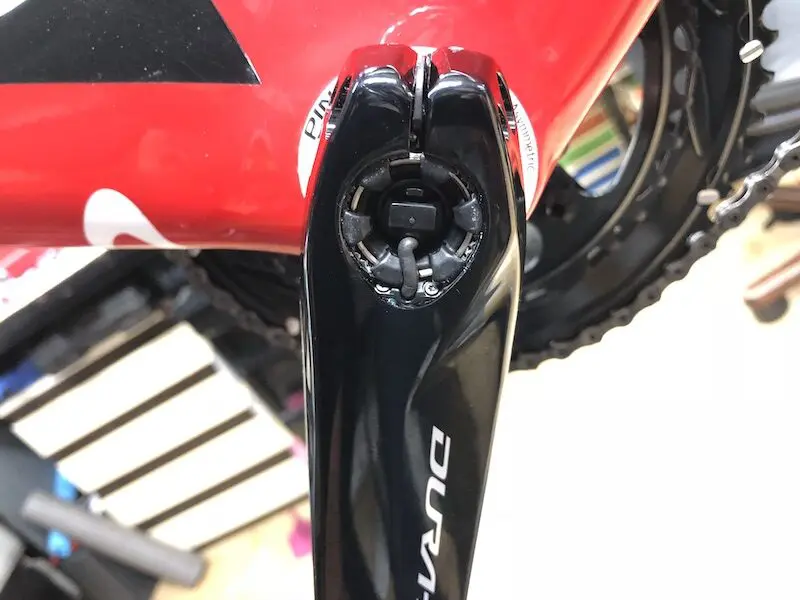
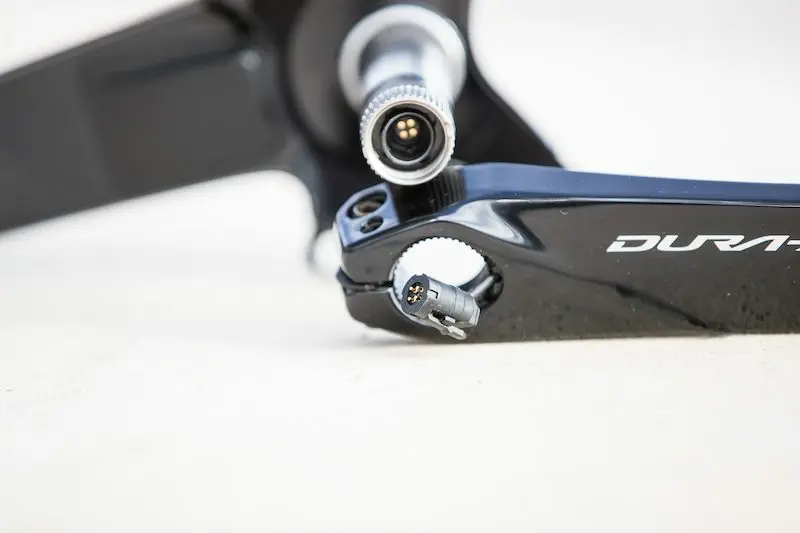
A jig is provided for positioning the magnet relative to the inner face of the small control unit on the crankset. It installs like any Shimano model, except that it is necessary to connect a wire from the left crank arm to the plug inside the spindle, in order to link the two crank arms.
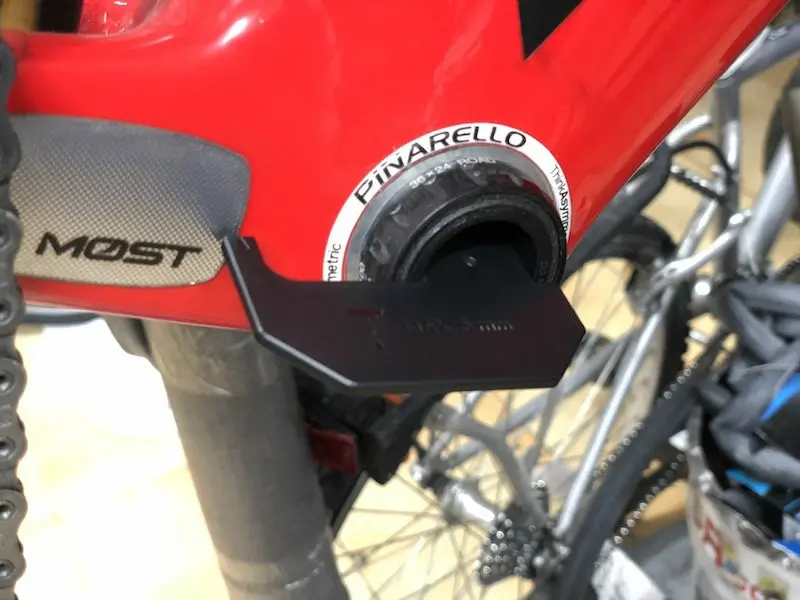
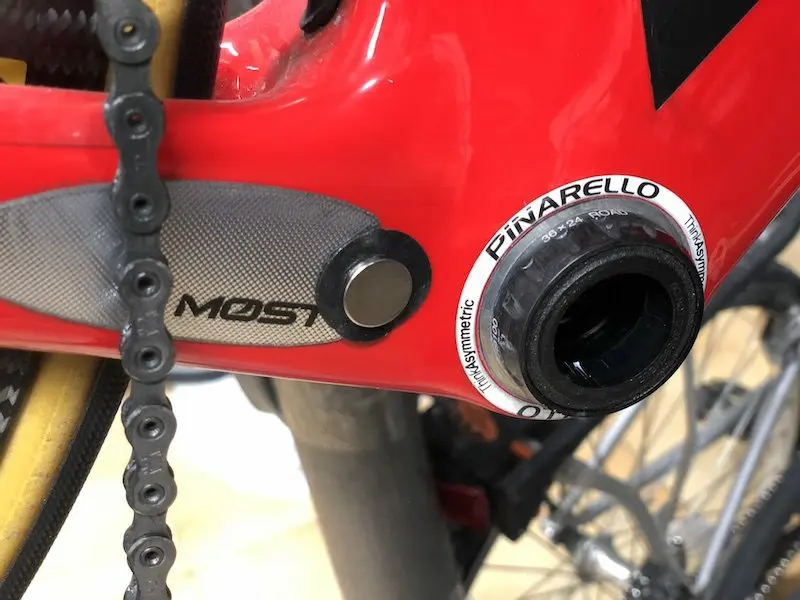
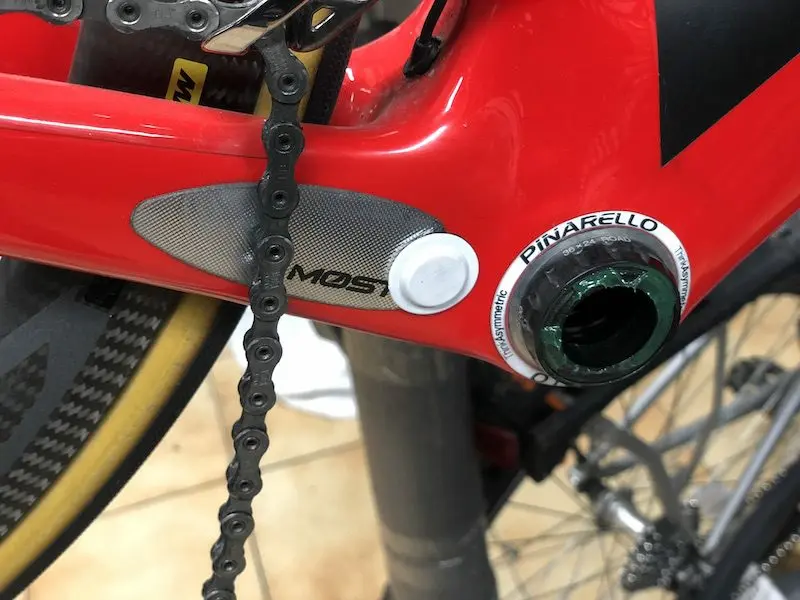
Nothing complicated just before tightening the crank arms normally and installing a small protective cap. The RC-9100-P is supplied without chainrings, but we know the advantage of these four-arm Shimano crank arms: the same bolt circle diameter allows mounting of 53-39 as well as 52-36 or 50-34. The power meter does not require any specific calibration when changing chainrings, as stress measurement is performed on the crank arms. On the housing, there is a small button and an LED, which are used to check the battery status, reset the system, or establish a Bluetooth connection with a smartphone to the E-tube Project application. This is used to check the battery charge level (located inside the bottom bracket spindle and rated for 300 hours of operation), verify calibration, or detect operating problems. It is very simple to use even for those who are not keen on new technologies. Recharging is done by lifting the housing cover and inserting a plug connected to the mains. It takes about 2h30 for a full recharge.
Getting Started
Two backward pedal revolutions are enough to wake up the sensor, which is then detected by any bike computer that uses the ANT communication system. Shimano does not emphasize this point, but it is advisable to perform a zero-offset calibration before each ride, and this applies to any power meter. Nevertheless, the RC-9100-P has an internal temperature compensation system to maintain its accuracy regardless of the conditions encountered during the ride. The calibration procedure is very simple on a Garmin bike computer and takes only a few seconds. Once on the road, the information displayed by the bike computer depends on the chosen display page settings. You can, as with any power meter, see instantaneous or smoothed power over 3 or 10 seconds, average, maximum, normalized power, training load of the ride, power developed on intermediate laps, etc. The clearest difference between the Shimano and most power meters on the market concerns the power distribution between the left and right legs, which is actually measured here. Indeed, the RC-9100-P has two independent sensors, whereas some devices measure power in the spindle (and thus without the possibility of determining if there is a power imbalance), only on the left crank arm (simply multiplying the left leg value by two), or at the crank spider, considering that the deformation of the first part of the spider corresponds to the effort provided by the right leg, and that of the second part corresponds to the effort of the left leg. Since we also have a power meter of the latter type on another bike, we can compare and note that the Shimano provides us with less advantageous values, meaning a slightly greater imbalance between the two legs. Furthermore, it can also provide information related to pedaling efficiency (or traction, in other words), as well as its fluidity. These are data that are not easy to act upon, but which, depending on the type of effort and terrain, allow one to know, for example, the most efficient pedaling cadence.
An Accuracy of +/- 2%
Shimano claims an accuracy of +/- 2% for its power meter. Concretely, this means that for a real power output of 300 watts, the measurement can fluctuate between 294 and 306 watts. This has little to no impact on long efforts, as small inaccuracies balance each other out, and is even of little importance for 30-second efforts where it is in any case extremely difficult to stay within 5 watts. It is only if you are aiming for a maximum power record in a sprint that the values need to be relativized. Nevertheless, compared to other power meters we have tested and the one we use regularly, all values are consistent and in line with our physical condition. Even on sprints, where each effort makes the sensor react and is visible in the file during ride analysis. The only reservation concerns very, very brief power peaks that do not always seem to be taken into account by the Shimano. This is noticeable during accelerations or when riding in traffic, and sometimes even within a peloton. This changes nothing in terms of training itself, but slightly modifies the average power values over an entire ride, or the left/right distribution of pedaling (since we tend to often start with the same leg).
Power shows fluctuating values during sustained and stable efforts. But this is perfectly normal because, on the one hand, it corresponds to the reality of varying pressure on the pedals (especially on flat terrain when there is always a bit of wind or slight topographical variations), and on the other hand, to the type of file recording. A Garmin bike computer, for example, offers recording of all data (speed, heart rate, power, cadence) every second – which we chose – or an “intelligent” recording based on the position on the road. In the latter case, the power data seen in the file is smoother.
A Certain Security
As we know, the quality of a power meter is also judged by its longevity, the reliability of its measurements, and their reproducibility. With Di2, Shimano has no shortage of experience or credibility in electronics, and there is no doubt that if the Japanese brand is launching the RC-9100-P on the market, it is because it is confident in its product and its durability. This is an argument that can make a difference when choosing a power meter, with an after-sales service known to be efficient and responsive in case of operating problems. This security is also found in the operation of the drivetrain. There is absolutely no difference when changing chainrings or gears with Shimano levers and derailleurs compared to another crankset from the brand. This is even more evident for us who use the Synchro-Shift system in Di2: the bike retains all its original characteristics without any new adjustments, just as the crankset retains the usual Q-Factor (crank arm spacing). Finally, if the price may seem substantial compared to other power meter systems (1499 € public price), it should not be forgotten that it includes a crankset priced at not far from 600 €. Considered as an option for a Dura-Ace groupset, the RC-9100-P power meter seems like a reasonable investment to us, especially if one takes into account the essential elements mentioned above: simplicity, precision, and quality of after-sales service.
=> SEE ALSO : All our Gear articles
Share the post "Shimano RC-9100-P Power Meter Review"