Share the post "Review of the New Specialized Venge S-Works"
The third generation of the Specialized Venge S-Works offers greater versatility while placing even greater emphasis on aerodynamics. Highlights include disc brakes, Di2 shifting, light weight, stiffness, and responsiveness. It’s one of the fastest bikes currently on the market. A fun test ride. By Guillaume JUDAS – Photos: @3bikes.fr
 Unveiled in late June 2018 and since used by riders such as Peter Sagan and Elia Viviani—as well as triathlete Vincent Luis—on all types of terrain, the new Venge S-Works succeeds two versions that have already made their mark in their respective model years. However, it is less specifically and exclusively designed for speed than the previous Venge ViAs model. And that is the American brand’s greatest achievement: offering a bike that is extremely aerodynamic under real-world riding conditions, while significantly reducing weight—to such an extent that one wonders whether the brand’s other high-end bike, the Tarmac S-Works, which is generally designed for challenging terrain, is still justified.
 Disc brakes required
The Venge ViAs was initially offered with a rim brake system, then released in a disc brake version. For this new model, Specialized leaves you no choice. The new Venge was developed exclusively for disc brakes and for use only with electronic derailleurs.  It’s a matter of logic. Indeed, disc brakes add a few watts of aerodynamic drag compared to conventional rim brakes. But this is more than offset by the complete integration of the brake hoses into the handlebar, head tube, and fork—or inside the frame tubes for the rear brake.

 A winding route, but clean and streamlined when viewed from the outside—and one that would have been impossible with the rigidity of traditional brake lines. The same applies to the drivetrain controls, as electrical wires are much more flexible than conventional cables. It’s a real pleasure to look at and ride, but much less so when it comes to assembly and maintenance. The through-axle wheel clamping system—now standard with disc brakes—is operated here using only an Allen wrench. The absence of levers saves about 2 watts.
 New handlebar setup All of these technical choices go hand in hand with the handlebar setup, which also saves about 6 watts compared to a traditional handlebar and stem. The brake hoses and derailleur cables run inside the handlebar along the flat, airplane-wing-shaped section, emerge beneath the stem, but remain in contact with the cockpit thanks to special rings designed to integrate with the fork pivot.
 Unlike one-piece handlebar assemblies, you can use any handlebar you like here—or at least adjust and angle it to suit your own riding style. Two fins screw into the junction with the stem for optimal airflow management. The top of the bar flares out from the centre toward the levers, so your knees won’t hit the bar when you’re out of the saddle, as sometimes happened on the ViAs. Finally, the upper section of the wing-shaped handlebar is textured.
 This not only improves aerodynamics but also provides a non-slip grip on this section. Casual triathletes can rest assured: the handlebar setup can accommodate a handlebar extension, which attaches to the stem. Lightweight (296 g) and, above all, very comfortable, it costs between 200 and 300 € (short or long).
 Conventional tube shapes Once you get past the surprise—and, dare we say, a sense of wonder—at the bike’s entire front end, the rest of the frame’s architecture seems less spectacular.
 The Specialized Venge S-Works is limited by UCI regulations regarding tube dimensions. The brand’s engineers have therefore developed aerodynamically efficient tube shapes designed for various wind exposure angles. As a result—though we’ll have to take their word for it—this new version is said to be 8 seconds faster over 40 km than the Venge ViAs, which features larger tubes. The weight savings are particularly notable: 240 g less on the frame, 25 g on the fork, 107 g on the handlebar and stem, 25 g on the seatpost, and 63 g on small parts. That’s a total weight reduction of 460 g. Our test bike weighs 6.9 kg without pedals in size 52, or 7.2 kg fully assembled and ready to ride. That’s an impressive performance for this type of bike—aerodynamic and equipped with disc brakes.
 In its attention to detail, Specialized has focused on the seat tube, which is cut out to accommodate the rear tire, There’s a relatively low junction with the seatstays—shaped to minimize drag in that area—and finally the Di2 junction box is neatly integrated behind the seatpost.
 The Venge S-Works features Rider-First Engineered technology, which ensures that all frame sizes deliver the same level of performance through the use of over 500 carbon components.
 Few versions available A top-of-the-line bike, the Specialized Venge is available in only three versions, all based on the same Fact 11r carbon frame, and exclusively with disc brakes and electronic shifting. The Venge S-Works complete bike, featuring Shimano Dura-Ace Di2 hydraulic components, Roval CLX 64 wheels, and a Specialized power meter crankset, priced at €11,299; the Venge Pro with a hydraulic Ultegra Di2 groupset and Roval CL 50 wheels at €7,199, and finally the frame kit (without the handlebar and stem) at €4,099. It is available in six sizes. The seatpost is available with a 0- or 20-mm setback, in two lengths. The stem is available in two angles and seven lengths, and the handlebars in four widths. For our test ride, we have a “custom” build featuring a full Dura-Ace Di2 groupset and Roval CLX 50 wheels.
 This compromise allows for a very slight reduction in the price of the complete bike compared to the S-Works version (no power meter here), saves about 100 grams on the wheels, and also offers a bit more crosswind stability thanks to the lower-profile rims. A Ticking Time Bomb
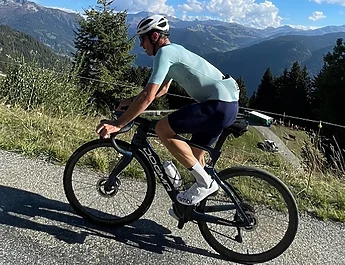
On the road, the Venge S-Works immediately proves to be stiff, dynamic, smooth, agile, and precise. It’s a less specialized bike than it appears, or at least not as specific in its handling as most aerodynamic bikes on the market. Let’s start by appreciating the geometry, which allows you to choose either a classic road bike position or the more forward position of a triathlete. It features a fairly long top tube, but with a relatively short stem as specified on the production model, and a head tube angle that’s slightly more upright than is typical for this size.
 The bike feels very stable at high speeds, yet the steering feels light and responsive. This is especially true since the internal cable routing through the stem and fork doesn’t compromise the smoothness of the steering. This lets you turn the bars all the way, for instance to fit the bike in a car boot. The trait is also evident when riding out of the saddle, where you can easily make small handlebar movements and sway the bike from side to side to use your body weight to gain power.
The bike’s reasonable weight and lateral stiffness—optimized by the thru-axles on the wheels—minimize any loss of efficiency on climbs.
The bike’s reasonable weight and lateral stiffness—optimized by the through-axles on the wheels—minimize any loss of efficiency on climbs. During explosive efforts, the bike feels light as air, with an instantaneous response. On flat terrain against the wind, the Venge is, of course, in its element. This is also noticeable when riding in a group and taking turns leading. When drafting behind another rider, you feel a reduction in power output, as if the speed gained were easier to maintain than with a bike featuring less aerodynamically optimized tubes. On descents, the bike offers exceptional ride quality and inspires absolute confidence. When it comes to comfort, the picture is less idyllic, even though the rear end doesn’t jolt too much. The rear triangle generally feels a touch more flexible than the front end, both laterally and longitudinally.  The very rigid handlebar setup feels inflexible. The shape of the lower part of the handlebars isn’t perfect in our view, with tapered angles where smaller hands struggle to find a comfortable grip. There’s no issue with the upper part, however. But overall, comfort isn’t this bike’s strong suit after several hours in the saddle. That leaves braking, which features two 140-mm discs (the complete bike comes with a 160-mm front disc and a 140-mm rear disc)—sufficient for a lightweight rider on hilly terrain—and offers braking performance similar to that of rim brakes. The feel and modulation are intuitive, but there’s still some grinding noise from the discs against the calipers after hard braking. It’s not really a deal-breaker, just a bit annoying. In any case, the Venge S-Works isn’t a bike you’d choose just because it has disc brakes. But perhaps it’s precisely because it has disc brakes that it performs so well in other respects. In any case, it’s a high-performance bike—one of the fastest currently on the market—when you’re chasing the clock on varied, hilly routes.
| SPECIALIZED VENGE S-WORKS |
| RATING: ***** PROS: clean lines, aerodynamics, weight, stiffness, versatility CONS: comfort, disc noise, complicated assembly and maintenance, price FRAME: Venge S-Works, Fact 11r carbon, Rider-First Engineered FORK: S-Works Fact 11r carbon WHEELS: Roval CLX 50 (Roval CLX 64 for the standard version) Tires: Specialized Turbo S-Works 700×24 (Specialized Turbo Cotton 700×26 for the standard version) |

| Contact: specialized.com |
Share the post "Review of the New Specialized Venge S-Works"